

Your wrists aren’t the only place fragrance can come alive. Applying perfume to pulse points can let warmth shape how you experience a scent, but the best placement depends on your skin, the fragrance, and how noticeable you want it to be.
If you’ve heard conflicting advice about rubbing your wrists, spraying your neck, or applying more for longer wear, the details can feel less simple than they should. Pulse points are useful starting places, not a fixed formula. A light, deliberate application is often easier to assess than coating every warm spot.
This guide shows you where to find pulse points and how to apply fragrance without overdoing it. You’ll learn a simple routine, why rubbing is best avoided, and how to adjust placement for your skin and plans. If you’re exploring a new scent, a sample can help you discover how it develops on your own skin before making it part of your routine.
Key Takeaways
- Pulse points are places where a heartbeat can be felt near the skin; warmth can influence how you experience a fragrance there.
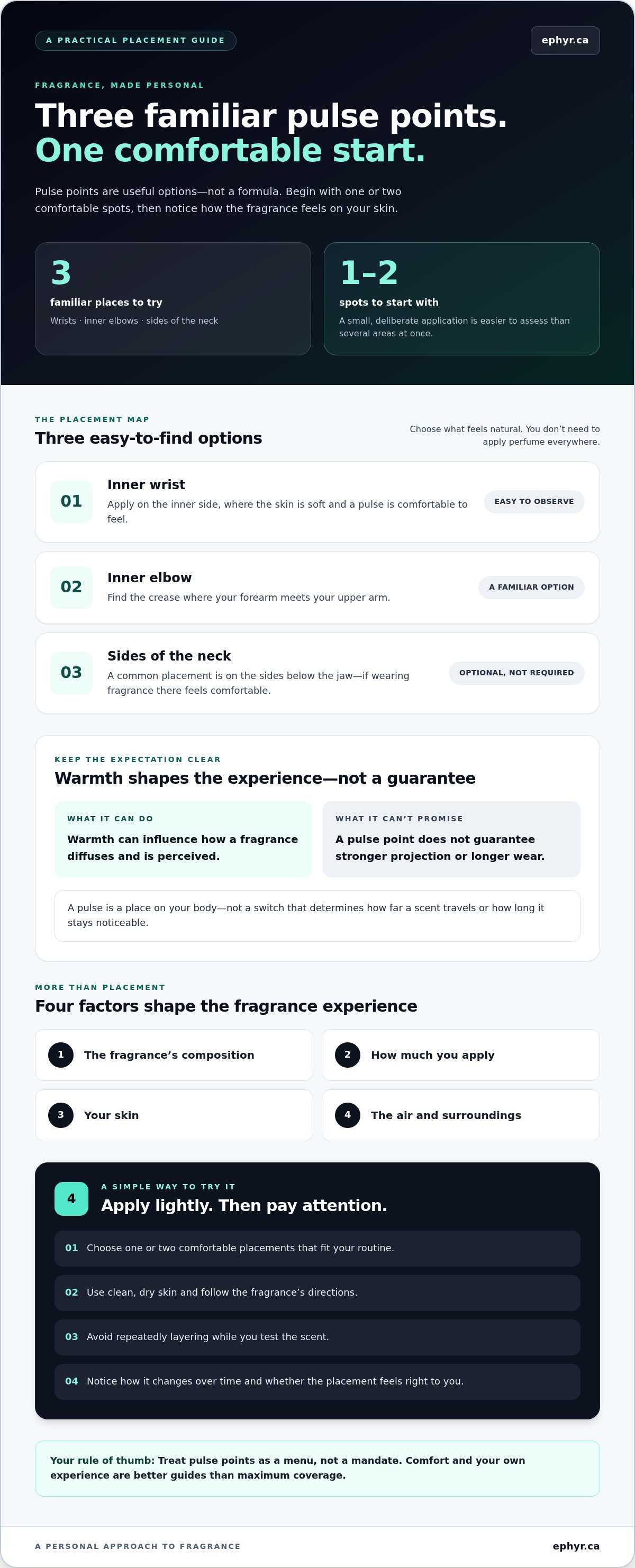
- Start with one or two comfortable placements, such as your wrists, inner elbows, or the sides of your neck.
- Applying perfume to pulse points is one option, not a requirement. Choose a skin placement that feels right for you.
- Use clean, dry skin and follow the fragrance’s directions. Avoid repeatedly layering while you test it.
- Notice how a scent changes over time on your skin before deciding whether its placement suits you.
Applying perfume to pulse points: what the advice really means
Pulse points are areas where a heartbeat can be felt close to the skin. Applying perfume to pulse points means choosing these spots as possible places to wear a fragrance, not following a script that sends every scent to the same locations. Their warmth can influence how a perfume unfolds and reaches your nose, but it isn’t a dial for guaranteed projection or longer wear.
Think of warmth as one part of a larger picture. A fragrance’s composition, how much you apply, your skin, and the air around you all shape the experience. A scent may feel more noticeable in a warm room, for example, while the same fragrance seems quieter outdoors. The broader science behind perfume application involves how a fragrance is composed and experienced, not just where it’s sprayed.
What makes a spot a pulse point?
The practical clue is simple: rest your fingers lightly on an area and see whether you can feel a pulse close to the surface. You don’t need to map your circulation or find every possible spot. In fragrance advice, “pulse point” is a handy label for areas that tend to feel warm, not a hidden switch that guarantees a scent will perform a certain way.
A pulse identifies a location on your body. It doesn’t determine how far a fragrance travels or how long it stays noticeable. Whether that spot suits your perfume is something to discover through comfort, preference, and your own experience.
Does warmth make perfume last longer?
Warmth can influence how a fragrance diffuses, shaping how its aroma is released and perceived. But it isn’t a dependable longevity switch. A scent that feels vivid at first may not remain noticeable for longer, and perfume worn on a cooler area may still be just right.
Warmth can shape how a fragrance diffuses; it doesn’t guarantee how long you’ll smell it.
Different formulas respond differently, and individual skin adds another layer. The same perfume may feel airy on one person and more pronounced on another. Amount and surroundings matter too: a close-fitting sleeve, a breezy day, or a warm indoor space can change how readily you notice a scent.
So treat pulse points as a menu, not a mandate. If a warm spot feels comfortable and gives you the impression you want, try it. If you prefer a quieter effect or another placement feels better, there’s no need to force the classic approach. Your experience with a particular fragrance is a better guide than the idea that warmth guarantees performance.
Where to apply perfume to pulse points on your body
Start with the spots that fit your routine, not a checklist of every possible placement. Wrists, inner elbows, and the sides of the neck are familiar choices because they’re easy to reach. Begin with one or two and see how the fragrance feels there. There’s no placement rule tied to gender, and no need to apply perfume everywhere.
Common pulse points and how to find them
For your wrists, apply to the inner side, where the skin is soft and you can comfortably feel a pulse. The inner elbow is the crease where your forearm meets your upper arm. On the neck, the sides below the jaw are a common placement. These spots are practical options, not a map you need to follow precisely.
Choose areas that are comfortable and make it easy to keep fragrance away from your eyes, mouth, and irritated skin. If your skin reacts easily, the FDA’s fragrance safety information offers general context on fragrances in cosmetics and potential sensitivities. You can also skip skin application if a particular area doesn’t feel right.
Choosing a placement for your day
For a familiar, easy-to-notice placement during the day, try a wrist. It’s simple to apply and easy to observe as the fragrance changes. The sides of the neck are another option if you’re comfortable wearing scent there. A smaller application at one site is a more useful starting point than spraying several areas at once.
Let your plans help you decide. Sleeves may cover your wrists, while a scarf or high collar may sit close to your neck. If you’ll be moving around or sharing a close space, a restrained application can feel more considerate. If you prefer not to wear fragrance on exposed skin, choose a different comfortable area rather than treating classic pulse points as compulsory.
Keep the routine personal and uncomplicated. Apply perfume where it fits naturally, then notice whether you enjoy the scent at that distance throughout your day. You might use your wrist for an ordinary workday and choose the neck another time, or settle on a single spot that feels right across both. The goal is a placement you can repeat comfortably, not maximum coverage.
If you’re still learning how a fragrance behaves on your skin, a fragrance sample can make it easier to explore one scent and placement at a time.
Pulse points versus other placements: what matters more than the myth
A pulse point is a familiar place to start, not a password fragrance needs before it will work. Perfume can be enjoyed on other comfortable areas of skin too. The right choice depends on the impression you want, how you like to wear scent, and what feels natural in your routine. There’s no universal placement that suits every wearer or formula.
Placement can shape the fragrance experience, but it can’t guarantee performance. A warm spot may affect how readily you notice a scent, but it doesn’t promise a stronger presence or longer wear. The fragrance itself and your preferences matter. If the usual advice doesn’t suit you, adjust it.
Are pulse points essential for wearing perfume?
No. Pulse points are a popular application choice, not a requirement for enjoying fragrance. Customary advice can offer a useful starting point, but it isn’t a rule for every person and perfume formula. You don’t need to find a noticeable heartbeat or cover several pulse points for your fragrance to be wearable. Choose a spot based on comfort and the scent impression you prefer.
How to decide between skin and another placement
Skin gives you a direct way to experience how a fragrance develops on you. If you’d rather avoid a particular area, choose another comfortable skin placement or consider an alternative such as clothing or a hair product designed for that use. Check the fragrance’s own directions before applying it to fabric or hair; don’t assume every formula is suitable for every surface.
Keep the comparison controlled. Pick one fragrance and one placement, then use a small, deliberate amount according to its directions. Notice how it smells to you at different moments and whether you like its closeness and character there. Changing several placements or adding more layers at once makes it harder to tell what you actually prefer.
- Choose for comfort: Skip any spot that feels inconvenient or irritating.
- Choose for the impression: Decide whether you want to notice the scent up close or experience it in a different way.
- Change one variable: Try a new placement on another wear rather than spraying broadly across multiple areas.
That measured approach makes applying perfume to pulse points a personal experiment, not a performance test. You might return to a classic spot, settle on another area, or use different placements with different fragrances. Let your own experience guide the adjustment. The best placement is the one that feels comfortable and lets you enjoy the scent as you intend.
How to apply perfume to pulse points without overdoing it
A restrained application is easier to assess and adjust than a cloud of fragrance. Before you begin, choose one or two comfortable spots and check the directions on the perfume’s packaging. Formulas and applicators differ, so let the product guide how much to use rather than following a universal spray count.
A simple pulse-point application routine
Use this sequence as a calm starting point:
- Start with clean, dry skin. Choose a spot that feels comfortable and isn’t irritated.
- Select one or two locations. For example, choose one wrist or an inner elbow. You can test another placement on a different wear.
- Apply as directed. Follow the fragrance’s own instructions, whether it uses a spray or another applicator.
- Pause before adding more. Give the scent time to settle, then decide whether you like its presence as it is.
This keeps the test deliberate. If you’re trying a fragrance for the first time, note the placement and amount you used. That gives you a clearer comparison later, without turning one wear into a series of overlapping applications.
Common application mistakes to avoid
After applying perfume to pulse points, resist the urge to rub your wrists together. The friction is unnecessary and can disturb the fresh application. Let the fragrance sit on the skin instead. You don’t need to press, massage, or spread it around to complete the routine.
Repeated sprays are another easy way to lose a clear read. A fragrance may seem subtle at first, but adding more before you’ve had a chance to assess it can make the overall effect harder to judge. Wait, notice how it smells to you, and only then consider whether you want another application in line with the product directions.
Keep the test simple if the format changes. A spray and a dab applicator may deliver fragrance differently, so don’t assume the same amount or method suits both. Use the packaging as your reference. If you’re comparing two fragrances, try them separately rather than layering them on the same spot; that makes it easier to recognize each scent’s character.
There’s no need to add a special preparation step or chase a technique that promises a particular result. The point is control: a clean starting place, a small number of placements, and enough patience to decide what you actually enjoy. A sample can make that kind of measured exploration easier. Explore fragrance samples and try a scent at your own pace.
Make pulse-point application your own with fragrance and skin
The same perfume can leave different impressions on different people. Your skin and your own sense of smell both shape the experience, so another person’s favourite placement or wear experience may not match yours. Rather than deciding from a quick first impression, notice how one fragrance changes as you wear it. Does it feel bright at first, then softer? Do you enjoy it at that distance throughout the day?
A small sample gives you room to find out before choosing a full-size bottle. Try it on one comfortable pulse point, keep the application consistent, and pay attention to how the scent develops over time. One wear offers a first impression; repeat wears can help you understand whether the fragrance and placement suit your routine.
Adjust the routine to the fragrance format
Formats call for slightly different handling. A spray disperses fragrance differently from a perfume oil, so don’t assume the same amount or application method works for both. For a spray, follow the directions on that specific product. For an oil, follow its directions too, applying deliberately and starting with a small amount. The product guidance takes priority over a one-size-fits-all routine.
Keep other variables steady as you test. If you change the placement, amount, and format all at once, it’s harder to tell what made the scent feel different. A simple note on where you applied it and what you noticed can make the next wear more informative.
Test a scent before making it part of your routine
Choose a sample and apply it to one pulse point as directed. Notice your first impression, then revisit the scent later rather than judging it in a single moment. You might find that a fragrance feels different as it develops, or that you prefer it at a particular distance from your nose. This is personal discovery, not a test with a right answer.
For a closer look at sampling as a way to explore niche fragrance, see Luxury Fragrance Samples Canada: The 2026 Guide to Niche Discovery. A curated selection can also make exploration feel more intentional: focus on fragrance houses and compositions that interest you, then let your own wear experience guide your preferences.
Thoughtful applying perfume to pulse points is less about chasing a guaranteed result and more about finding a comfortable match between the fragrance, its format, and your day. Maison Ephyr’s hand-picked fragrances and samples offer a considered starting point for that exploration. Explore Maison Ephyr’s hand-picked fragrances and samples.
Let your next fragrance find its place
Make your next wear a small act of discovery. Choose a scent that interests you, apply it in a way that feels comfortable, and let your own response guide what you try next. Applying perfume to pulse points isn’t about mastering a rigid formula. It’s about finding a personal rhythm with fragrance, one considered choice at a time.
Maison Ephyr offers authentic fragrances sourced directly from authorized brands and distributors, with samples available for most fragrances. Explore curated niche fragrance houses and discovery sets as you consider what might suit your taste and routine. A sample can be a thoughtful first step before choosing a full-size fragrance, giving you the chance to experience the scent on your own skin.
Explore Maison Ephyr’s hand-picked fragrances and samples, and find a scent worth making your own.
Frequently Asked Questions
Does applying perfume to pulse points make it last longer?
Not necessarily. A warm spot can change how readily you notice a fragrance, but it can’t promise extra hours of wear. If you’re unsure whether a scent is fading, step away for a while and notice it again later rather than adding more immediately. Our noses can grow accustomed to a fragrance, so a quick sniff isn’t always the full story.
Can I apply perfume to my wrists without rubbing them together?
Absolutely. Apply the fragrance as directed and let your wrists be; they don’t need a little handshake to make the perfume work. Rubbing adds friction and can disturb the fresh application. If you’re wearing a watch or bracelet, consider placing the fragrance where it won’t be trapped beneath the accessory, then see how comfortable the spot feels.
Is the neck a good place to apply perfume?
It can be, if you enjoy wearing fragrance there and your skin is comfortable with it. The neck may put the scent close to your nose, so begin with the product’s directions and consider how noticeable you want it to feel. If the area is irritated or freshly shaved, give it a rest and choose another spot for that wear.
Can I apply perfume to areas other than pulse points?
Yes. Pulse points are familiar landmarks, not the only places fragrance can go. Choose another comfortable area of skin if that suits your routine better. For clothing or hair, check that the product is intended for that use and follow its directions. A perfume made for skin isn’t automatically a good match for every fabric or hair product.
Why does the same perfume smell different on different people?
The same fragrance can make a different impression because skin chemistry and personal perception vary. Reformulation can also change how a perfume smells compared with someone’s memory of it. So if a friend loves a scent, treat that as an invitation to try it, not a prediction. Your own skin and nose get the final vote.
Should I apply perfume before or after getting dressed?
For skin application, applying before you dress can make it easier to reach the chosen spot without spraying your clothes by accident. Let the fragrance settle before fabric covers the area. If you want to apply it to clothing instead, follow the product’s directions and consider the garment. Different fabrics may respond differently, so avoid treating a favourite outfit as a testing surface.
How can I tell whether I have applied too much perfume?
If the scent feels intrusive in close conversation or you notice it dominating a shared space, that’s a cue to use less next time. You’re aiming for a fragrance you can enjoy, not one that enters the room before you do. Follow the product directions, then give yourself time to assess it before reaching for another spray.
Article by
Dmitrii Savishin
Dmitrii Savishin is the founder of Maison Ephyr and Parfum Exquis, two Canadian destinations dedicated to the world of niche perfumery. With years of experience discovering exceptional fragrance houses from around the globe, Dmitrii shares expert insights on perfume trends, fragrance notes, luxury brands, and the art of choosing the perfect scent. His mission is to make niche perfumery more approachable while helping readers discover fragrances that leave a lasting impression.


