

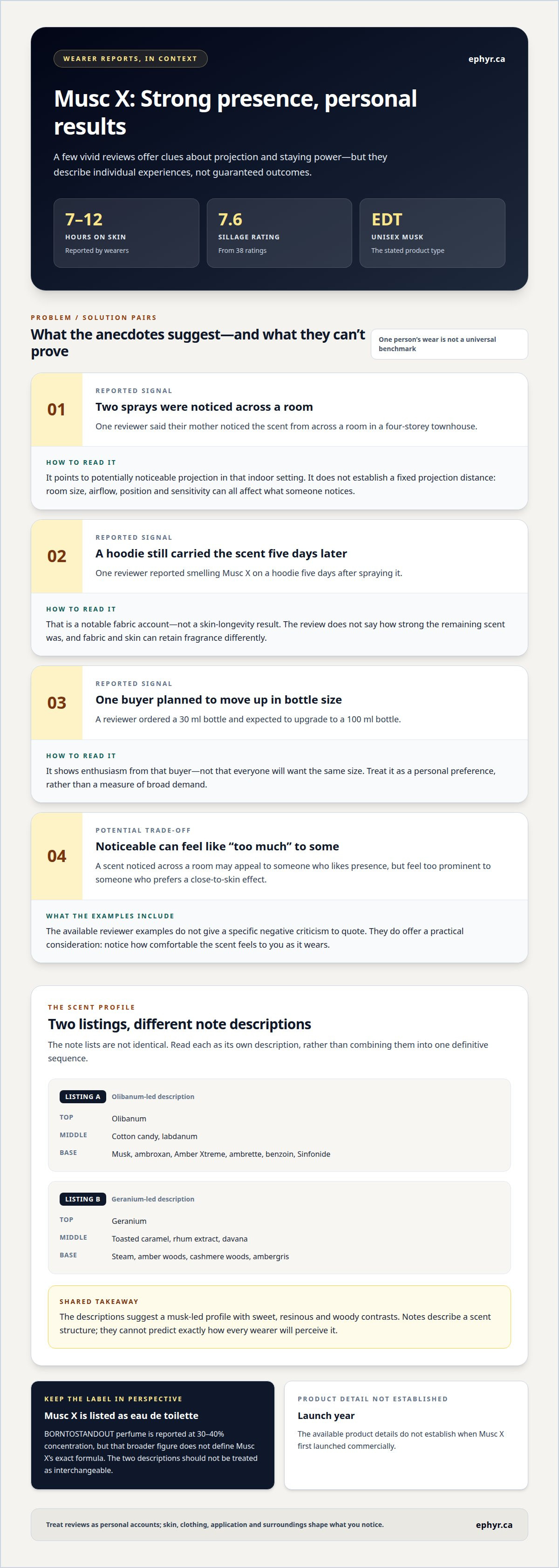
A musk can feel soft without staying quiet. BTSO Musc X is a unisex eau de toilette with a profile that moves from olibanum to cotton candy and labdanum, then settles into musk, ambroxan, amber woods and other warm, musky facets. Wearers report around seven to twelve hours on skin, while its sillage rating is 7.6 from 38 ratings.
Sweetness, warmth and noticeable presence make BTSO Musc X worth considering beyond its note list. This review looks at how the listed notes differ, what wearers report about projection and longevity, and what the available product details can and cannot tell you. Individual experiences vary, so treat reviews as personal accounts rather than universal results.
Key Takeaways
- Follow the fragrance’s listed notes from its opening through its sweeter heart and musky base to understand its overall character.
- Weigh positive and critical user impressions as personal experiences, not universal predictions of how the scent will wear.
- See how skin and clothing reports help put its longevity and projection into practical context.
- Learn what the launch-year information adds to the fragrance’s profile and place in the collection.
- Use your scent preferences to decide whether exploring other niche fragrances or 1ml samples is a useful next step.
Fragrance notes
Fragrance notes describe ingredients or scent impressions associated with a perfume’s development. Musc X is a unisex eau de toilette in the musk family, and listings give two different note descriptions. One lists olibanum at the top, cotton candy and labdanum in the middle, then musk, ambroxan, Amber Xtreme, ambrette, benzoin and Sinfonide at the base. Another names geranium, toasted caramel, rhum extract, davana, steam, amber woods, cashmere woods and ambergris.
Top notes describe a fragrance’s opening impression. One Musc X description names olibanum, an aromatic resin associated with incense; another lists geranium. The heart notes, which describe the central phase, are cotton candy and labdanum in one account, and toasted caramel, rhum extract and davana in the other. The listings offer different descriptions, not one consistent sequence to treat as definitive.
Base notes describe the deeper elements of a fragrance’s dry-down. One listing names musk, ambroxan, Amber Xtreme, ambrette, benzoin and Sinfonide; the other names steam, amber woods, cashmere woods and ambergris. Together, these descriptions suggest a musk-led profile with sweet, resinous and woody contrasts. They can’t predict exactly how every wearer will perceive it.
Fragrance concentration describes the proportion of aromatic materials in a perfume. BORNTOSTANDOUT perfume is reported at 30-40% concentration, while Musc X is identified as an eau de toilette. Those labels shouldn’t be treated as interchangeable specifications for this particular scent. Its product type is eau de toilette; the broader concentration figure doesn’t, on its own, define Musc X’s exact formula.
A release year is the year a fragrance first launched commercially. The available product details don’t establish Musc X’s launch year, so focus on its stated type: a unisex musk eau de toilette. Room fragrances are made to scent indoor spaces, while incense releases aroma through burning. Musc X is described as wearable perfume, not either of those formats.
Compared with other musk perfumes, Musc X’s listings contrast cotton candy or caramel with resin, woods and musk. That describes the note structure, not a measured ranking or performance advantage. Its intended use is as a personal fragrance; the notes imply no therapeutic benefit. Follow the product label and avoid applying perfume to your eyes or irritated skin. The term eau de toilette describes a fragrance type, not regulatory approval or sale status in Canada.
The listings differ in how they describe the opening: BORNTOSTANDOUT® Musc X names olibanum as a top note, while Born to Stand Out Musc X lists essence of geranium. The listed middle notes for BORNTOSTANDOUT® Musc X are cotton candy and labdanum. These distinctions keep the comparison grounded in the notes each listing names, rather than implying one agreed-upon pyramid. The descriptions may differ without establishing a definitive order beyond their own listed notes.
Positive and negative user reviews
A user review describes one person’s experience of a fragrance in a particular setting. Musc X reviewers have reported noticeable projection, scent lingering on clothing, and interest in a larger bottle. These are useful snapshots, not a universal performance score. Skin, clothing, application and surroundings all shape what someone notices.
One reviewer said two sprays were noticeable to their mother across a room in a four-storey townhouse. This suggests the fragrance may be perceptible beyond the wearer’s immediate space, but it doesn’t establish a fixed projection distance. Room size, airflow, the wearer’s position and another person’s sensitivity all affect that impression. It does offer a practical clue: two sprays may feel prominent in close indoor settings.
Longevity is how long a wearer can detect a fragrance after applying it. One reviewer reported smelling Musc X on a hoodie five days after spraying it. That’s a notable account of scent on fabric, but it shouldn’t be taken as evidence of how long the fragrance lasts on skin. Fabric and skin retain scent differently, and the review doesn’t say how strong the fragrance remained throughout those days.
A purchase plan can also signal how a wearer feels about a scent. One reviewer ordered a 30 ml bottle and expected to upgrade to a 100 ml bottle. That’s a positive indication of personal enthusiasm, not proof that every wearer will want the same size. It does, however, show that at least one buyer considered the smaller bottle an introduction rather than a final choice.
Negative feedback is most useful when it identifies a specific issue, such as excessive sweetness, projection that feels too assertive or a scent that wears differently than expected. The available reviewer examples don’t provide a specific criticism to quote, so inventing one would be misleading. Instead, consider strength as a possible trade-off: a fragrance noticed across a room may suit someone seeking presence but feel too prominent to someone who prefers a close-to-skin effect.
Use the anecdotes as a decision filter. If you enjoy noticeable scents, the report of two sprays being noticed across a room may appeal to you. If you’re sensitive to lingering sweetness or prefer subtle projection, try a small amount before wearing it more fully. Compare how it develops on skin and fabric, and note the setting. One person’s hoodie and townhouse can’t predict your experience, but they suggest what to pay attention to.
The reported 2 sprays and the mother’s across-room noticeability describe one specific indoor experience, while the hoodie account concerns scent detected 5 days after first spraying. Neither report supplies a standard for judging every wear or every setting. Together, they point to two questions worth considering before choosing Musc X: how noticeable you want a fragrance to be around other people, and whether its trace on clothing matters to you. A personal test can help answer both. Pay attention to your own comfort with the scent as it wears, rather than treating either account as a promise of the same result.
Launch year
A launch year is the calendar year a fragrance first became available to consumers. The established product details for Musc X identify its Korean origin and formula manufacturer, COSMAX CO. LTD. These details describe where and how it was made, not when it first launched. They aren’t a substitute for a dated release record.
Born to Stand Out is the brand associated with Musc X. A dated brand announcement or a first-edition catalogue entry would provide stronger evidence of its launch year than a current product listing. A listing shows that a product is presented for sale now; by itself, it doesn’t record when the product entered the market. This distinction matters when building a reliable fragrance timeline.
Manufacturing information offers another useful distinction. The MUSC X formula manufactured by COSMAX CO. LTD. contains 57.00% alcohol. That figure describes the formula, not its age or release date. Likewise, “made in Korea” identifies the product’s country of origin. Neither detail supplies a calendar year, and neither should be converted into one through guesswork.
Packaging can show several dates, so read each label carefully. A batch or production date refers to manufacturing, not automatically to the launch year. A retailer’s listing date records when that seller presented the item, not necessarily when the brand first released it. For example, a listing uploaded after a bottle was produced wouldn’t establish the fragrance’s original debut.
To assess a launch-year claim, consider what kind of evidence you have and which event its date describes. A dated announcement naming Musc X points to a release event. A production code may relate to a batch, while a later product page may simply show that the fragrance remains for sale. These records answer different questions, even when each includes a date and the BORNTOSTANDOUT name.
The practical conclusion is precise: Musc X is made in Korea, and its COSMAX-manufactured formula contains 57.00% alcohol. Those verified details do not establish a launch year. Avoid attaching a year based only on country of manufacture, a formula specification, or the appearance of a recent product listing. A reliable timeline needs a dated release record explicitly tied to Musc X.
This distinction also separates a fragrance’s launch from later production. The original release marks the product’s first market introduction; manufacturing may happen at another time. If you’re comparing bottles, record the evidence beside each date, such as “production information” or “release announcement.” This helps prevent a batch detail from being mistaken for the Born to Stand Out fragrance’s debut year.
Longevity and sillage
Longevity is the time a fragrance remains detectable after application. Musc X wearers reported noticeably different skin results: one described about 12 hours, while another reported about 7 hours. Together, these accounts suggest a range of personal experiences, not a fixed wear time. They’re useful as reference points when considering how the fragrance may fit a workday or evening.
Sillage is the scented trail a fragrance leaves as its wearer moves. Musc X has a sillage rating of 7.6 based on 38 ratings. This gives a snapshot of user perception, not a measured projection distance. A rating can help set expectations about presence, but it doesn’t tell you exactly how far the scent will carry in a particular room.
Projection describes how readily people nearby can smell a fragrance. It relates to sillage but focuses on scent reaching others around the wearer. Two Musc X reviewers may have different impressions because skin, application, surroundings and individual sensitivity affect what they notice. A close conversation and an open, busy space create different conditions for smelling the same perfume.
Skin and clothing also provide different tests. The reported 7-hour and 12-hour figures refer to skin, while fabric can retain a scent differently. Keep those observations separate when comparing reviews. A fragrance that remains detectable on a sleeve may not have the same presence on skin. For a fair personal test, apply Musc X to skin and assess it through the day.
A simple wear log can make your own assessment more useful. Record when you applied the fragrance, where you applied it and when you can next detect it. Note whether you smell it yourself or someone nearby notices it. These details help distinguish longevity from projection instead of treating them as one general impression. Repeat the same approach on another day for a clearer comparison.
For practical expectations, read the reviewer reports as endpoints rather than promises. The 7-hour account describes a shorter skin experience; the 12-hour report describes a longer one. The 7.6 sillage rating adds a separate view of scent trail. Taken together, the numbers suggest Musc X can have lasting wear and noticeable presence, while leaving room for personal differences in application, skin, and setting.
That distinction matters when choosing when to wear it. A fragrance with a perceptible trail may suit settings where a noticeable scent feels appropriate. In closer spaces, measured application gives you more control over its presence. Your own wear log provides the most relevant comparison: it connects the reported figures to your skin, routine, and surroundings.
Main accords
A main accord is the overall scent impression created by several notes together. Musc X can be understood through four broad facets: musky, sweet, woody-amber and resinous-aromatic. These are interpretations, not a separate official note list. They help explain how ingredients such as musk, cotton candy, cashmere woods and olibanum may shape the perfume’s character.
The musky accord provides a central framework. Musk appears in one listed base, while ambrette and ambroxan add further soft, skin-like associations. Sinfonide and Amber Xtreme also appear in that base description. Together, these materials suggest a modern musk profile rather than a single-note scent, giving the contrasting sweet and woody facets a shared foundation.
Sweetness describes sugary or syrupy impressions in a fragrance. Cotton candy appears in one note listing, while toasted caramel and rhum extract feature in another. These notes support a gourmand-leaning interpretation, with davana adding an aromatic contrast. Sweetness doesn’t define the entire scent: it sits alongside musk, resin and woods for a more layered impression.
The woody-amber accord combines dry or smooth wood impressions with warm, amber-like depth. Musc X’s descriptions name amber woods and cashmere woods, along with ambroxan and Amber Xtreme. These names suggest a polished, warm direction in the overall structure. Benzoin and ambergris appear in separate listings as further elements. The result is best understood as a warm woody facet, not a precise prediction of how every wearer will perceive it.
Olibanum and labdanum bring a resinous, aromatic dimension to one note description. Geranium and davana provide a greener, herbal contrast in another. These details complicate a simple “sweet musk” label: the profile also includes aromatic and resinous elements. Since the listings give different note combinations, treat the accords as a broad interpretation, not a guaranteed sequence on skin.
To assess the balance, pay attention to each facet as you wear the fragrance. First, notice whether musk stands out. Then look for the sugary impression of cotton candy or caramel, followed by woods and resin. This sequence can help distinguish the scent’s overall character from its individual notes. It also gives you clearer terms for comparing Musc X with fragrances you already know.
If you’re exploring how different fragrance profiles balance sweetness, woods, and musk, browse distinctive scent profiles as a next step.
Maison Ephyr: Xerjoff Fragrances
Maison Ephyr offers Xerjoff Fragrances for readers interested in exploring another expression of niche perfumery. If Musc X has helped clarify your preferences, compare those impressions with Xerjoff, Nishane or Casamorati fragrances. Consider whether you’re drawn to sweetness, woods, musk or a contrasting scent direction.
Sampling can make that exploration more considered. Maison Ephyr offers 1ml fragrance samples, so you can experience a scent on your own skin and observe how it develops through your day. This is useful when you’re deciding between a familiar profile and a new one, without relying only on note descriptions.
For a closer look at Xerjoff Fragrances or 1ml samples, visit ephyr.ca.
Choose your next scent with intention
A fragrance can help you recognize which scent qualities you want to explore next. If BTSO Musc X has clarified your preferences, use that insight as a starting point: decide whether you want a familiar direction or a contrast, then compare fragrances at your own pace.
Maison Ephyr offers carefully curated options for your next exploration. Focus on the qualities that matter most to you, whether you want to explore a different style or find another fragrance that feels like a natural fit. Clear preferences make the search more personal and purposeful.
When you’re ready to explore, contact Maison Ephyr for fragrance advice. Let your next choice begin with curiosity, and trust your own sense of what feels right.
Frequently Asked Questions
What does BTSO MUSC X refer to?
BTSO Musc X refers to BORNTOSTANDOUT Musc X, a unisex eau de toilette in the musk fragrance family. “BTSO” is a shortened form of the brand name, Born to Stand Out. The name identifies a wearable perfume, not a room fragrance or incense product. When comparing listings, look for the full Musc X name and eau de toilette description to distinguish it from similarly named fragrances.
What is the price of BTSO MUSC X in Canada?

Article by
Dmitrii Savishin
Dmitrii Savishin is the founder of Maison Ephyr and Parfum Exquis, two Canadian destinations dedicated to the world of niche perfumery. With years of experience discovering exceptional fragrance houses from around the globe, Dmitrii shares expert insights on perfume trends, fragrance notes, luxury brands, and the art of choosing the perfect scent. His mission is to make niche perfumery more approachable while helping readers discover fragrances that leave a lasting impression.


