
What if the difference between a scent that lingers and one that vanishes isn't just the price tag; what if it's a precise calculation of molecular density? Most enthusiasts struggle to decode the technical gap of eau de parfum vs eau de toilette, often buying based on prestige rather than performance. It's a common frustration. You invest in a high-end profile only to have it fade by midday, or you accidentally choose a composition that's far too cloying for professional environments.
At Maison Ephyr, we treat fragrance as a piece of functional art. We'll help you master the vocabulary of high-end perfumery and understand the internal configuration of your investment. You'll learn how the 15-20% oil concentration in an Eau de Parfum creates a different emotional arc than the lighter 5-15% range found in an Eau de Toilette. We're breaking down the engineering logic behind longevity and the impact of the latest IFRA 51st Amendment standards. This guide ensures you have the confidence to select a scent that meets the Maison Ephyr benchmark for precision, from the first spray to the final dry down.
Key Takeaways
- Understand how the internal configuration of pure perfume oil and high-grade alcohol dictates a scent's initial blueprint.
- Decode the technical performance of eau de parfum vs eau de toilette to ensure your investment lasts through your entire daily schedule.
- Learn to distinguish between sillage and projection so you can control the "wake" you leave behind in different social settings.
- Discover why heavier molecular weights in base notes like oud and amber are the true secrets to long-term durability on the skin.
- Explore why the artisanal quality of raw materials in niche houses often matters more than the concentration percentage on the bottle.
The Olfactory Blueprint: Defining Eau de Parfum and Eau de Toilette
Think of a fragrance bottle as a high-performance engine. The "juice" inside is the fuel; it's a precise blend of raw materials, high-grade alcohol, and distilled water. This internal configuration determines how the scent behaves once it leaves the atomizer. In the industry, we define this by its fragrance concentration. This metric isn't just a marketing label. It's a technical measurement of the percentage of pure perfume oil dissolved in the solvent. Understanding the technical gap of eau de parfum vs eau de toilette is the first step in mastering your olfactory signature.
The blueprint of a scent is built on three core pillars:
- Raw Materials: The essential oils and absolutes that form the aromatic core.
- High-Grade Alcohol: The carrier that projects the molecules into the air.
- Distilled Water: The stabilizing agent that balances the solution's intensity.
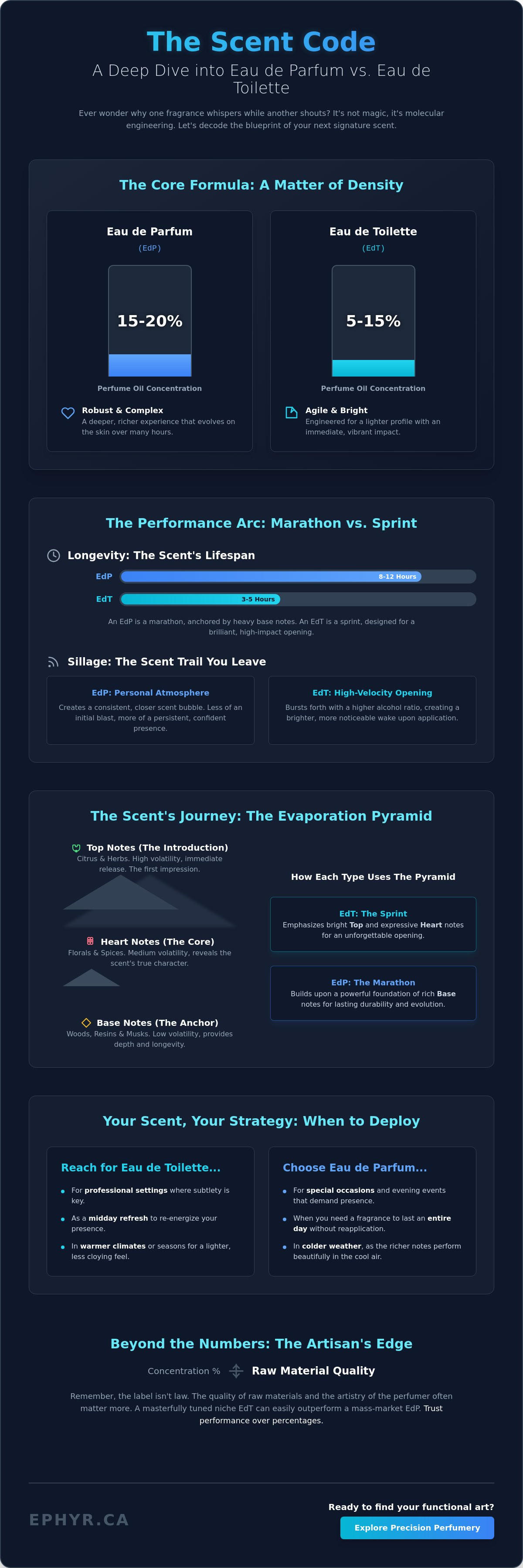
An Eau de Toilette (EdT) is engineered for a lighter profile, typically featuring a concentration of 5% to 15% perfume oil. It's built for agility and immediate impact. Conversely, an Eau de Parfum (EdP) steps up the molecular density. With an oil content ranging from 15% to 20%, it offers a more robust structure. This higher concentration changes the fundamental physics of the scent, allowing it to cling to the skin with greater tenacity.
The Role of Alcohol in Scent Delivery
Alcohol isn't just a filler; it's the propulsion system for your fragrance. It acts as the carrier that lifts the scent away from your body. Because an EdT contains a higher ratio of alcohol, it creates a brighter, more immediate "burst" upon application. This creates a high-velocity opening that fills a room quickly. The quality of this alcohol is critical. Master craftsmen use high-purity, laboratory-grade solvents to ensure the opening notes remain crisp. Low-quality carriers can distort the delicate top notes of a composition, ruining the initial performance before the scent even has a chance to settle.
Why Concentration Labels Aren't Law
Don't let the label on the bottle be your only guide. These percentages are industry conventions, not rigid legal requirements. In the world of niche perfumery, these boundaries are frequently pushed. A masterfully tuned EdT from a boutique house can often outlast a mass-market EdP. This is because the performance of a fragrance depends heavily on the quality of the raw materials. Superior natural extracts behave differently than synthetic shortcuts. When you choose a brand like Xerjoff or Nishane, you're investing in engineering that prioritizes long-term durability over standard classification. Focus on the performance of the investment rather than just the number on the box.
Performance Metrics: Longevity and the Lifecycle of a Scent
Longevity is the ultimate benchmark of a fragrance's engineering. It measures the exact window of time a scent remains detectable on the skin. This isn't a matter of chance. It's a result of molecular weight. Heavier molecules, such as oud, musk, and amber, possess lower volatility. They cling to the surface. When analyzing eau de parfum vs eau de toilette, the distinction lies in how these molecules are balanced. An EdP formulation is often weighted toward these dense base notes. This creates a deep, enduring dry down that persists long after the initial spray.
An Eau de Toilette takes a different tactical approach. It prioritizes the top and heart notes. These are the vibrant, lighter molecules that provide an immediate olfactory impact. They are designed for a shorter, more intense experience. This makes EdT an excellent choice for a midday refresh or a high-impact meeting. However, this vibrancy comes at the cost of endurance. The lifecycle of an EdT is intentionally brief, focusing on the "opening" rather than the "anchor."
The Evaporation Arc: Top, Heart, and Base Notes
Every fragrance follows a specific evaporation arc. This is dictated by the volatility of its components. The evaporation rate is a direct result of the ingredients chosen:
- Top Notes: Citrus and herbs. High volatility. Immediate release.
- Heart Notes: Florals and spices. Medium volatility. The core identity.
- Base Notes: Woods and musks. Low volatility. The long-term anchor.
An EdT is a sprint. High impact. Fast finish. It's ideal for those who value a bright, clean profile. An EdP is a marathon. It offers a slow evolution, revealing complex layers over eight to twelve hours. This gradual unfolding is part of the matching concentration to environment strategy that seasoned collectors use to curate their presence.
Skin Chemistry and Environmental Factors
Your skin is the final ingredient in the formula. Hydrated skin acts as a primer, holding fragrance molecules more effectively than dry skin. Heat also plays a critical role. High temperatures accelerate the release of the scent, increasing projection but potentially shortening the overall longevity. To counteract this, master perfumers use fixatives. Fixatives are the invisible anchors of a perfume, binding the lighter notes to the heavier base to slow the rate of evaporation. If you want to see how these dynamics play out in real time, exploring discovery sets is the most efficient way to test performance on your specific skin chemistry.
Sillage and Presence: Designing Your Personal Atmosphere
Sillage is the invisible architecture of your presence. It's the wake you leave behind as you move through a room. Projection is different. It's the radius; the specific distance the scent travels from your skin to the people around you. While many assume that a higher oil concentration leads to a louder announcement, the technical reality of eau de parfum vs eau de toilette is often counter-intuitive. In the first hour of wear, an Eau de Toilette frequently projects further than its more concentrated counterpart. This happens because the higher alcohol ratio acts as a high-velocity delivery system, launching scent molecules into the air with greater force.
An Eau de Parfum takes a more disciplined approach. Because it contains more perfume oil and less alcohol, the molecules are "heavier" and less volatile. They don't fly; they linger. This creates what master craftsmen call a "scent bubble." It's an intimate, three-dimensional atmosphere that stays close to the wearer. Understanding this spatial engineering allows you to choose your presence with precision, whether you want to command a room or invite someone into your personal space.
The Intimacy of Eau de Parfum
An EdP is designed for the wearer and those they allow into their immediate circle. It prioritizes richness over reach. The scent feels thicker and more textured on the skin. This makes it the ideal configuration for evenings or close-encounter settings where subtlety is a form of power. In these environments, you don't need to shout. The depth of the "juice" speaks for itself, revealing its internal nuances only to those within arm's length. It's a mature choice for the professional who values a private, long-lasting investment over a loud, temporary display.
The Radiance of Eau de Toilette
If an EdP is a warm, glowing hearth, an EdT is a bright spotlight. It's engineered to announce your presence with a fresh, airy radiance. This "sparkle" effect is why floral and citrus notes thrive in lower concentrations; the alcohol helps these delicate molecules dance and project. It's the perfect tool for daytime use where you want a noticeable but non-intrusive trail. An EdT ensures you're recognized as you enter a room without overwhelming the olfactory landscape. It's a tactical instrument for the office or outdoor events, providing a clean, professional finish that mirrors the efficiency of high-end hardware.
- Sillage: The lingering trail in your wake.
- Projection: The immediate reach of the scent.
- Volatility: How quickly the carrier alcohol evaporates.
- Texture: The physical "weight" of the fragrance on the skin.
Selection Logic: Matching Concentration to Environment and Intent
Choosing between eau de parfum vs eau de toilette is more than a preference; it's a tactical deployment. Every environment has a specific olfactory landscape. A crowded boardroom demands different engineering than a black-tie gala. You need to consider the "mission" of the day. Is the goal to remain crisp and alert for ten hours, or to provide a textured, intimate presence for a three-hour dinner? Master craftsmen don't just pick a scent; they select a concentration that aligns with the physical requirements of their schedule.
The Professional Environment
Shared spaces require a disciplined approach. In an office setting, an Eau de Toilette is often the superior choice. Its higher alcohol ratio provides a clean, professional aura that projects without intruding on a colleague's personal space. This helps avoid "scent fatigue," a common issue in long meetings where heavy base notes can become cloying. Focus on compositions with energizing notes like bergamot or vetiver. These act as cognitive primers, helping you maintain a sharp mental state throughout the workday while ensuring your presence remains non-intrusive.
Climate and Seasonality
The Canadian climate presents unique challenges for fragrance performance. In the dead of a dry, frigid winter, scent molecules struggle to lift off the skin. The air is too thin and cold to carry them effectively. This is when you reach for an Eau de Parfum. These denser formulations provide the necessary weight and internal engineering to survive the cold. Conversely, during a humid summer, an EdT shines. The heat accelerates evaporation, turning a lighter concentration into a refreshing, cooling sensation that feels airy rather than heavy. It's a functional response to your environment.
You can further refine this by considering your surroundings. A well-chosen home fragrance canada residents use to anchor their living space can act as a base layer for your personal scent. Some enthusiasts even use a "layering" strategy. They apply an EdP to pulse points for longevity, then mist a matching EdT on their clothing for an immediate, radiant opening. This creates a multi-dimensional signature that evolves as you move between different thermal zones. It's about maximizing the performance of your investment through strategic application.
While specialized boutiques focus on niche scents, the convenience of a broader marketplace allows for a complete lifestyle upgrade. You can discover more about E-commerce Retail of Perfumes and Electronics to explore a wide range of premium products that complement your personal style.
Ready to engineer your own olfactory signature? Explore our curated range of performance-driven niche fragrances to find the concentration that fits your lifestyle.
The Niche Perspective: Beyond the Label with Maison Ephyr
Standard classifications serve as a useful baseline for enthusiasts. However, in the world of niche perfumery, the technical gap of eau de parfum vs eau de toilette often becomes secondary to the raw integrity of the ingredients. A master craftsman doesn't just follow a percentage chart. They prioritize the internal configuration of the scent. When you move beyond mass-market offerings, you'll find that a high-grade concentration is only as good as the molecules it carries. Natural extracts behave like living organisms on the skin. They evolve. They breathe. They defy the linear expectations of synthetic substitutes.
This is where the concept of performance shifts from a metric to an art form. While many collectors look for an EdP to ensure longevity, niche houses often push further into the territory of Extrait de Parfum. These formulations represent the pinnacle of concentration, often reaching 20-40% oil content. At this level, the fragrance isn't just a scent; it's a long-term investment in olfactory durability that persists well beyond the standard eight-hour window.
Artisanal Integrity and Ingredient Quality
Consider how Amouage utilizes rare resins and silver frankincense. These materials possess a natural density that standard labels can't fully describe. Their longevity is legendary because the raw materials are engineered by nature to endure. Similarly, Xerjoff focuses on olfactory artistry that prioritizes texture and complexity over mass-market appeal. These scents use a higher percentage of naturals. This results in a "living" fragrance that interacts uniquely with your specific skin chemistry. The result is a profile that feels more three-dimensional and personalized than any mass-produced alternative.
The Discovery Process
Concentration is a theory. Your skin is the reality. You shouldn't commit to a full-scale investment without testing how a specific concentration behaves on your body. Temperature, hydration, and pH levels all influence the final output. This is why we advocate for a methodical discovery process. Utilize luxury fragrance samples canada to live with a scent for at least 48 hours. This window allows you to experience the full evaporation arc, from the initial high-velocity opening to the final, lingering base notes. Accessing perfume samples canada experts provide is the most efficient way to find your perfect match. It ensures your signature scent isn't just a label, but a precisely tuned instrument for your personal atmosphere.
Mastering Your Olfactory Signature
You now possess the technical blueprint to bridge the gap of eau de parfum vs eau de toilette with professional precision. You've learned how molecular weight dictates the lifecycle of a scent and how carrier volatility shapes your presence in a room. Whether you need a high-velocity opening for the office or a dense, textured anchor for a formal evening, your selection is now a tactical choice. It's about treating your signature scent as a piece of functional engineering rather than a simple accessory.
Maison Ephyr provides the precise instruments for this level of mastery. We're a dedicated official retailer for elite houses like Amouage, Xerjoff, and Nishane. We prioritize your individual discovery process. That's why we offer authentic 1ml samples for every profile in our collection. This allows you to test the internal configuration on your skin before committing to a full investment. Combined with our expert guidance, you can select a scent that aligns with your personal performance standards. Explore our curated collection of Niche Perfumes and find your perfect concentration. Your next signature scent is waiting to be engineered.
Frequently Asked Questions
Is Eau de Parfum always better than Eau de Toilette?
No, performance depends entirely on your specific environment and intent. An Eau de Toilette is often superior for daytime professional settings where you want a crisp, non-intrusive radiance. It's a question of engineering. If you need a high-velocity opening that fills a room quickly, the higher alcohol content of an EdT is the correct tool for the job.
How many hours should an Eau de Parfum actually last?
A well-formulated Eau de Parfum should remain detectable for eight to twelve hours. This longevity is a direct result of the 15-20% oil concentration found in the internal configuration. While the debate of eau de parfum vs eau de toilette often centers on strength, the real metric is durability. Heavier base molecules like amber and musk ensure the scent survives a full workday.
Can I wear Eau de Parfum during the day?
You absolutely can wear an EdP during the day. It simply requires a more disciplined application strategy. Because an EdP sits closer to the skin, it creates a personal atmosphere that is less likely to cause scent fatigue in others. Focus your application on pulse points. This keeps the projection managed while you benefit from the rich, textured layers of the dry down.
Why does my Eau de Toilette smell stronger than my Eau de Parfum initially?
This is due to the physics of alcohol volatility. Eau de Toilette contains a higher ratio of carrier alcohol, which acts as a propulsion system for the scent molecules. This creates a sharper, more aggressive burst in the first thirty minutes. An EdP is denser and less volatile. It doesn't fly; it lingers, revealing its complexity slowly over many hours.
Does the price difference between EdP and EdT reflect the quality of ingredients?
The price reflects the higher volume of pure perfume oil. In the eau de parfum vs eau de toilette comparison, the EdP requires more of the expensive juice to reach its 15-20% benchmark. However, in niche perfumery, both concentrations utilize the same artisanal quality of raw materials. You're paying for the physical density of the product and its long-term performance on your skin.
What is an Extrait de Parfum and how does it compare?
Extrait de Parfum is the highest tier of concentration, typically ranging from 20% to 40% oil. It's the pinnacle of olfactory engineering. Unlike an EdT or EdP, an Extrait has very little alcohol. It stays extremely close to the wearer, offering an intimate, three-dimensional experience. It's built for maximum longevity, often remaining detectable for over twelve hours.
Should I apply more sprays of an Eau de Toilette to make it last longer?
Applying more sprays will increase your initial projection, but it won't change the evaporation rate. The lifecycle of an EdT is dictated by its molecular structure, not the volume applied. If you want a scent to last longer, try applying it to hydrated skin or layering it over a matching body cream. This provides a physical anchor for the molecules.
Does fragrance concentration affect how the notes smell?
Yes, concentration shifts the focus of the olfactory pyramid. An Eau de Toilette emphasizes the top and heart notes, making citrus and florals feel more radiant and sparkling. An Eau de Parfum allows the heavier base notes to take center stage. This creates a scent that feels thicker and more grounded, often revealing woody or resinous nuances that remain hidden in lighter concentrations.


