

What if your perfume hasn’t changed, but the weather has? The same fragrance can seem brighter and more noticeable on a warm, humid day, then quieter or slower to emerge in the cold. Understanding how climate affects perfume scent helps explain why a familiar favourite may suddenly feel too strong, too faint or simply different.
Your impression is real, but it doesn’t necessarily mean the fragrance itself has changed. Temperature can influence how readily scent evaporates and reaches your nose, while humidity, perspiration and even clothing can shape the experience. That makes choosing a fragrance after one quick test less reliable, especially across Canada’s changing seasons.
In this guide, you’ll learn how heat, cold and humidity can affect a perfume’s projection and development, and how to distinguish changing conditions from changing preference. You’ll also find a practical way to test a fragrance more than once before deciding how it wears for you. Samples and discovery sets from Maison Ephyr make it easier to explore a scent across different days before choosing a full bottle.
Key Takeaways
- Learn how climate affects perfume scent by separating the effects of temperature and humidity on fragrance diffusion.
- Compare scent impressions in warm, cold, humid and heated indoor conditions, while accounting for context.
- Test a fragrance consistently and record the conditions to make clearer comparisons over time.
- Change one factor at a time, such as the setting or weather, to understand what may be shaping your impression.
- Use samples or discovery sets to explore how a fragrance wears across different days before choosing a full bottle.
How Climate Affects Perfume Scent and Your First Impression
A perfume can feel composed and subtle indoors, then seem brighter or more noticeable when you step into a warm afternoon. That shift can be surprising, especially when you’ve worn the same fragrance before. The bottle may be unchanged, but the conditions around it are not.
Climate affects perfume scent by influencing how fragrance is released and perceived, not by automatically changing the formula. Temperature, humidity, your skin and the surrounding air all contribute to the impression. So can the moment itself: a busy room, a breeze or a nose that has grown accustomed to the scent may change how present it feels.
Perfume is a formulated blend, but wearing it is an experience shaped by more than what’s in the bottle. The science behind perfume offers useful context on fragrance composition and how scent interacts with its surroundings. Still, no single weather rule describes every formula or wearer. Ingredients can behave differently, and the same scent may register differently from one person to another.
Does weather change the perfume or the way you smell it?
A changed impression doesn’t, by itself, mean a perfume has spoiled. Weather can influence how readily scent reaches you, while skin and surroundings affect what you notice. That’s different from a change to the fragrance itself, which may occur over time or with unsuitable storage. One warm-day impression isn’t enough to diagnose either. Compare the scent again under different conditions before drawing a conclusion.
Your skin is part of the picture, too. Its warmth, moisture and natural scent can influence how a fragrance comes across after application. Clothing and nearby odours may also contribute to the overall impression. These factors don’t make perfume unpredictable; they mean fragrance is experienced in context, rather than in isolation.
Why the same fragrance can feel stronger or softer
Projection describes how noticeable a fragrance feels beyond the wearer. A scent that seems to fill a room may feel more contained outdoors, where moving air disperses it. Think of a voice: it can sound louder in a small, quiet room than in a busy open space. The comparison has limits, since fragrance molecules and sound behave differently. Perceived intensity also depends on the perfume’s composition and the wearer.
That’s why “stronger” doesn’t necessarily mean the perfume has become more powerful, and “softer” doesn’t necessarily mean it has faded. A shift in the air, your skin or your attention may change the impression. To understand how climate affects perfume scent for you, treat a first impression as an observation, not a final verdict. The next sections look more closely at specific weather conditions and ways to compare them.
How Temperature and Humidity Influence Perfume Diffusion
Temperature and humidity can shape a fragrance experience, but they’re different parts of the environment. Temperature describes how warm or cool the air and skin feel. Humidity describes the amount of moisture in the air. Neither acts alone: application, airflow, skin and nearby smells also affect what reaches your nose and how noticeable it seems.
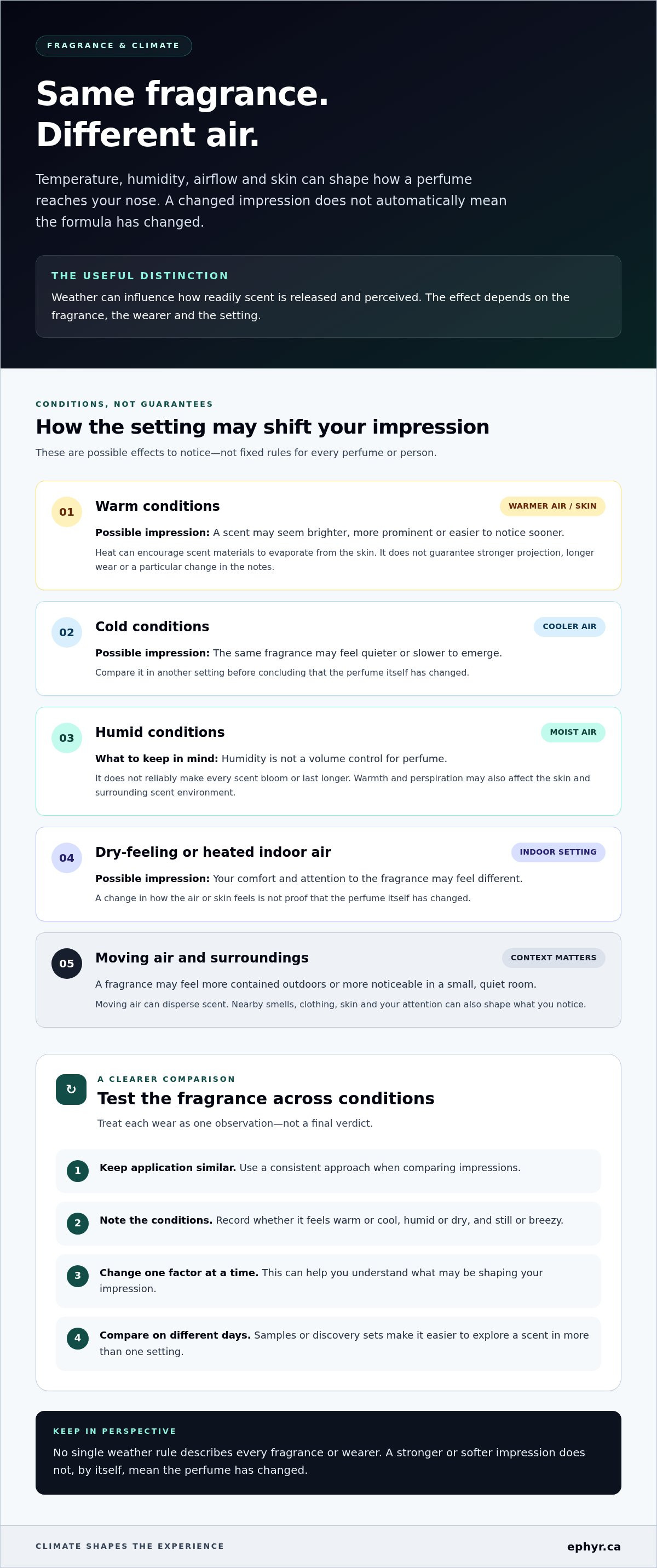
In brief: warmer conditions may help some fragrance materials evaporate more readily, while humidity and dry-feeling air can change the surrounding context. The result depends on the perfume, wearer and setting. This is a guide, not a performance formula. How climate affects perfume scent isn’t identical for every fragrance or person.
What heat can change in a fragrance experience
On a warm day, a fragrance may seem more prominent. Heat can encourage scent materials to evaporate from the skin, potentially making the aroma easier to notice sooner. That can affect perceived projection, or how present a scent feels around you. It doesn’t guarantee stronger projection, longer wear or a particular change in the notes.
The result depends on the composition, where and how much you apply, and the warmth of your skin. A fragrance that feels vivid after a walk outdoors may seem more restrained in a cool room. Even then, temperature isn’t the only possible explanation: moving air, clothing and surrounding smells all matter.
How humidity and dry conditions shape perception
Humidity is not a volume control for perfume. Moist air may alter how a fragrance is experienced, but it doesn’t reliably make every scent bloom or last longer. In humid conditions, warmth and perspiration may also affect the skin’s surface and the surrounding scent environment. Those influences can overlap, making humidity difficult to isolate as the cause.
In a dry-feeling setting, including an indoor space with heating, the air and skin may feel different than they do outside. That can change your comfort and your attention to a fragrance without proving the perfume itself has changed. Cooling creates another indoor contrast: an air-conditioned room may feel cooler and drier than a humid day outdoors. In Canada, the move from outdoor weather to heated interiors can happen within a single day, so note the setting as well as the forecast.
For a useful comparison, keep your application similar and notice whether the air is warm or cool, humid or dry-feeling, still or moving. Treat each impression as one observation, not a universal verdict on the fragrance. If you’re comparing scents, fragrance samples and discovery sets let you experience a scent in more than one setting before choosing a full bottle.
Hot, Cold, and Changing Weather: Comparing Perfume Impressions
A useful way to understand how climate affects perfume scent is to compare the same fragrance across settings, rather than assume a season determines how it will wear. The table offers possibilities to investigate, not rules for particular notes or scent families. Keep your application as consistent as you can, and record where you were when you noticed a difference.
| Condition | Possible impression | Context to consider | Testing tip |
|---|---|---|---|
| Warm weather | The scent may feel more noticeable or develop differently. | Direct sun, activity and warm skin can shape the experience. | Compare a calm outdoor moment with an indoor one. |
| Cold weather | The fragrance may seem quieter or slower to emerge. | Outdoor air, clothing and time spent indoors all matter. | Note whether you tested outside or in a sheltered space. |
| Humid conditions | The overall impression may feel fuller or simply different. | Humidity can coincide with warmth and perspiration. | Observe the scent in open air and an enclosed setting. |
| Heated indoors | A fragrance may feel more present after coming inside. | Indoor warmth can contrast sharply with cold outdoor air. | Record the indoor setting separately from the outdoor one. |
How a fragrance may feel in warm or humid conditions
Warmth or humidity may make a fragrance more noticeable to some wearers, but neither guarantees stronger projection. Try noticing it in open air, then again in an enclosed place where airflow and nearby smells differ. If the impression shifts, record the change without assigning it to a particular note or scent family. You’re observing how this fragrance behaves in context, not proving a universal seasonal rule.
That distinction matters. A scent that feels pronounced in a close indoor space may seem more diffuse outside, even in similar weather. Humidity may be part of the picture, but so may temperature, perspiration and movement. A single warm or humid-day test can’t isolate the cause.
What to notice in cold weather and heated interiors
Cold outdoor air and a heated room can create contrasting experiences within the same outing. A fragrance that seems restrained outside may feel more apparent indoors, or the reverse. Neither impression means cold weather has stopped the perfume from performing. Write down the setting and conditions before comparing. That record helps separate an outdoor observation from the effects of indoor warmth, airflow or surrounding scents.
Most importantly, a changed impression doesn’t establish that a fragrance is unsuitable for you or spoiled. Weather-related perception is different from the perfume’s storage history, and one quick test can’t settle the question. Look for a pattern across occasions. If the scent varies with the setting, you’ve learned something useful about when and where you enjoy wearing it, without needing to label it a warm-weather or cold-weather fragrance.
How to Test Perfume Across Different Climate Conditions
A reliable comparison needs a little structure. Try the same perfume on separate occasions, keep your application as consistent as possible, and change one condition at a time where practical. That gives you a clearer sense of how climate affects perfume scent for you, without relying on memory to compare two very different days.
A simple routine for comparing the same perfume
Use a sample or apply the same amount of fragrance to the same area of skin each time. Avoid adding other scented products during the test if you can, since they may complicate what you notice. You don’t need a laboratory notebook. A few clear observations are enough.
- Record the setting: Note whether you’re indoors or outside, and whether the air feels warm, cool, humid or dry.
- Keep the application consistent: Use the same amount and apply it in a similar way each time.
- Notice the opening: Write down your first impression shortly after applying, without deciding yet whether you like the fragrance overall.
- Check again later: Note what you perceive as the scent develops, and whether it feels more or less noticeable.
- Repeat on another occasion: Compare your notes, changing just one factor, such as the setting or weather, where possible.
Your first impression and your later one are both useful, but neither tells the whole story by itself. Your attention, activity and surroundings may shift during wear. Keep your notes simple and personal: “more noticeable outside” is more useful than a broad conclusion about how a whole scent family performs in a season. A practical guide to testing perfume samples at home can help you build a repeatable routine in a familiar setting.
How to tell weather effects from storage or preference
Wearing conditions and storage are separate questions. A fragrance may seem different outside because of the environment around you; that observation doesn’t show that the bottle’s formula has changed. If a scent seems consistently different, consider how it has been stored as a separate factor. A dedicated guide to how to store perfumes can help you assess that side of the picture.
Preference matters, too. Perhaps you enjoy a fragrance more in cool air, or find it less comfortable in a warm, enclosed space. That response is valid, even if weather helps explain part of it. Testing isn’t about proving a perfume works in every condition. It’s about learning when you enjoy wearing it.
Explore fragrance samples and discovery sets to compare a scent across your own changing conditions before choosing a full bottle.
Explore Perfume with Maison Ephyr as the Weather Changes
A single wear is a snapshot. A fragrance may feel distinct on a cool morning, during a warm afternoon or after you step into a heated room. Repeated, attentive wear gives you a more useful picture than deciding from one impression. It helps you notice whether a scent’s changing presence reflects the conditions, your preference or some combination of both.
Why sampling suits changing conditions
A sample makes it easier to revisit a fragrance on separate occasions before choosing a full bottle. Wear it in different settings, keep your application similar and jot down what you notice. One day, the scent might feel close and understated; another day, it may seem more apparent. Neither observation promises how it will perform next time. Each is part of your own experience.
Discovery sets offer another way to explore several fragrances through repeated wear, rather than relying on a quick first impression. If you’re building a thoughtful sampling routine, a guide to luxury fragrance samples in Canada can help you make the most of testing at home. The value is in giving each scent time and attention across the conditions you actually experience.
Turn your observations into a more confident choice
As you compare, focus on a few details: temperature, humidity, whether you’re indoors or outside, and how the fragrance feels to you. A note like “more noticeable in a warm room” gives you something concrete to consider later. You don’t need to decide that a perfume belongs to one season or performs the same way for everyone.
Personal preference is the final measure. You may enjoy a fragrance most in cool outdoor air, or prefer it in a warm, familiar room. That choice remains valid even if the conditions help explain why it feels different. Maison Ephyr’s expert fragrance guidance can support a considered selection based on the impressions you’ve gathered, rather than a seasonal label.
Exploring Maison Ephyr’s fragrance selection is a natural next step when you’re ready to find a scent worth getting to know. Samples and discovery sets let you begin with one fragrance, more than one day, and the confidence that comes from knowing how you experience it.
Let Your Next Fragrance Become an Experiment
Your next scent choice doesn’t have to begin with a definitive answer. Let curiosity lead. Notice which settings make you want to wear a fragrance again, and trust the impressions that hold up over time. That personal pattern is more useful than a rule about what you should wear in a particular season.
Understanding how climate affects perfume scent can turn everyday changes in weather into a chance to discover what feels right for you. A fragrance can be part of a winter morning, a warm afternoon or a quiet evening indoors. Your preferences may shift with the moment, and that’s part of the pleasure of wearing scent.
When you’re ready to find something new to explore, explore Maison Ephyr’s fragrance selection. Take your time, follow your curiosity and let your next favourite reveal itself through wear.
Frequently Asked Questions
Does hot weather make perfume smell stronger?
It can make a fragrance seem more noticeable, but the effect varies. If your perfume feels unusually bold on a warm day, avoid reapplying straight away. Give it time, then check how it smells after moving from outdoors to a cooler or more enclosed space. The setting may contribute to the impression. A lighter application next time can help you decide what feels comfortable without changing your fragrance choice.
Can humidity affect how perfume smells?
Yes, humidity can be part of the experience, but it doesn’t reliably intensify every perfume. A humid day may also mean more perspiration or time spent in enclosed spaces, which can influence what you notice. If the scent seems different, consider those conditions rather than attributing the change to humidity alone. For a fair comparison, wear it in a similar setting on another day when the air feels less humid.
Why does my perfume smell different in winter?
Winter can mean moving between cold outdoor air and heated interiors, so your fragrance may seem different from one part of the day to the next. A scarf or coat can also bring the scent closer to your attention when you adjust or remove a layer. Note where you noticed the change and whether you had just come indoors. That context can help explain the impression without assuming the perfume has changed.
Does cold weather stop perfume from projecting?
No. Cold weather doesn’t automatically prevent a fragrance from being noticeable. It may feel more contained outdoors, while a heated room can create a different impression. Check the scent after you’ve settled indoors instead of judging it during a brief walk outside. If it still feels quieter than you prefer, consider whether the amount applied suits the setting, rather than assuming the perfume can’t project in winter.
Should I wear a different perfume in summer and winter?
Only if you want to. There’s no need to follow a strict seasonal rotation: comfort and personal taste matter more than a calendar rule. You might prefer a familiar fragrance in a different amount or setting as the weather changes. If you’re choosing between two scents, wear each on separate occasions and consider where you’ll spend the day. Your own experience is a better guide than a general seasonal label.
Can climate change the perfume itself?
Ordinary changes in weather while you’re wearing perfume don’t automatically alter the formula in its bottle. A different scent impression can come from the conditions of wear. A bottle’s condition is a separate question: prolonged exposure to unsuitable storage conditions may affect a fragrance over time. If you notice a persistent change, consider the bottle’s storage history as well as your recent wearing conditions before deciding what’s responsible.
How can I test perfume in different weather?
Use a sample or the same amount of perfume on separate occasions, and note the setting, how the air feels and what you notice at different points in the wear. Keep the application and skin area consistent where practical. Avoid testing several unfamiliar scents one after another, since your nose may become less responsive to differences. A few brief notes can make the comparison clearer than relying on memory alone.
Article by
Dmitrii Savishin
Dmitrii Savishin is the founder of Maison Ephyr and Parfum Exquis, two Canadian destinations dedicated to the world of niche perfumery. With years of experience discovering exceptional fragrance houses from around the globe, Dmitrii shares expert insights on perfume trends, fragrance notes, luxury brands, and the art of choosing the perfect scent. His mission is to make niche perfumery more approachable while helping readers discover fragrances that leave a lasting impression.


