
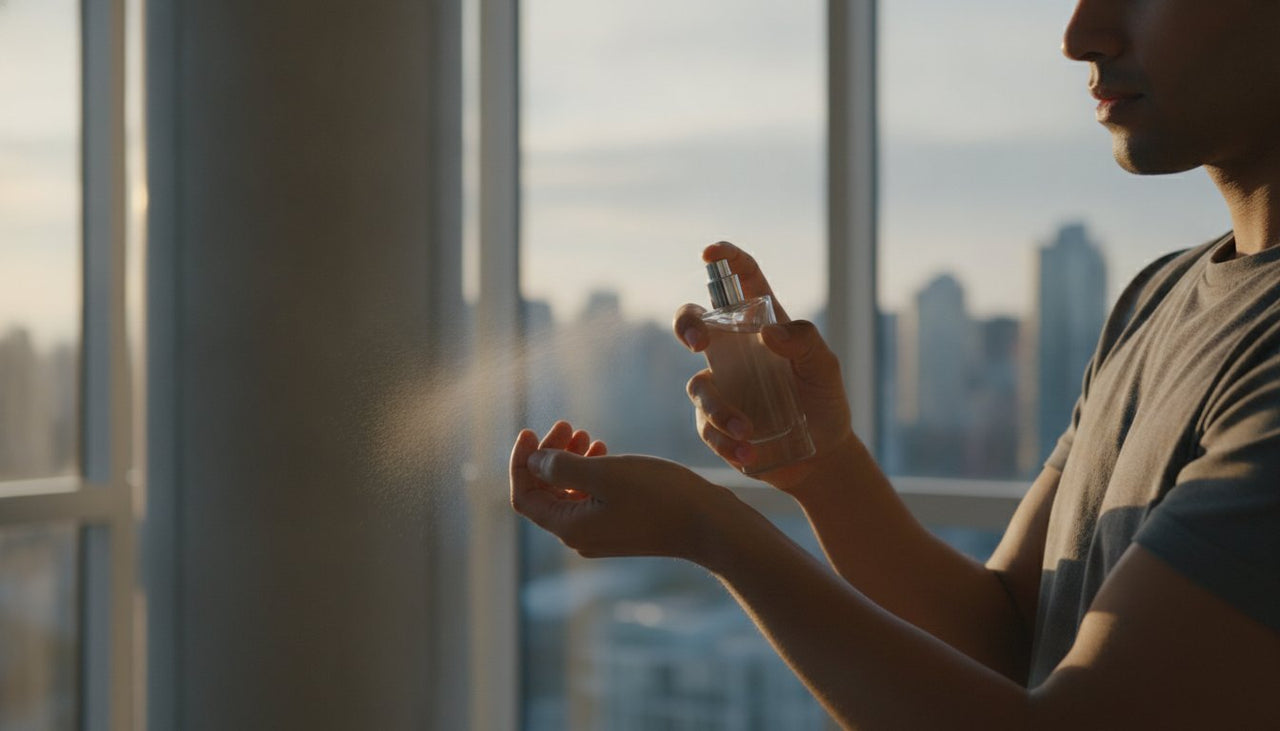
Your luxury fragrance isn't just a finishing touch. It's a piece of high-performance hardware that requires precise calibration to function. Most collectors feel the sting of a prestigious scent vanishing before the morning meeting ends. It's frustrating to invest in an Amouage or Xerjoff masterpiece only to have the sillage collapse within two hours. Understanding the Maison Ephyr methodology for how to apply perfume changes the entire experience. You don't just wear a scent. You engineer its presence.
We agree that wasting expensive juice through poor technique is a silent tragedy for any enthusiast. This guide promises to transform your routine into a master craftsman's ritual. You'll learn to achieve 8+ hours of wear and master the technical precision required for perfect projection. We'll break down the biological science of pulse points, the strategic use of discovery sets, and the architectural logic of scent layering. It's time to treat your fragrance like the long-term investment it truly is.
Key Takeaways
- Discover why the Golden Window after a shower is the scientifically superior time to prime your skin for a scent that lasts.
- Learn the technical precision of how to apply perfume to specific heat zones that act as your body's natural fragrance radiators.
- Master the disciplined application rules required for high-concentration niche houses like Amouage and Xerjoff to ensure elegant projection.
- Stop the common habit of molecular bruising that destroys expensive top notes and causes premature scent decay.
- Explore the architectural logic of layering scents and using hair mists to create a sophisticated, multi-dimensional sillage.
The Foundation: Preparing Your Skin for Olfactory Excellence
Every masterpiece requires a prepared canvas. If you've wondered how to apply perfume for maximum impact, you must start with the skin's surface. Fragrance molecules are volatile; they naturally want to escape into the air. Without a proper "tack" to hold them, even the most robust Extrait de Parfum will dissipate prematurely. Most enthusiasts overlook this mechanical reality. They spray onto dry, thirsty skin and wonder why their investment vanishes by noon. Your skin isn't just a surface. It's a biological engine that drives the scent's performance.
Moisturized skin acts as a natural primer. When you hydrate, you provide a lipid-rich environment that traps scent oils, effectively slowing down the evaporation process. This interaction is a core principle in The History and Art of Perfumery, where the relationship between the carrier and the skin determines the scent's life cycle. Heat also plays a critical role. Warm skin encourages the initial "bloom" of top notes, allowing complex citrus or floral accords to project with immediate clarity. Choosing an unscented lotion is the secret to maintaining a pure profile, ensuring your canvas doesn't distort the intended engineering of the scent.
Hydration as a Performance Metric
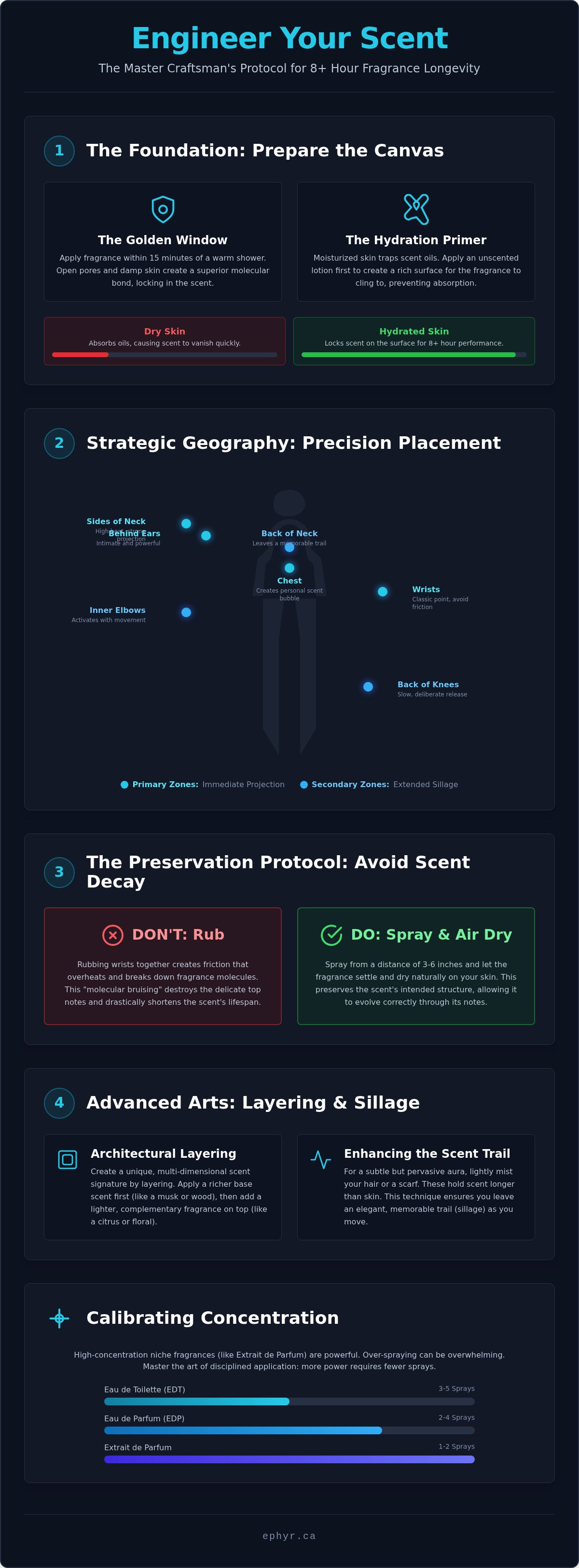
Precision timing is the hallmark of a master. The "Golden Window" occurs immediately after a warm shower. Your pores are open and your skin is naturally damp, which facilitates a superior bond with the fragrance molecules. This is particularly vital in the Canadian climate. Our dry winters act as a desiccant, stripping moisture from the skin and killing sillage instantly. Heavier skin prep isn't optional during these months; it's a technical requirement.
Don't rush to dress. Follow the 15-minute rule. Give the fragrance time to settle and bond with your skin's natural oils before introducing fabric. This prevents clothing from wicking away the oils you've just carefully placed. When you master the timing of how to apply perfume, you ensure the scent profile remains pure and undistorted by external friction.
Strategic Geography: The Precision Placement of Fragrance
Mapping how to apply perfume is less about luck and more about thermal engineering. Your pulse points act as biological radiators. These specific zones, where blood vessels sit nearest to the skin, generate consistent heat that pushes scent molecules into the air. By identifying the hierarchy of heat on your body, you can control exactly how your fragrance projects and how long it survives. A Master Craftsman doesn't spray at random. They map their application to the day's expected movement.
The Primary Pulse Points
The primary pulse points remain the industry standard for a reason. The sides of the neck and the area behind the ears serve as the engine room for immediate projection. This is where the scent meets the air first. The wrists are equally vital, though they require a disciplined touch to avoid friction. Many collectors also favor the chest. This creates a personal scent bubble that rises to your own nose throughout the day, providing a constant sensory feedback loop. When applying to these sensitive areas, keeping FDA Guidelines on Fragrance Safety in mind ensures your skin remains as healthy as it is fragrant.
Secondary Zones for Extended Sillage
Secondary zones offer a sophisticated alternative for extended sillage. The back of the neck is perhaps the most strategic spot for those who want to leave a memorable trail as they walk away. Meanwhile, the inner elbows and the backs of the knees are lower-heat areas that provide a slower, more deliberate release of the fragrance heart notes. Kinetic energy is the catalyst here. Movement acts as a mechanical trigger; as your joints flex and your body temperature fluctuates, these secondary zones activate, pulsing scent molecules into your surroundings with every step. If you're looking to experiment with these zones, starting with discovery sets is the most efficient way to test how different concentrations react to your unique body chemistry.
The Master Craftsman approach involves mapping your sprays to your daily rhythm. If you'll be seated at a desk, focus on the chest and wrists. For an evening event involving high mobility, prioritize the back of the neck and inner elbows. This tactical geography ensures your fragrance isn't just a static cloud. It becomes a dynamic extension of your presence. Mastering how to apply perfume with this level of precision separates the enthusiast from the true connoisseur.
To further refine the energetic dimension of your presence, you may consider integrating the organic flower essences from Starseed Essence Shoppe into your daily ritual, grounding your spiritual intentions before applying your high-performance fragrance.
Calibrating Concentration: Techniques for Niche Scents
Niche perfumery operates on a different logic than mass-market design. Standard fragrances often rely on high alcohol content for an immediate, loud opening that fades quickly. Niche houses focus on the structural integrity of the oil concentration. Understanding how to apply perfume when dealing with these high-density formulations requires a calibrated touch. You aren't just spraying; you're deploying a complex chemical sequence that unfolds over several hours. The density of the juice dictates the rhythm of the wear.
High-intensity houses like Amouage demand what experts call the "One Spray Rule." These compositions feature raw, potent materials that can easily overwhelm a room if mismanaged. The "dry down" is where the true engineering value lies. Higher concentrations transition more slowly from volatile top notes to the heavy resins and woods of the base. Discovery sets are your essential diagnostic tools here. They allow you to observe how your unique skin chemistry handles these dense molecules before you commit to a full-scale application.
Eau de Parfum vs. Extrait de Parfum
Eau de Parfum is the industry workhorse, offering a balanced ratio of projection and longevity. It's designed to be noticed. Extrait de Parfum is a different instrument entirely. With oil concentrations often exceeding 20%, it trades explosive sillage for incredible durability. It sits closer to the skin, creating an intimate aura. Less is always more with extraits. Overloading the skin leads to olfactory fatigue, a state where your nose simply shuts down to protect itself from the intensity. If you are using lighter concentrations like Eau de Cologne, the strategy shifts to frequent, targeted refreshes throughout the day.
Technique for High-Oil Formulations
Distance is a critical variable in your application ritual. Spraying from exactly six inches creates the optimal mist distribution. This ensures the oils land in a fine, even layer rather than a concentrated puddle. For the highest concentrations, use the "Dab and Press" method. Apply the scent to one pulse point and gently press your skin against another. Never rub. Friction generates heat that can prematurely "cook" the delicate top notes. Identifying "beast mode" fragrances early allows you to adjust your spray count, ensuring your presence is felt with elegance rather than force. Mastering how to apply perfume with this level of technical precision ensures your signature scent remains clear and undistorted.
The Preservation Protocol: Avoiding the Common Pitfalls of Scent Decay
Preserving the structural integrity of your fragrance is as critical as the initial spray. Most users inadvertently sabotage their sillage before they even leave the house. If you want to master how to apply perfume, you must understand that fragrance molecules are delicate chemical bonds, not indestructible liquids. Rough handling leads to molecular bruising. This is a technical failure where the heat generated by friction destroys the volatile top notes. Instead of a sparkling citrus or floral opening, you're left with a flattened, distorted version of the intended profile.
Rubbing your wrists together is a cardinal sin of olfactory engineering. This mechanical action creates a spike in skin temperature that forces the scent to bypass its natural progression. You essentially skip the introduction and move straight to the middle notes, losing the nuance that makes niche perfumery a luxury experience. The clothing conflict is another common trap. Fabrics lack the lipids and heat required to project a scent properly. Instead, the oils often become trapped in the fibers, leading to a stale scent profile and potential staining on delicate materials.
Breaking the Rubbing Habit
Let your fragrance air-dry naturally. This preservation of the evaporation process ensures the scent unfolds exactly as the master perfumer intended. If you must distribute the juice across both wrists, use the "Press" technique. Gently touch your pulse points together without sliding them. The chemical crushing of molecules occurs during rubbing, effectively shearing the delicate bonds that hold top notes together. This simple shift in how to apply perfume protects the chemical architecture while ensuring even coverage.
Storage as a Component of Application
Your application ritual begins long before you pick up the bottle. Storing your Xerjoff perfumes in the bathroom is a recipe for environmental decay. The constant fluctuations in heat and humidity cause rapid oxidation, turning a complex masterpiece into a dull, flat liquid. Follow the "Cool, Dark, and Dry" rule. Keep your collection in its original box or a dedicated cabinet away from direct sunlight. An oxidized perfume won't perform, regardless of your technique. To ensure you're working with a pristine product, browse our curated collection at Maison Ephyr for authentic, professionally stored niche masterpieces.
The Art of the Scent Trail: Masterclass in Layering and Sillage
Sillage is the invisible wake you leave behind. It’s the olfactory equivalent of a ship's trail on the water. Mastering how to apply perfume requires moving beyond simple skin application and into the realm of spatial engineering. You aren't just wearing a scent; you are curating an environment. This involves managing your "scent bubble" to ensure your presence is felt with quiet confidence rather than overwhelming force. In Canada, this ritual must adapt to the seasons. The humid summers accelerate molecular vibration, while the frigid winters can dampen even the strongest base notes.
Adapting your ritual to the climate is a technical necessity. Heat acts as a catalyst for sillage, meaning a lighter hand is required during July afternoons. Conversely, the dry, cold air of a Canadian January requires more robust base notes and a slightly more generous application to maintain a consistent trail. This seasonal shift ensures your fragrance remains a functional piece of art regardless of the external temperature. It’s about understanding the physics of the molecules you've chosen to wear.
Advanced Layering Techniques
Layering is a disciplined form of bespoke creation. Follow the "Heavy to Light" rule: apply base-heavy scents like ouds or ambers before adding ethereal top-notes. This prevents the delicate molecules from being smothered by the heavier ones. To achieve a holistic aura, consider combining scented candles with your personal fragrance to set a consistent sensory tone in your space. Precision is key here. Use fragrance samples to test these combinations on your skin before committing to a full application. This trial phase ensures the different chemical architectures complement rather than conflict with one another.
The Hair and Clothing Strategy
Many collectors ignore the most effective tool for sillage: the hair. Because hair is porous and moves constantly, it acts as a mechanical diffuser. However, standard perfumes contain alcohol that can dehydrate the hair shaft. This is why specialized hair mists are the most underrated tool for longevity. They offer the same high-end engineering without the damage. For clothing, utilize the "Mist and Walk" method. Spray the air in front of you and walk through the cloud. This provides an even distribution that avoids the "stale" profile mentioned in our preservation protocol.
Controlling your sillage is a mark of professional maturity. In an office setting, a single spray to the chest or back of the neck is sufficient. For an evening event, you might increase the count to three or four sprays across primary and secondary zones. Understanding how to apply perfume with this level of nuance allows you to project elegance in any environment. It transforms a simple product into a functional art form that evolves with your movement and the Canadian air. To complement this refined aesthetic, the luxury jewelry and accessories from ZAAFAR Atelier offer the perfect visual counterpart to a sophisticated olfactory presence.
Refine Your Olfactory Signature
Your fragrance is a technical instrument. It demands respect and precision to perform. By treating skin hydration as a critical performance metric and mapping your body's heat zones, you ensure every spray reaches its full potential. You now understand that the ritual of how to apply perfume is an essential act of preservation. Avoiding friction and environmental decay keeps the complex chemical architecture of your scent intact from the first mist to the final dry down.
Maison Ephyr stands as an authorized retailer for prestigious houses like Amouage, Xerjoff, and Nishane. We provide the high-performance hardware for your olfactory expression. Our experts offer specialized fragrance consultations to help you navigate these dense, artisanal compositions with confidence. With fast, secure shipping across Canada, your next masterpiece is ready for deployment. We invite you to treat your collection as a long-term investment in your personal presence.
Explore our curated collection of niche masterpieces and start your discovery journey today. Master the ritual and let your scent speak with the quiet authority of a true connoisseur.
Frequently Asked Questions
How many sprays of perfume is too much?
Two to three sprays are generally sufficient for high-concentration niche fragrances. If you're using a potent Extrait de Parfum, knowing how to apply perfume with restraint is vital. A single spray might suffice. Over-application leads to a cluttered scent profile that overwhelms those around you. It's better to start with a minimal dose and observe the projection. You can always recalibrate for your next wear once you understand the scent's specific thermal engineering.
Does perfume last longer on skin or clothes?
Perfume lasts longer on clothes because fabric doesn't have the biological heat to accelerate evaporation. However, skin is the superior canvas for olfactory development. Your body heat allows the top, heart, and base notes to bloom in their intended sequence. Applying to clothes often results in a flat, linear scent profile. For the best results, prioritize pulse points on the skin but consider a light mist on a scarf for extended sillage.
Why can't I smell my own perfume after an hour?
Olfactory fatigue occurs when your brain ignores a constant sensory input to remain alert for new smells. This is a common biological reset. If you've mastered how to apply perfume correctly, others will still perceive your scent even if you don't. Avoid spraying too close to your face or chest to minimize this effect. Rotating your fragrances frequently also prevents your nose from becoming overly accustomed to a specific signature profile.
Can I apply perfume to my hair safely?
Applying standard perfume to your hair can be damaging due to high alcohol content, which strips moisture from the hair shaft. A more sophisticated choice is using dedicated hair mists. These formulations are engineered with lower alcohol levels and often include nourishing lipids. If you must use a traditional fragrance, mist the air and walk through it to ensure an even, light distribution that minimizes direct contact with your strands.
Should I apply perfume before or after I get dressed?
You should apply perfume before you get dressed. This allows the molecules to bond directly with your skin's natural oils and any primers you've applied. It also prevents the fragrance from staining delicate fabrics or being wicked away by clothing fibers. By the time you dress, the scent has had the necessary fifteen minutes to settle and begin its transition from the volatile top notes to the richer heart.
What is the best way to test perfume samples for longevity?
The most effective way to test 1ml fragrance samples is by applying them to clean, moisturized skin, one at a time. Don't test multiple scents simultaneously; this creates olfactory confusion. Observe the scent at thirty-minute intervals to track the dry down. Using discovery sets from Maison Ephyr allows you to evaluate how different concentrations react to your specific skin chemistry over a full eight-hour wear cycle before investing in a full bottle.
Does skin type (oily vs. dry) affect how perfume smells?
Skin type significantly impacts the performance and profile of a fragrance. Oily skin acts as a natural anchor for scent oils, often resulting in increased longevity and a more intense projection. Dry skin lacks these lipids and tends to consume the fragrance molecules rapidly. This is why we emphasize using body creams and lotions as a primer. A well-hydrated canvas ensures that the scent projects with the intended clarity and duration.
Is it okay to store my perfume in the fridge?
Storing perfume in a standard kitchen fridge is generally not recommended. Constant temperature fluctuations from opening the door can stress the chemical bonds of the fragrance. A stable, cool, and dark environment like a dedicated cabinet or a wine cellar is much more effective. Professional collectors prioritize consistency above all else. Extreme cold can be just as damaging as extreme heat, potentially causing the delicate oils to separate or degrade over time.
Article by
Dmitrii Savishin
Dmitrii Savishin is the founder of Maison Ephyr and Parfum Exquis, two Canadian destinations dedicated to the world of niche perfumery. With years of experience discovering exceptional fragrance houses from around the globe, Dmitrii shares expert insights on perfume trends, fragrance notes, luxury brands, and the art of choosing the perfect scent. His mission is to make niche perfumery more approachable while helping readers discover fragrances that leave a lasting impression.


