
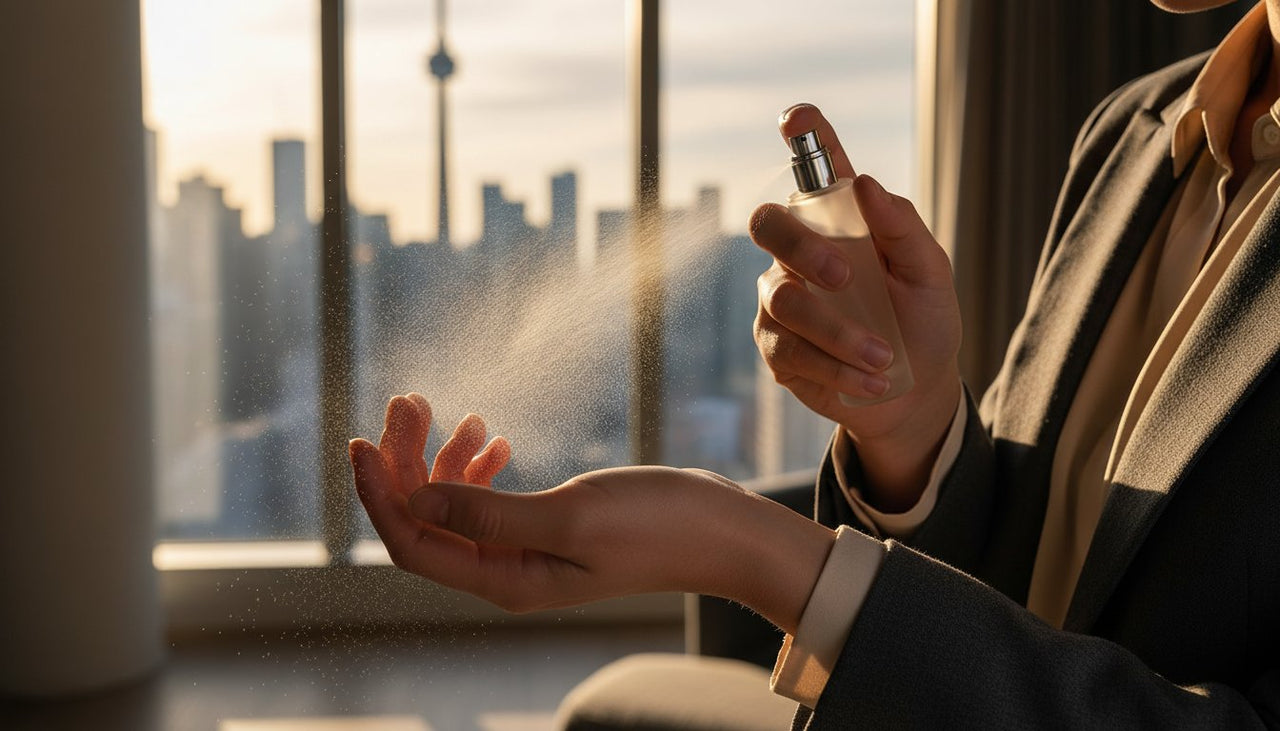
Your signature scent is a technical failure if it vanishes before your first mid-morning meeting ends. For many Canadian collectors, investing C$420 in a niche fragrance only to see it disappear within 120 minutes is an all too common reality. It's a waste of liquid art. Mastering how to apply perfume is not about vanity; it is about managing the invisible architecture of your presence. You likely recognize that a scent should be discovered, not announced, yet achieving that balance often feels like a moving target.
We promise to transform your daily application into a disciplined performance ritual. You will learn the technical methods required to ensure your fragrance projects with precision and endures for at least 8 hours. Our guide analyzes the mechanics of sillage, the thermodynamics of skin application, and the exact spray patterns used by master perfumers to maintain a consistent olfactory profile. It's time to stop over-spraying and start projecting with purpose. We provide the blueprint for uncompromising scent performance.
Key Takeaways
- Master the technical discipline of how to apply perfume by treating fragrance as a molecular architecture that responds to heat and friction.
- Identify the strategic pulse points and high-heat zones required to project your scent with surgical precision and optimal sillage.
- Implement the "Moisture Sandwich" technique and pre-application hydration to engineer a scent profile capable of 12-hour endurance.
- Leverage the porous nature of hair and specific fabrics to extend performance while protecting delicate fibers from alcohol-based damage.
- Preserve the integrity of your niche collection by neutralizing the three enemies of perfume through professional storage standards.
The Ephyr Standard: Why Application is a Technical Discipline
Perfume is not a mere accessory. It is molecular architecture. Each bottle contains a complex arrangement of volatile compounds that respond dynamically to heat, friction, and airflow. Most people simply wear a scent. At Ephyr, we master its performance. Understanding how to apply perfume is a technical discipline that separates the casual user from the fragrance enthusiast. It requires a Master Craftsman mindset. You must view your skin as a canvas and the fragrance as a precision instrument.
Luxury niche fragrances operate on a different frequency than mass-market options. Commercial scents are often engineered for an immediate, loud opening that fades quickly. Niche houses prioritize depth and evolution. This requires a calibrated approach. While the conventional application of pure perfume provides a baseline, the Ephyr Standard demands a deeper understanding of thermal dynamics. Precision placement ensures that your scent trail, or sillage, remains consistent throughout the day. It’s about controlled release rather than a sudden burst of chemicals.
Understanding Concentration: EDT vs. EDP vs. Extrait
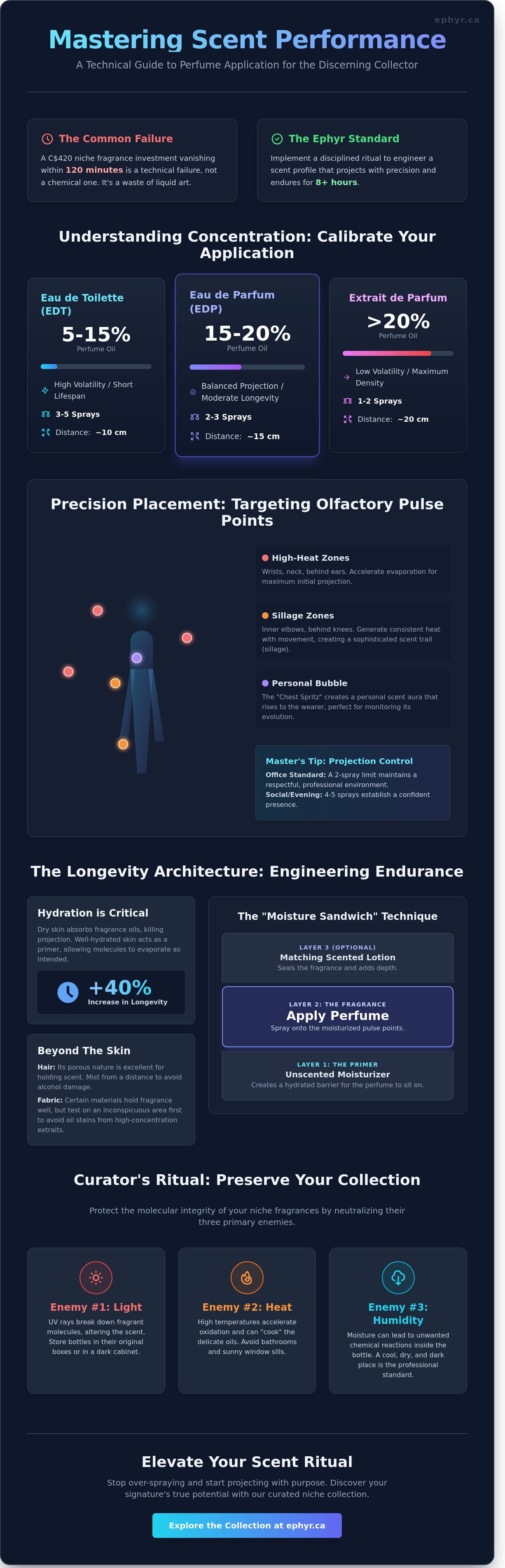
Concentration dictates the physics of your application. An Eau de Toilette (EDT) typically contains 5% to 15% perfume oil, requiring a closer spray distance of about 10 centimetres. An Eau de Parfum (EDP) increases this to 15% to 20%, demanding more restraint to avoid overwhelming the senses. Extrait de Parfum is the peak of olfactory density. These formulations often exceed 30% oil concentration. When you learn how to apply perfume at this level, distance is your primary tool. Spraying from 20 centimetres allows the heavy molecules to atomize properly. Adjust your technique for heavy hitters like Amouage perfumes. Their high resin content requires a wider spray radius to prevent oil spotting on skin or fabric.
- EDT: 3 to 5 sprays. High volatility. Short lifespan.
- EDP: 2 to 3 sprays. Balanced projection. Moderate longevity.
- Extrait: 1 to 2 sprays. Low volatility. Maximum density.
The Science of the Dry-down
The dry-down is the most critical phase of scent performance. It is the transition from top notes to the heart and base. Skin temperature acts as the engine for this process. High heat accelerates evaporation, causing top notes like citrus or mint to vanish in under 30 minutes. A disciplined application targets cooler pulse points to slow this transition. This preserves the architectural integrity of the scent.
The phenomenon of "skin-eating" is rarely a matter of chemistry. It is usually a matter of hydration. Dry skin absorbs the oils meant for evaporation, killing the projection. Studies show that well-hydrated skin can increase fragrance longevity by up to 40%. Apply an unscented moisturizer before your scent ritual. This creates a lipid barrier that allows the perfume to sit on the surface, ensuring the notes transition as the perfumer intended. Precision is the difference between a fading memory and a lasting impression.
Precision Placement: Targeting Your Olfactory Pulse Points
Application is a precise exercise in thermal dynamics. To master how to apply perfume, you must target the body's natural heat zones. Pulse points are the strategic locations where blood vessels sit nearest the skin surface, acting as organic radiators. High-heat zones include the wrists, the base of the neck, and behind the ears. These areas accelerate evaporation, ensuring the scent projects outward with clarity rather than sitting dormant on the skin.
For a more sophisticated scent trail, target the "unseen" pulse points. The inner elbows and the area behind the knees are essential for long-term sillage. As you move, these joints generate consistent heat, distributing fragrance molecules into your wake. The "Chest Spritz" is another functional technique. It creates a personal scent bubble that rises directly to the wearer. This allows you to monitor the fragrance's evolution throughout the day without overwhelming those around you.
Managing projection is a mark of the master craftsman. In a professional Canadian office, a two-spray limit is the standard for maintaining a respectful environment. Social settings or evening events provide more latitude. Here, four to five sprays can establish a confident presence. Understanding these technical nuances is the first step toward elevating your personal aesthetic to a professional level.
The Golden Rule: Never Rub Your Wrists
Friction is the enemy of quality. Rubbing your wrists together creates "olfactive bruising." This physical heat prematurely crushes delicate top notes, distorting the intended profile of the scent. Use the "Gentle Press" instead. Touch your wrists together lightly to ensure even distribution without damaging the molecular structure. This technique is vital for maintaining the integrity of the complex, high-tier ingredients found in Xerjoff fragrances. Precision application preserves the artist's original vision for hours longer than a careless rub.
The Ideal Distance: The 6-Inch Rule
Distance dictates performance. Spraying too close to the skin leads to "pooling," which results in uneven evaporation and a messy finish. Hold the atomizer approximately 15 centimeters (6 inches) away from the target area. This creates a fine mist that covers a larger surface area for better adhesion. You should follow expert advice on making perfume last longer by ensuring your skin is clean and properly hydrated before application. Avoid the "Walk-Through" method. It's an inefficient myth that wastes expensive niche juice on the floor. Direct, measured skin contact is the only way to achieve a professional standard of performance when learning how to apply perfume effectively.
The Longevity Architecture: Engineering a Scent That Lasts
Fragrance performance is a matter of molecular physics. A scent is only as effective as the surface that hosts it. Dry skin is the primary enemy of longevity. It acts like a sponge, absorbing perfume oils into the dermis and silencing the projection. To master how to apply perfume, you must first engineer a stable foundation. This is the primer phase of scent application. It ensures the fragrance remains on the surface where it can breathe and project.
Priming the Canvas: Skin Preparation
Hydration is your most powerful tool. Applying fragrance to parched skin results in a 40 percent faster evaporation rate. Use a high-quality, unscented lotion to create a moisture barrier. For maximum endurance, apply a thin layer of an occlusive, such as Vaseline, to your pulse points. This creates a physical anchor for the scent molecules. They sit on top of the barrier rather than disappearing into your pores. It's a simple mechanical advantage that doubles your wear time.
- Apply immediately after a warm shower while skin is still damp and pores are open.
- Use unscented products to avoid olfactory interference with your chosen fragrance.
- Focus on high-heat areas like the neck, wrists, and inner elbows for optimal diffusion.
Advanced Layering Strategies
Creating a bespoke scent requires a disciplined approach to layering. You aren't just stacking smells; you're building a structural hierarchy. Always apply heavy base notes first. Woods, resins, and musks provide the structural integrity needed for long-term performance. Lighter florals and citrus notes should follow. This technique ensures the volatile top notes are supported by the denser oils beneath them, creating a 12-hour endurance profile.
Precision testing is vital for this process. Many enthusiasts use luxury fragrance samples in Canada to trial different combinations. These small vials allow for controlled experimentation without the financial commitment of a full bottle. It's a calculated way to find which notes harmonize on your specific skin chemistry. If a scent begins to fade by mid-afternoon, resist the urge to respray. Instead, apply a small amount of unscented moisturizer to the pulse point. This reactivates the dormant oils and extends the life of the fragrance by an additional three hours. It's about efficiency, not volume. Professional application is a balance of chemistry and restraint.
Beyond the Skin: Mastering Hair Mists and Fabric Interactions
Mastering how to apply perfume requires looking past the pulse points. Hair fibers are naturally porous. They act as exceptional scent carriers, often retaining fragrance molecules 50% longer than skin. However, standard Eau de Parfum formulations contain high concentrations of ethanol. This alcohol acts as a solvent. It strips moisture from the hair cuticle, leading to brittleness and loss of shine. Precision application is necessary to balance performance with hair health.
Fabric interactions demand equal technical consideration. Scent molecules bond differently to synthetic fibers than they do to organic ones. While textiles offer a stable platform for longevity, they lack the heat necessary for complex note evolution. Understanding how to apply perfume to your wardrobe ensures a consistent olfactory profile that survives the harsh Canadian climate, where layers are a functional necessity.
The Art of the Hair Mist
Dedicated hair mists are engineered with lower alcohol content and added conditioning agents. They provide a lightweight veil of scent without compromising structural integrity. To achieve the best results, use the Brush Technique. Spray your hairbrush from a 15cm distance. Wait three seconds for the initial alcohol burst to evaporate. Run the brush through your hair. This ensures even distribution and prevents localized dryness. Hair provides the most consistent sillage. Every movement of the head releases a fresh wave of fragrance, creating a dynamic aura that follows your lead.
Scenting Your Wardrobe Safely
Textiles require a cautious approach. High oil concentrations in extrait de parfum can leave permanent stains on delicate materials. Always conduct a spot test on an inconspicuous area before full application.
- Silk and Suede: Avoid direct contact. These materials are highly reactive to oils.
- Light Linens: Maintain a 30cm distance to prevent "spotting."
- The Lining Spritz: Apply scent to the interior lining of a blazer or coat. This creates a subtle reveal as you move, protecting the exterior aesthetic.
Winter in Canada presents a unique challenge: scent ghosting. Heavy wool coats and cashmere scarves trap fragrances for weeks. If you switch scents frequently, this leads to a cluttered olfactory profile. Clean your winter accessories regularly to maintain a blank canvas. Interestingly, the way you curate home fragrance in Canada can complement your personal wardrobe. A cohesive environment ensures that your clothes don't absorb conflicting household odors, preserving the purity of your chosen perfume.
The Curator’s Ritual: Maintenance and Storage Excellence
Owning a high-end fragrance is only half the battle. Knowing how to apply perfume effectively requires an intact formula, yet many collectors unknowingly sabotage their scents within months of purchase. Your collection faces three primary enemies: light, heat, and humidity. These elements act as catalysts, accelerating the breakdown of complex molecules and stripping the fragrance of its depth. A bathroom, characterized by constant steam and rapid temperature swings, is a scent graveyard. These fluctuations can degrade a C$300 bottle in less than 12 months, turning a masterpiece into a flat, unrecognizable liquid.
Oxidation is the silent killer of niche perfumery. You'll know a scent has "turned" when the bright, volatile top notes vanish, replaced by a sharp, acidic odor resembling vinegar or burnt plastic. Physical changes are also a red flag. If the liquid has darkened significantly or developed sediment, the structural integrity is compromised. Disciplined storage isn't just about aesthetics. It's about protecting a technical investment.
Optimizing Your Storage Environment
Sunlight is the most aggressive catalyst for chemical decay. UV rays trigger photodegradation, specifically targeting the delicate niche oils found in luxury extraits. The master craftsman’s secret is simple: keep the original box. This packaging acts as a precision-engineered light barrier, ensuring the juice remains shielded even if displayed on a shelf.
- Thermal Stability: Maintain a consistent temperature between 15 and 18 degrees Celsius.
- Humidity Control: Keep bottles in a dry environment with less than 50% humidity to prevent seal degradation.
- Shelf Life: While a standard eau de toilette may last 24 months, a high-concentration extrait stored in total darkness can maintain its profile for over 10 years.
The Path to a Signature Scent
Finding a signature requires data, not impulse. The 24-hour test is the only way to evaluate the full lifecycle of a fragrance. A scent that opens with brilliant citrus may dry down into a heavy, cloying musk that doesn't suit your personal style. By using perfume samples in Canada, you can live with a composition across different environments and temperatures before committing to a full-sized bottle. This disciplined discovery process mirrors the way we select high-performance hardware. You wouldn't choose a workstation without reviewing the benchmarks; don't choose a scent without testing the dry down.
Mastering how to apply perfume is a journey of precision and patience. It requires an understanding of both the art of the blend and the science of the skin. When you're ready to move beyond the commercial and into the exceptional, it's time to refine your selection. Explore the curated vault at Maison Ephyr to find the instrument that resonates with your personal standard of excellence.
Command Your Olfactory Presence
Refining how to apply perfume is the final step in the curator’s journey. It’s the difference between a scent that fades and one that resonates. By targeting pulse points and mastering the architecture of longevity, you ensure your fragrance performs at its peak. Proper maintenance and storage aren't just suggestions; they're essential protocols for protecting your investment in high-end perfumery. This is the Ephyr Standard in practice.
We bring this same level of technical precision to our curated selection. Ephyr is an official retailer for world-class houses including Amouage, Xerjoff, and Nishane. Every bottle we ship reflects our commitment to craftsmanship and quality. We provide fast shipping across all Canadian provinces, from British Columbia to Newfoundland. For those seeking a deeper exploration, our expert-led fragrance discovery sets offer a structured path to your next signature scent. We treat every order with the meticulous attention a masterwork deserves.
Discover your next masterpiece in our curated niche collection. Precision is the hallmark of a true master.
Frequently Asked Questions
How many sprays of perfume is too many?
Two to four sprays represent the standard for professional scent performance. Exceeding five sprays often leads to olfactory saturation, which compromises the sophistication of your presence. The concentration of the formula dictates the limit. An Eau de Parfum with 15% to 20% oil concentration requires fewer triggers than a lighter Eau de Cologne to maintain a refined sillage.
Can I apply perfume to my clothes instead of my skin?
Skin is the superior canvas for scent development because human skin temperature averages 34 degrees Celsius. This heat facilitates the evaporation of top notes and the reveal of complex base notes. While fabric holds scent for a longer duration, it lacks the thermal dynamics required for a bespoke olfactory profile. Spraying on clothes can also leave visible oil stains on 100% silk or delicate synthetics.
Why can’t I smell my own perfume after an hour?
You are likely experiencing olfactory fatigue, a biological process where the brain filters out constant stimuli. This shutdown occurs when the nose is consistently exposed to the same aromatic molecules. It doesn't mean the scent has dissipated. A 2022 study on sensory adaptation confirmed that the human brain categorizes "safe" background smells within 15 minutes to prioritize new environmental data.
Does perfume expire, and how can I tell?
Most fragrances have a functional shelf life of 3 to 5 years. Oxidation occurs when oxygen enters the bottle, eventually altering the chemical composition of the essential oils. You can identify expiration by a sour, vinegar-like odor or a noticeable change in liquid clarity. Storing bottles in a 15-degree Celsius environment away from UV light extends this longevity beyond the standard manufacturer estimate.
What is the best way to apply perfume for a date night?
Focus on intimate pulse points to ensure close-range performance. Apply one spray to the nape of the neck and one to each wrist to create a subtle scent trail. Learning how to apply perfume for evening events requires a calculated approach. Aim for a 0.5-meter projection radius to maintain an air of sophisticated mystery without overwhelming your partner.
Should I spray perfume on my hair?
Avoid spraying traditional perfumes directly onto your hair. The high alcohol content, which often exceeds 80% in designer bottles, can dehydrate the hair cuticle and cause brittleness. If you desire a hair-scenting effect, spray your brush first to let the alcohol dissipate before grooming. This technique provides the aesthetic benefit without the chemical damage associated with direct application.
What are pulse points, and why do they matter for scent?
Pulse points are specific areas where blood vessels sit closest to the skin's surface, including the neck, wrists, and behind the knees. These zones act as natural radiators. The localized heat accelerates the diffusion of aromatic compounds into the air. Understanding these thermal hubs is essential for mastering how to apply perfume with technical precision, ensuring the fragrance projects efficiently throughout a 12-hour day.
How do I make my perfume smell stronger without over-spraying?
Hydrated skin is the foundation of scent retention and projection. Apply an unscented moisturizer or a matching body lotion before spraying to trap the fragrance molecules on the surface. Dry skin absorbs the oils too quickly, which shortens the performance window. This preparation step can increase the longevity of a single application by 30% while maintaining the integrity of the original scent profile.


