
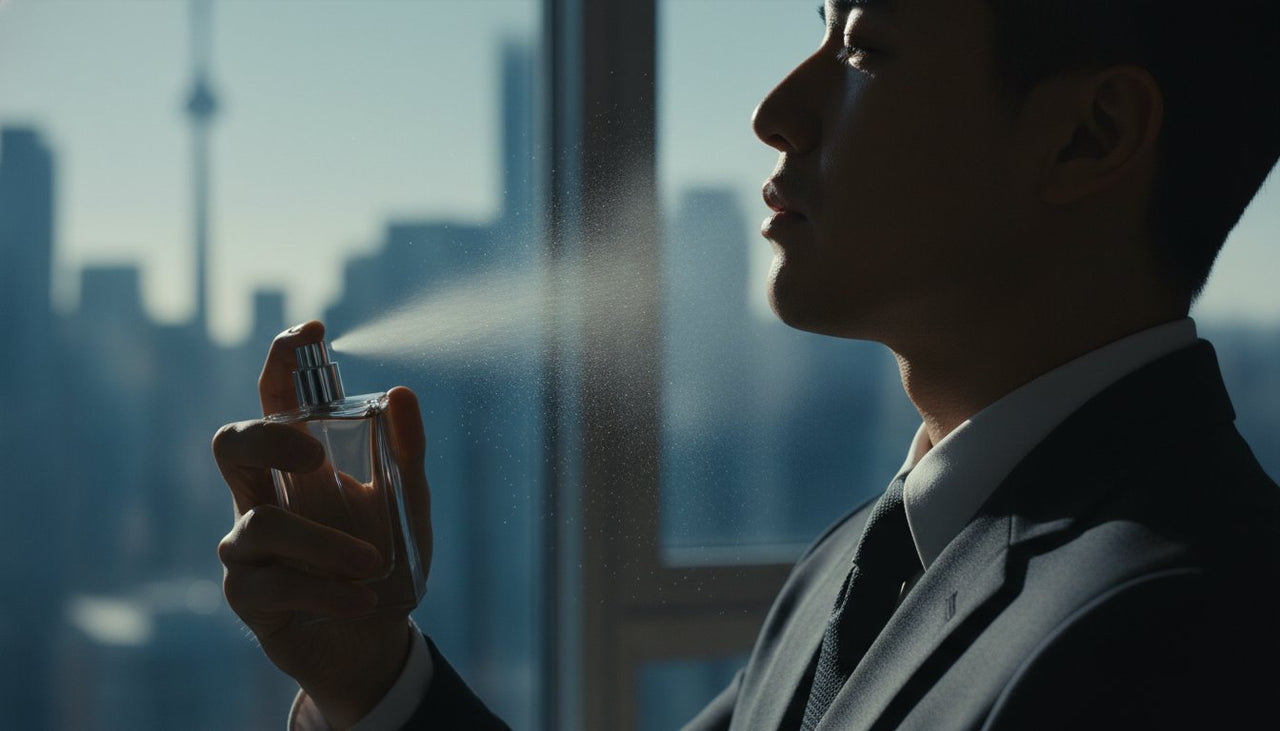
A premium fragrance is not a cosmetic accessory; it is a precision instrument that requires a calibrated operator. Most enthusiasts treat their C$250 bottle like a common body spray, resulting in a scent that evaporates before the first morning meeting. Mastering how to use perfume is about understanding the thermal dynamics of your own skin. In the dry, 15 percent humidity of a Montreal winter, your application technique determines whether your signature scent projects with authority or vanishes into the cold air.
It's frustrating when a complex Eau de Parfum smells divine in the bottle but turns unrecognizable on your wrist within 120 minutes. You've likely felt the sting of a scent that chokes out a room or, conversely, disappears before you've even finished your first coffee. You deserve a sillage that remains consistent without overwhelming the boardroom. This guide provides the technical blueprint for scent longevity and precision layering. We will analyze the specific physics of pulse points, the architecture of fragrance notes, and the exact spray count required to maintain the Ephyr standard of excellence throughout the day.
Key Takeaways
- Treat your fragrance as an invisible garment. Learn to apply scent as the final, technical layer that completes your personal aesthetic.
- Master the physics of heat. Discover the master craftsman's blueprint on how to use perfume to ensure precision projection from your primary pulse points.
- Eliminate the "wrist rub" tragedy. Stop the common application myths that bruise delicate top notes and compromise the integrity of your scent profile.
- Defeat the Canadian "scent eater." Use the Moisture Lock technique to create a humectant barrier that prevents fragrance evaporation in cold, dry air.
- Adopt the Ephyr Standard. Understand why curated sampling of elite niche brands is the only way to secure a signature scent that truly performs.
The Architecture of Scent: Why Application is an Invisible Garment
Perfumery doesn't end at the bottling line. It ends on your skin. Think of scent application as the final movement in a complex artistic process. A master perfumer creates the formula, but you execute the delivery. This is your invisible garment. It's a layer that completes your persona, providing a finished edge to your silhouette that fabric cannot achieve. Just as a high-end workstation requires precise thermal management to function, a fragrance requires a strategic interface with your body to perform. Mastering how to use perfume is about understanding this biological hardware.
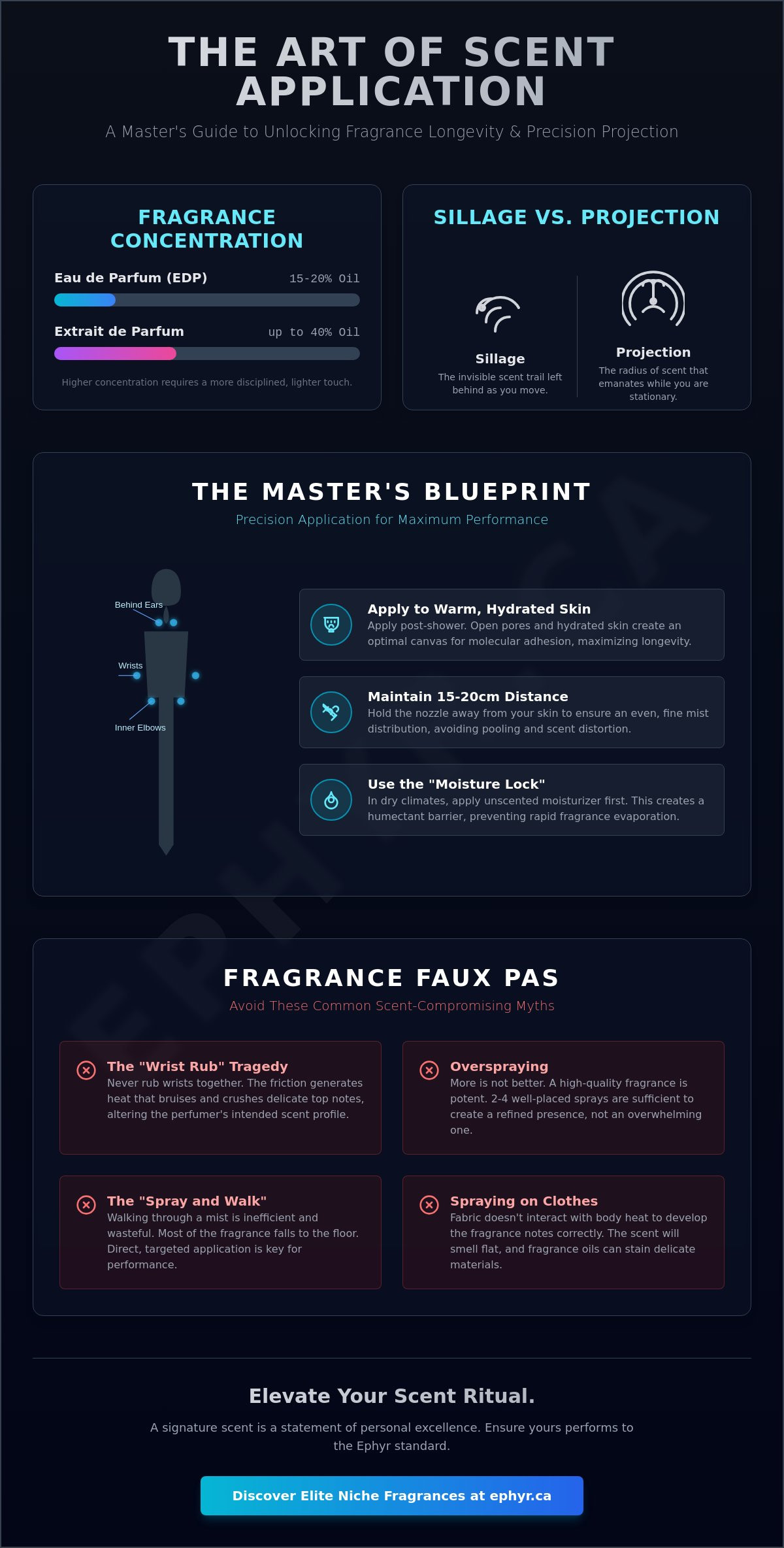
Fragrance isn't a static accessory. It's a living, breathing entity that reacts to your specific biology. The relationship between concentration and application style is critical. An Eau de Parfum (EDP) typically carries 15 to 20 percent fragrance oil, while an Extrait de Parfum can reach 40 percent. These aren't just statistics on a spec sheet. They dictate your strategy. High-concentration blends are dense and potent. They require a disciplined, lighter touch. Over-applying a high-end Extrait is like overclocking a processor without a cooling solution; the result is a crashed sensory experience for everyone in the room.
The history of perfumery reveals that scent has always been an intimate dialogue between the liquid and the wearer. Modern application is no different. It's a technical skill that demands precision. When you learn how to use perfume correctly, you transform a simple product into a bespoke signature. This is the Ephyr standard: uncompromising quality met with expert execution.
Understanding Sillage and Projection
Sillage is the trail. It's the invisible wake you leave in the air as you move through a space. Projection is the radius. It measures how far the scent travels from your body while you're stationary. In the niche fragrance world, efficiency always beats volume. A scent with 12 hours of longevity doesn't need six sprays. Two well-placed mists offer a cleaner, more professional signal. More isn't better. Better is better. High-quality ingredients provide a clear signal without the need for excessive decibels.
The Role of Skin Chemistry
Your skin is the canvas. It's a complex environment of pH levels, lipid content, and temperature. These biological markers act as variables in the final scent profile. This explains why a C$400 bottle smells distinct on every individual. Paper strips are for laboratory testing; skin is for the real world. Testing on your wrist allows the heat of your blood to activate the molecules. This creates a unique finish that belongs only to you. It's the ultimate form of personalization, turning a luxury item into a one-of-one original.
The Master Craftsman’s Blueprint: Where and How to Spray
Mastering scent application is an exercise in managing thermal energy. Your pulse points act as natural diffusers. These specific zones, where blood vessels sit closest to the skin, generate consistent heat. This warmth acts as a catalyst for evaporation, projecting the fragrance molecules into the air. To understand how to use perfume with professional precision, you must treat your body like a high-performance instrument. Apply your scent immediately after a warm shower. Your pores are open; your skin is hydrated. This creates an optimal environment for molecular adhesion, ensuring the scent doesn't simply evaporate into nothingness.
Precision requires the correct distance. Hold the nozzle exactly 15 to 20 centimetres from your skin. This ensures the mist distributes evenly across the surface area. Spraying too close leads to pooling, which can cause the alcohol to distort the fragrance profile. For those focused on skin health, reviewing fragrance safety regulations provides clarity on how ingredients interact with your biology. A controlled, measured application is the hallmark of a refined routine. It's about efficiency, not volume.
Targeting the Pulse Points
The neck and wrists are standard, but the master craftsman utilizes tactical locations for maximum impact. A single spray behind each ear is essential for creating sillage. As you move, the scent trail follows your kinetic path, leaving a subtle signature in your wake. The inner elbows are a secret weapon for longevity. Unlike wrists, which often rub against sleeves or workstations, the inner elbow is protected. This isolation allows the fragrance to remain intact for up to 10 hours. For a sophisticated alternative, use a dedicated hair mist. Hair is naturally porous; it holds scent longer than skin while providing a constant, airy release of notes. This level of detail represents the Ephyr standard of personal presentation.
The Mist vs. Direct Spray Technique
The "walk through the cloud" method is a technical failure. It's a waste of 70 percent of your liquid, which ends up on the floor rather than your skin. Direct skin contact is the only way to anchor heavy base notes like oud, amber, or cedarwood. These dense molecules require body heat to evolve through their intended olfactory layers. Precision application ensures the fragrance develops its full architectural depth over time. For high-end niche scents, the sweet spot for application is typically 2 to 4 sprays. This ensures a professional projection that commands the room without overwhelming it. Every spray should be a calculated decision.
Fragrance Faux Pas: Deconstructing Common Application Myths
Precision is the difference between a masterpiece and a mess. In the world of high-end scents, application is a technical skill. Most people approach their bottles with enthusiasm but lack the discipline required for peak performance. Understanding how to use perfume effectively means unlearning habits that actively degrade the product. Scent is a volatile medium. It requires a controlled environment and a steady hand to reach its full potential.
The Chemistry of Friction
Stop rubbing your wrists together. It is a common reflex that serves as a ritual of destruction. When you rub your skin, you create kinetic energy that spikes the surface temperature. This heat forces the delicate top notes to evaporate prematurely. You are effectively bruising the fragrance's opening narrative. Instead of a balanced introduction, you get a distorted, rushed version of the scent profile.
The Ephyr approach favors the "tap" method. Apply the liquid to one pulse point and gently touch it to the other. Do not grind the skin. Let the alcohol carrier evaporate naturally. This patience preserves the olfactory pyramid; it allows the transition from top notes to heart notes to happen on the perfumer's timeline. Think of it as thermal optimization for your skin.
Environmental Hazards for Your Bottle
Your bathroom is a graveyard for quality liquid. The rapid fluctuations in temperature and humidity act as a catalyst for chemical decay. Steam from your morning shower dismantles molecular bonds. This process leads to oxidation, which fundamentally alters the scent you paid for. If you want to protect your luxury fragrance samples canada, keep them in a cool, dark, and dry space. A dedicated drawer or a shelf away from direct sunlight is the professional standard.
- Oxidation Signs: Look for a darkening of the liquid or a metallic, vinegar-like odor.
- Storage Rule: Maintain a consistent temperature. Avoid windowsills at all costs.
- Integrity Check: If the juice becomes cloudy, the essential oils have likely separated.
There is a persistent myth that a high price tag guarantees eternal longevity. This is false. Many bespoke scents rely on rare, natural ingredients. These extracts are inherently more volatile than the heavy synthetics found in mass-market products. A C$400 bottle featuring natural citrus might only last five hours. That is not a failure of quality; it is a reality of the ingredients' molecular weight. Over-spraying to compensate for this is a tactical error. It creates an olfactory assault rather than an alluring aura. Mastering how to use perfume means respecting the limits of the ingredients. Two to three sprays are usually the threshold for a sophisticated presence. Anything more is just noise.
Mastering the Elements: Adapting Scent to the Canadian Climate
Canadian air is a notorious scent eater. In cities like Montreal, humidity levels often drop below 20 percent during the winter months. Dry air acts as a vacuum for moisture; it pulls fragrance molecules off your skin before they have the chance to develop. Mastering how to use perfume in these unforgiving conditions requires a technical approach to surface preparation. You need a humectant barrier. This Moisture Lock technique involves applying unscented lotion to trap the fragrance. It’s about thermal optimization for the body.
Longevity depends on structural integrity. Combine a matching body cream with high-performance cologne for men to build a resilient base. As temperatures drop below zero, switch your palette. Airy citruses fail in the cold. They lack the molecular weight to project through heavy layers of wool. Transition to heavy ambers, resins, and woods. These notes possess the density required to pierce through the frost and maintain their presence.
Hydration as a Fragrance Primer
Hydrated skin is a superior canvas. Dry skin is porous and absorbs scent oils too quickly, effectively killing the projection. Apply a thin layer of petroleum jelly to your pulse points before spraying. This creates a non-porous anchor that holds the scent on the surface. Focus on oil-based carriers. They mirror the craftsmanship of a well-tuned machine, providing a steady, bottleneck-free release of aroma throughout a 12-hour day. It’s a bespoke solution for a harsh climate.
Clothing vs. Skin: The Hybrid Approach
Skin provides the warmth necessary for top notes to bloom, but fabric offers endurance. Natural fibers like wool and cotton are excellent scent reservoirs. They can hold a profile for 48 hours or more. Spraying a scarf creates a scent cocoon that stays active even when you're bundled up for a commute. Be precise with your application. Avoid silk and light suedes. Alcohol-based sprays can cause permanent discoloration on delicate C$500 accessories. A hybrid strategy ensures your presence remains felt from the street to the studio.
Elevating Your Ritual with Maison Ephyr
Mastering the technical nuances of how to use perfume is only the first phase of the journey. The second phase involves the quality of the materials. At Maison Ephyr, we view fragrance as liquid architecture. It is an extension of your personal space, requiring the same precision and thermal optimization as a high-end workstation. We move beyond the loud, mass-market scents found in department stores. Our focus remains on the Ephyr Standard. This means a curated selection of niche houses like Amouage, Xerjoff, and Nishane. These are not merely products; they are individually tuned instruments designed for those who value depth over volume.
Expert guidance helps you break the cycle of generic application. Most people spray without intent. We teach you to apply with purpose. Our approach treats high-end perfumery as a form of functional art. Every bottle in our collection represents a commitment to uncompromising performance and aesthetic discipline. We invite you to explore our studio of scents, where the unseen details of sillage and longevity are prioritized above all else.
The Path to a Signature Scent
Commitment should never be blind. Finding a signature requires a rigorous testing phase. Our 1ml samples serve as your diagnostic tool. Use these vials to evaluate how a fragrance reacts to your unique skin chemistry across different environments. A scent might perform beautifully in a climate-controlled office but shift during a humid evening in Toronto. Living with a scent for three to five days is the only way to understand its full lifecycle. It allows you to witness the transition from the volatile top notes to the enduring base. This process ensures you don't just buy a bottle; you invest in a long-term companion. Based in Montreal, we guarantee 100% authenticity on every decant. Our logistics network ensures fast national shipping across Canada, delivering your next olfactory discovery directly to your door with professional speed.
Curating a Fragrance Wardrobe
The concept of a single "daily driver" is a relic of the past. A master craftsman understands that different tasks require different tools. Your ritual should evolve based on the occasion. A business meeting demands a scent applied with surgical precision, perhaps two sprays to the chest to maintain a professional bubble. A black-tie gala allows for a more expansive presence, utilizing pulse points to increase projection. This is the art of curating a fragrance wardrobe. You are building a toolkit for every mood and environment. By selecting specific scents for specific moments, you ensure your presence is always calibrated for peak performance. The right fragrance doesn't just sit on the skin. It integrates with your identity. Start building your bespoke collection today. Explore our curated collection at Maison Ephyr.
Mastering the Final Layer of Your Personal Architecture
Scent isn't just a fragrance; it's a structural element of your daily presentation. You've now mastered the technical precision of how to use perfume by treating it as an invisible garment. Rubbing your wrists is a design flaw that compromises the scent's integrity. Instead, apply with intent to your pulse points. Whether you're navigating a -20°C Montreal winter or a humid Ontario afternoon, your application must adapt to the environment. This level of detail separates the enthusiast from the true connoisseur.
At Maison Ephyr, we serve as the bridge between raw olfactory power and refined luxury. We're an official retailer for world-class houses like Amouage, Xerjoff, and Nishane. Our team provides expert olfactory guidance to ensure your scent profile remains bespoke and bottleneck-free. We prioritize technical excellence with fast, reliable shipping to every province across Canada. It's time to elevate your ritual from a simple spray to a disciplined art form.
Discover your next signature scent with our Niche Discovery Sets
Step into the world with the quiet confidence of a master craftsman. Your olfactory masterpiece is ready for its first wear.
Frequently Asked Questions
How many sprays of perfume is too much?
Three to five sprays is the standard limit for most Canadian office environments. Applying more than five sprays of a high concentration Eau de Parfum creates a scent cloud that can overwhelm a 10 square metre room. Precision is key; you want an intimate sillage rather than a chemical broadcast. Stick to the pulse points to ensure the fragrance performs as intended without becoming a distraction.
Should I spray perfume on my clothes or my skin?
Always apply perfume directly to your skin to allow the fragrance to evolve with your natural body chemistry. The heat from your pulse points, like the wrists and neck, acts as a thermal engine for the scent. While spraying clothes can help the scent last, it prevents the complex transition from top notes to base notes. For the best results on how to use perfume, aim for clean, hydrated skin.
Why can't I smell my own perfume after an hour?
Your brain likely shut down the signal through a process called olfactory fatigue, which often happens within 15 to 30 minutes of application. This is a biological filter designed to prevent sensory overload. Just because you can't detect the notes doesn't mean the fragrance has dissipated. Ask a friend for a scent check before you reach for the bottle again. Over-applying due to fatigue is a common amateur mistake.
Does rubbing your wrists together really ruin the perfume?
Rubbing your wrists together creates friction that generates heat, which prematurely breaks down the delicate top note molecules. This physical agitation bruises the scent profile, causing the bright citrus or floral openings to vanish instantly. Instead, spray each wrist from a distance of 15 centimetres and let the liquid air-dry. This preservation of the molecular structure is the Ephyr standard for scent integrity.
What is the best time of day to apply fragrance?
The optimal time for application is immediately after a warm shower when your pores are open and your skin is still slightly damp. Mastering how to use perfume requires understanding the role of skin temperature and moisture. Applying at 8:00 AM after your morning routine ensures the scent develops fully by the time you reach your first meeting. It's about building a foundation for 12 hour performance.
Can I spray perfume in my hair?
You can spray perfume in your hair, but you should apply it to a brush first to avoid the drying effects of high alcohol content. Hair is porous and holds scent longer than skin, acting as an excellent secondary diffuser. However, direct application can lead to brittle strands over a 6 month period of daily use. Use this technique sparingly to create a subtle scent trail as you move.
How do I make my perfume last longer in dry weather?
To extend longevity in dry Canadian winters, apply an unscented moisturizer or petroleum jelly to your pulse points before spraying. Dry skin absorbs fragrance oils too quickly, which kills the projection. By creating a lipid barrier, you trap the scent on the surface for an extra 4 to 5 hours. This technical adjustment is essential when the humidity drops below 30 percent in cities like Calgary or Winnipeg.
Does perfume expire if I don't use it quickly?
Most fragrances have a shelf life of 3 to 5 years if stored in a cool, dark environment away from bathroom humidity. You'll know a bottle has expired when the liquid darkens or develops a sour, vinegar-like odor. Oxidation is the primary enemy of artisanal builds. Keeping your collection in a dedicated drawer at a consistent 18 degrees Celsius will protect your investment for the long term.


