
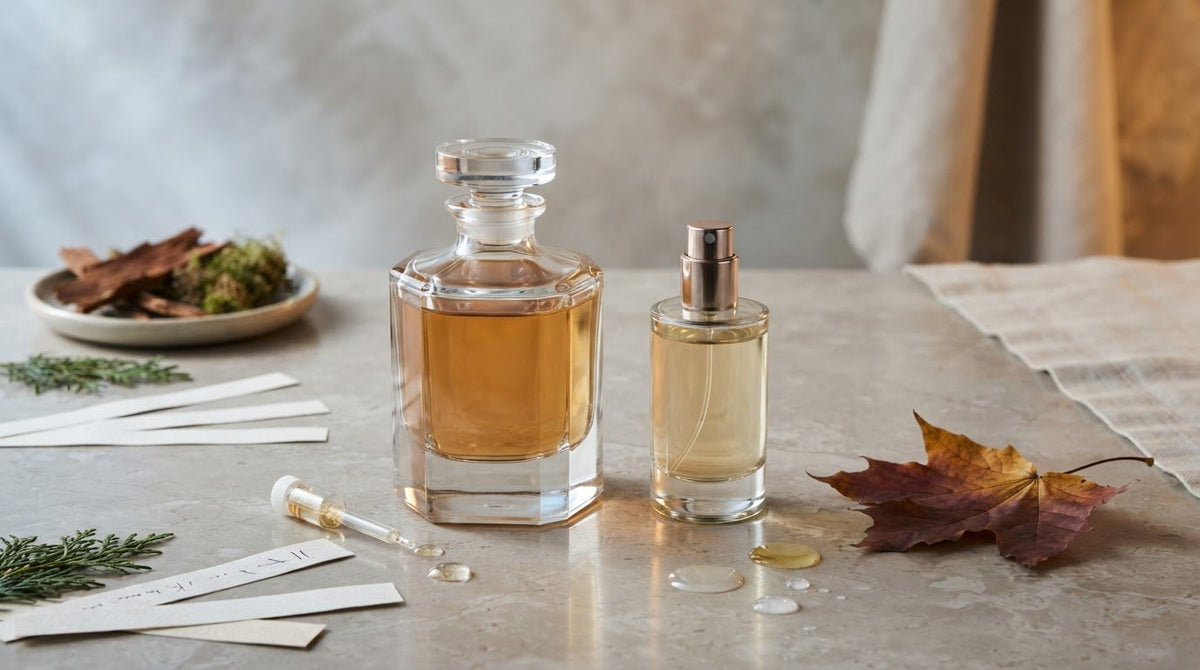
A fragrance can echo a luxury scent without pretending to be it. That’s the key distinction when comparing perfume dupes vs original fragrances: a dupe is a separate fragrance inspired by a scent profile, while a counterfeit claims another brand’s identity. Dupes are legal, though quality and ingredient safety vary.
The appeal makes sense. You may want a familiar scent style without committing to a bottle you’ll rarely wear. Think of a dupe as a sketch of a scent’s silhouette, not an exact portrait. It may capture the opening, then take its own path on your skin.
Here, you’ll learn how dupes, clones, alternatives and counterfeits differ, what affects their cost in Canada, and how longevity shapes the choice. By the end, you’ll have a clearer way to choose a fragrance that suits your day, taste and budget.
Key Takeaways
- Tell an inspired fragrance apart from a counterfeit by looking at whether it has its own identity or pretends to be another brand.
- Compare value by considering bottle size and how often you’ll wear the scent, not just the upfront cost.
- Use the terms “dupe,” “clone” and “alternative” as clues to a fragrance’s relationship to the scent that inspired it.
- Assess longevity on your own skin; concentration, scent composition and skin chemistry all influence how a fragrance develops and lasts.
- Explore original niche fragrances through 1ml samples, including selections from Xerjoff, Nishane and Casamorati.
Are fragrance dupes the same as counterfeit perfumes?
No. An inspired fragrance is a separate perfume designed to resemble a popular scent profile. A counterfeit tries to pass itself off as the original brand, often through copied branding or packaging. Fragrance dupes are legal, but quality and ingredient safety vary between brands. That distinction matters when comparing perfume dupes with an original fragrance.
Original perfumery is a crafted composition, not just a familiar opening note. Perfumers may spend years perfecting an original fragrance, balancing its materials, transitions and overall character. A dupe might capture the first impression, such as a sweet vanilla accord, yet develop differently on skin. An original has its own creative direction, while an inspired scent takes an existing profile as its reference point.
Safety deserves careful consideration. Fragrance ingredients can trigger sensitivities, and the quality and safety of dupe ingredients vary. Read the product’s ingredient information, especially if you already know a particular material affects you. Patch test any new fragrance before wearing it broadly: apply a small amount to a limited area and observe your skin. A familiar smell doesn’t mean the ingredients are familiar.
Season and setting can help guide your choice. A light, fresh fragrance may feel easier to wear during a warm Canadian summer day, while a richer amber or gourmand may suit colder weather or an evening out. These are preferences, not fixed rules. Test a fragrance in the conditions where you plan to wear it, since heat, clothing and indoor spaces can affect how noticeable it feels.
Your choice can also reflect what you value. An original may appeal if you care about a perfumer’s distinct composition and the experience behind it. An inspired fragrance may suit someone seeking a familiar scent style at a lower cost. Ethical concerns arise when a product borrows another perfume’s identity too closely. A separate name and presentation signal inspiration; copied logos or packaging can mislead buyers about what they’re purchasing.
| Option | Identity | Craft and experience | Safety considerations |
|---|---|---|---|
| Original | Distinct brand and composition | Created as its own fragrance; development may take years | Review ingredients and patch test |
| Dupe or inspired fragrance | Separate scent inspired by a popular profile | May resemble an opening, with different development | Quality and ingredient safety vary |
| Counterfeit | Attempts to appear as the original brand | Misrepresents its identity | Do not assume copied branding verifies contents |
Choose an original for its individual composition, an inspired scent for a similar profile, and avoid products that misrepresent their brand identity.
Budget-friendly ways to try perfume
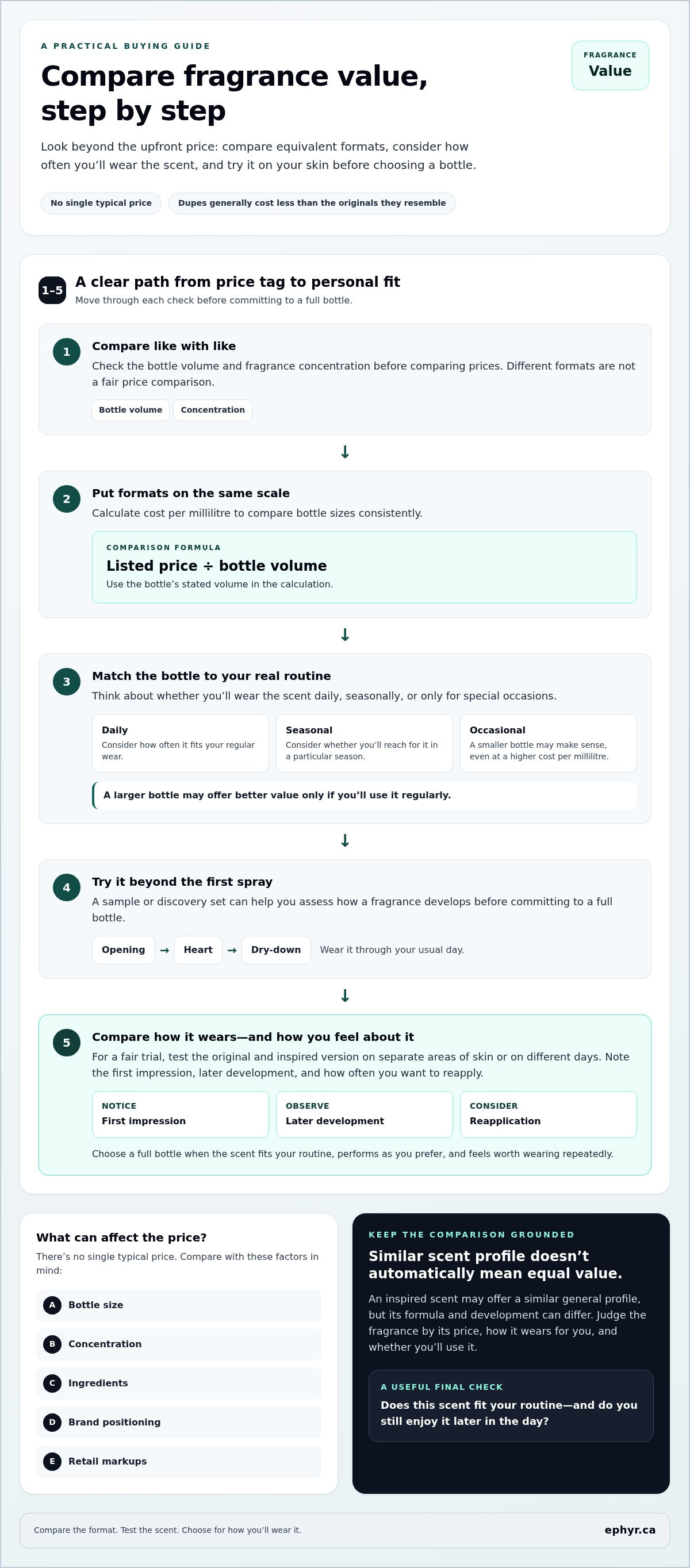
In Canada, dupes generally cost less than the original fragrances they resemble, but there’s no single typical price. Bottle size, concentration, ingredients, brand positioning and retail markups all affect the price, so compare the same volume and format.
Canadian retailers selling inspired fragrances include independent perfume boutiques and beauty shops with their own scent lines. A retailer’s reputation alone doesn’t establish a fragrance’s quality. Look for a clear product identity, ingredient information and packaging that doesn’t pretend to be another brand.
Start with the smallest practical format before committing to a full bottle. A sample or discovery set lets you assess more than the first spray. Wear the fragrance through its opening, heart and dry-down, then decide whether you still enjoy it later in the day.
- Compare like with like: Check the bottle volume and fragrance concentration before comparing prices.
- Calculate cost per millilitre: Divide the listed price by the bottle’s volume to compare formats consistently.
- Track actual use: Consider whether you’ll wear the scent daily, seasonally or only for special occasions.
- Test before buying: Try a sample on skin and note how the scent develops during your usual day.
A smaller bottle can make sense for occasional wear, even when its cost per millilitre is higher. A larger bottle may offer better value only if you’ll use it regularly. For example, a bold evening fragrance might sit untouched during the workweek, while a softer everyday scent gets more frequent use.
Also consider what the price reflects. Original designer and niche fragrances can carry costs associated with branding, packaging, retail markups, distribution and ingredient sourcing. A lower-priced inspired scent may offer a similar general profile, but its formula and development can differ. Similarity alone doesn’t establish equal value.
For a fair trial, test the original and inspired version on separate areas of skin or on different days. Note the first impression, later development and how often you want to reapply. This simple comparison can distinguish an enjoyable scent from one that appeals only during a brief visit to a shop.
Set a budget based on how you’ll wear the fragrance, not just the bottle. If you’re still deciding, sample formats can limit the commitment while helping you explore fragrance styles. Choose a full bottle when the scent fits your routine, performs as you prefer and feels worth wearing repeatedly.
There’s no typical price range: dupes generally cost less than the original fragrances they resemble. Prices vary with bottle size, concentration, ingredients, brand positioning and retail markups.
Differences between dupes, clones, and alternatives
A dupe resembles a popular fragrance profile, while an original designer fragrance has its own composition and identity. The degree of similarity varies: a clone usually aims for a closer resemblance, while an alternative can share a general mood without closely matching one perfume.
Perfume Dupes and Original Designer Fragrances
A dupe is a separate fragrance built around a recognizable scent profile. For example, it might echo a perfume’s rose, musk and amber character without copying its name or packaging. An original designer fragrance is composed and presented as that brand’s own creation. Compare them beyond the opening: the heart and dry-down can reveal differences in balance, texture and direction.
Clones and Original Scent Similarity
A clone generally suggests a closer recreation of an original’s scent DNA than the broader term “dupe.” That aim doesn’t make the formulas identical. For example, two perfumes may both open with citrus and woods, yet differ as the citrus fades or the woods become more prominent. Test each on skin, then compare the opening, later development and overall character.
Alternatives to Original Fragrances
An alternative is the broadest label. It describes a fragrance with a similar style or mood, rather than promising a close match to one named perfume. A fresh, woody alternative might appeal to someone who enjoys that general direction, even if it uses different notes and develops differently. Choose an alternative by identifying the qualities you want, such as a crisp opening or a soft, warm finish.
Labels can guide expectations, but they don’t establish a precise scale of similarity. One seller may use “clone” for a close interpretation; another may use “dupe” for a looser resemblance. Treat the wording as a starting point, then assess the fragrance itself. For a fair comparison, wear each scent separately and note its opening, heart and dry-down. A blotter can help compare first impressions, but skin shows how each fragrance behaves as you wear it.
Use this quick decision path: choose a dupe if you want a familiar scent profile at a lower cost; consider a clone if closeness to a particular scent matters most; pick an alternative if you want the same general mood without a near-recreation. If the original’s precise evolution is the point, its own composition remains the clearest reference. The best label is the one that sets an honest expectation for the scent you’ll actually wear.
Dupes versus counterfeit perfumes
In Canada, fragrance dupes are legal, while counterfeit perfumes attempt to pass themselves off as another brand’s product. A separate scent inspired by a popular profile differs from a bottle carrying copied branding and packaging. The key test is identity: does the product present itself as its own fragrance, or pretend to be the original?
Look beyond a similar scent description. A legitimate inspired fragrance can describe its style, such as a warm amber profile, while using its own name and presentation. A counterfeit may imitate a brand name, logo, bottle design or box to create the impression that it came from that brand. Similar notes alone don’t make a fragrance counterfeit.
Use a simple inspection before buying online or in person. Read the product name and seller description, then examine the bottle and box. Check whether the packaging consistently identifies one fragrance brand. For example, a bottle named as an independent amber scent differs from one labelled with a luxury house’s name despite being sold as an imitation.
- Read the label: Look for the fragrance’s own name and brand identity.
- Inspect the box: Notice copied logos, brand names or distinctive packaging.
- Compare the listing: Check whether the seller describes an inspired scent or claims it is the original.
- Watch for mixed signals: An independent product name paired with another brand’s logo deserves caution.
Presentation matters because fragrance descriptions can be imprecise. Words such as “inspired by” may communicate a similar style, but they don’t establish that the formula matches the reference. A seller might describe a scent as resembling a rose-and-musk perfume. That comparison differs from claiming the bottle itself is made by the original brand.
Packaging can offer clues, but scent similarity cannot verify authenticity. A counterfeit may smell close, while a genuine original can smell different to you because of skin chemistry or storage conditions. Use brand identity and product presentation as your first checks. Don’t rely on a familiar opening note as proof.
For a practical decision, separate three questions: who made the fragrance, what identity does the packaging claim, and what scent profile does the description promise? A clearly named independent perfume can be an inspired option. A bottle presented as Chanel, Dior or another original brand, while its identity is uncertain, raises a different concern. This distinction keeps resemblance separate from misrepresentation.
Choose an inspired fragrance when you want a similar style under its own identity. Treat copied brand presentation as a warning sign, not a shortcut to a bargain. Checking the label and packaging gives you a clearer basis for deciding what you’re buying.
Longevity and reapplication
A dupe can open close to its reference, then shift in unexpected ways an hour or two later. Longevity also varies with concentration, ingredient quality, scent category and individual skin chemistry. Compare both fragrances over a full day, not just during the first few minutes.
Skin oils, hydration and body temperature can change how a perfume smells. Environment and climate matter, too. A fragrance worn on a warm Canadian afternoon may project differently from the same scent in a cool, dry room. Your own wear test gives more useful evidence than another person’s spray count.
Use a simple comparison routine:
- Apply each fragrance on separate days, using the same number of sprays.
- Record the opening, the scent after an hour or two, and the later dry-down.
- Note projection, the distance a scent radiates, separately from sillage, its trail as you move.
- Track when you want to reapply, rather than relying on memory.
A wear test can reveal a practical difference: a dupe may resemble an original at first, yet fade or change sooner. Some wearers may need to reapply a dupe two or three times before afternoon. That experience isn’t universal, so compare it with your own routine and the original’s performance on your skin.
Application can influence the result. Moisturized skin may help a fragrance last longer. Pulse points are common application areas, and rubbing the skin after spraying can alter the scent’s development. Try applying to moisturized skin, allow the fragrance to settle and avoid rubbing. Use the same approach for both perfumes to make your comparison fair.
Spray count should reflect the fragrance’s character and setting. As a starting point, the guidance here suggests 4-6 sprays for fresh fragrances, 1-3 for strong oud or dark scents, and 2-4 for sweet amber or gourmand styles. These are not targets to chase. Adjust for close indoor spaces, personal comfort and the fragrance’s projection.
In a perfume-dupe-versus-original comparison, judge value by the wear you actually get. If a lower-cost scent needs repeated reapplication, its upfront savings may feel less compelling. If both fragrances suit your routine, a dupe may meet your needs. Test a 1ml fragrance sample to observe how a scent develops on your skin before choosing a full bottle.
Maison Ephyr: Xerjoff Fragrances
Maison Ephyr offers Xerjoff Fragrances for readers drawn to original niche compositions rather than scent approximations. If you’re still comparing profiles, 1ml fragrance samples offer a practical way to experience a fragrance on your own skin before choosing a full bottle. The selection also includes Nishane Fragrances and Casamorati, giving you distinct creative directions to explore. Focus on how each scent develops, how it fits your routine, and whether its character feels right to you. That’s a more personal comparison than relying on a dupe’s resemblance alone.
To explore original fragrances or ask Maison Ephyr a question, visit ephyr.ca.
Choose a scent that feels like yours
The perfume dupes vs. original decision can be an opportunity to define what you want fragrance to do for you. Is it a quiet signature for everyday wear, a creative accent for a particular mood, or a scent you’ll remember years from now? Let that intention guide your next test. Notice which compositions feel distinctive, comfortable and worth returning to, rather than choosing by resemblance alone.
If you’re ready to explore original fragrances, Maison Ephyr offers Amouage, Xerjoff and Nishane. Consider how each scent fits your preferences, then choose at your own pace. The right fragrance doesn’t need to imitate someone else’s signature. It can become part of yours.
Contact Maison Ephyr for fragrance advice, and take your next step toward a scent that feels personal.
Frequently Asked Questions
Are original perfumes always a better choice than dupes?
No. The better choice depends on what you value: an original composition, a familiar scent style or room to experiment. For example, someone building a small fragrance wardrobe may prefer exploring different profiles over owning one signature bottle. Someone who loves a particular perfume’s full development may favour its original. Decide based on the experience you want, not the label alone.
Are fragrance dupes safe to wear?
Safety can vary between brands because formulas and ingredient quality differ. Read the product’s ingredient information, especially if you already know certain fragrance materials bother your skin. Don’t assume that a familiar scent profile uses the same ingredients as its inspiration. If you’re trying an unfamiliar fragrance, start with a patch test on a small area rather than applying it widely.
Can fragrance dupes cause skin irritation?
Yes. A fragrance dupe, like any scented product, can irritate skin or trigger a reaction in someone sensitive to an ingredient. A scent’s similarity to a perfume you tolerate doesn’t establish that its formula will suit you. Try a small patch test first, and stop using the fragrance if irritation appears. Be especially attentive when testing a new scent alongside other scented products.
What does “inspired by” mean legally in fragrance?
“Inspired by” describes a fragrance designed to resemble the style or profile of a popular perfume without copying its branding, packaging or trademarks. In Canada, fragrance dupes are described as legal; the key distinction is whether a product stands as its own fragrance or presents itself as another brand’s original. The phrase signals an intended resemblance, not identical ingredients or performance.
How do dupes compare with originals in longevity and projection?
There’s no fixed performance ranking: longevity and projection vary with concentration, ingredients, scent category and skin chemistry. A close-smelling dupe may wear differently from its reference, even if the opening seems similar. Compare them under the same conditions: use the same application approach, note how noticeable each remains, and record when you’d want to refresh it. Your own routine is the useful benchmark.
How can I identify a counterfeit perfume versus a legitimate dupe?
Read the product identity rather than relying on scent alone. A legitimate dupe uses its own name and branding while describing a resemblance; a counterfeit tries to appear as the original brand. For example, an independent perfume described as having a similar floral profile makes a different claim from a bottle presented as the luxury brand itself. Look for consistency between the label, packaging and product description.
Are perfume dupes worth buying compared with originals?
They can be worthwhile if you enjoy the scent profile and will wear the fragrance often. Think beyond the initial purchase: a perfume used daily may offer more practical value than one reserved for rare occasions. A dupe may suit experimentation, while an original can be preferable when its particular composition is what you want. Wearability, not resemblance alone, should guide your decision.
What are the pros and cons of perfume dupes versus original fragrances?
Dupes can make a familiar scent style easier to explore, but their formula, development and wear may differ from the reference. Originals offer their own compositions and creative identity, but may require a larger commitment if you’re unsure about a scent. For example, test an unfamiliar profile in a small format before choosing a full bottle. Then weigh how much distinctiveness, similarity and everyday use matter to you.
Article by
Dmitrii Savishin
Dmitrii Savishin is the founder of Maison Ephyr and Parfum Exquis, two Canadian destinations dedicated to the world of niche perfumery. With years of experience discovering exceptional fragrance houses from around the globe, Dmitrii shares expert insights on perfume trends, fragrance notes, luxury brands, and the art of choosing the perfect scent. His mission is to make niche perfumery more approachable while helping readers discover fragrances that leave a lasting impression.


