
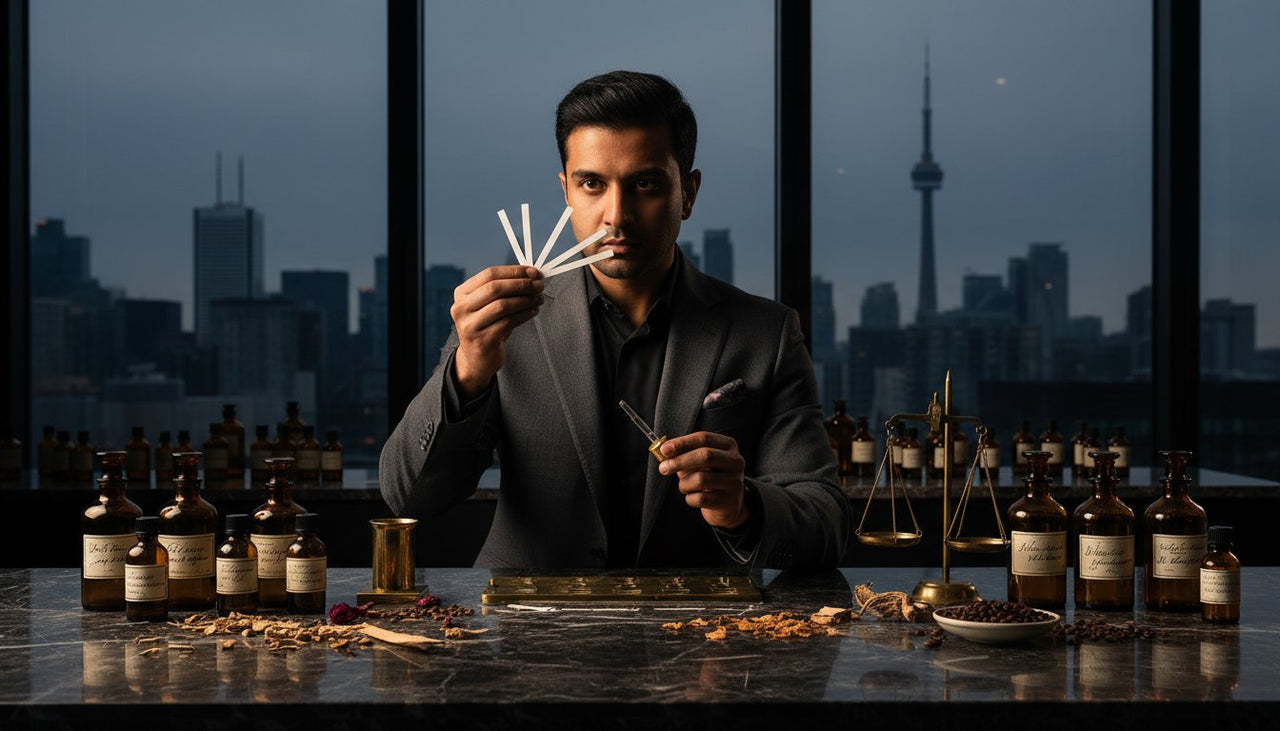
Your signature scent isn't a mere accessory; it's a precision-engineered invisible layer of your identity. A single 50ml bottle of niche extrait often contains over 85 individual raw materials balanced to a 0.01% margin of error. Most enthusiasts treat their morning routine as a simple habit, yet a high-performance fragrance is the most complex piece of functional art you'll ever wear. It requires the same level of calibration as a custom-built workstation to ensure the aromatic notes remain stable on your skin throughout the day.
You've likely spent C$380 on a luxury bottle only to find the scent profile collapses before your first morning meeting. In the cold, dry air of a Canadian winter, the evaporation rate of volatile top notes accelerates, making technical precision even more vital for longevity. We'll show you how to master the technical artistry of niche perfumery to curate a sophisticated wardrobe that defines your presence. We'll explore molecular weights and concentration levels to ensure your next investment delivers the uncompromising performance you expect.
Key Takeaways
- Learn to decode the olfactory architecture of high-end scents using the Ephyr Standard to assess technical quality and composition.
- Discover why artisanal niche houses prioritize raw material integrity over the mass-market appeal of typical designer labels.
- Use the technical Fragrance Wheel to pinpoint the specific notes that create a sophisticated, silent dialogue with your skin.
- Architect a bespoke wardrobe of scents that act as precision instruments for your daily moods and professional environments.
- Master the sampling process to ensure your next investment is a calculated choice rather than an expensive guess.
The Olfactory Architecture: Understanding the Language of Fragrance
A fragrance isn't just a pleasant smell. It's a highly engineered composition of raw botanicals and synthetic molecules. We treat it like a technical schematic. Every ingredient serves a purpose. Every molecule has a specific weight. This is the intersection of organic chemistry and bespoke artistry. At Ephyr, we evaluate every profile through the lens of The Ephyr Standard. This framework demands more than just a nice scent; it requires technical excellence, stability, and a narrative arc that holds up under scrutiny. It's about the "how" and "why" behind the bottle.
The emotional impact of scent is undeniable. It's the only sense with a direct line to the limbic system. A specific note can recall a memory from July 2004 with more clarity than a high-definition photograph. This makes the selection process vital. Finding your scent is an act of meticulous discovery. You aren't just shopping. You're sourcing a critical component for your personal identity. It's a disciplined search for a scent that aligns with your internal logic and aesthetic values. Precision matters here as much as it does in a workstation build.
The Olfactory Pyramid: Top, Heart, and Base Notes
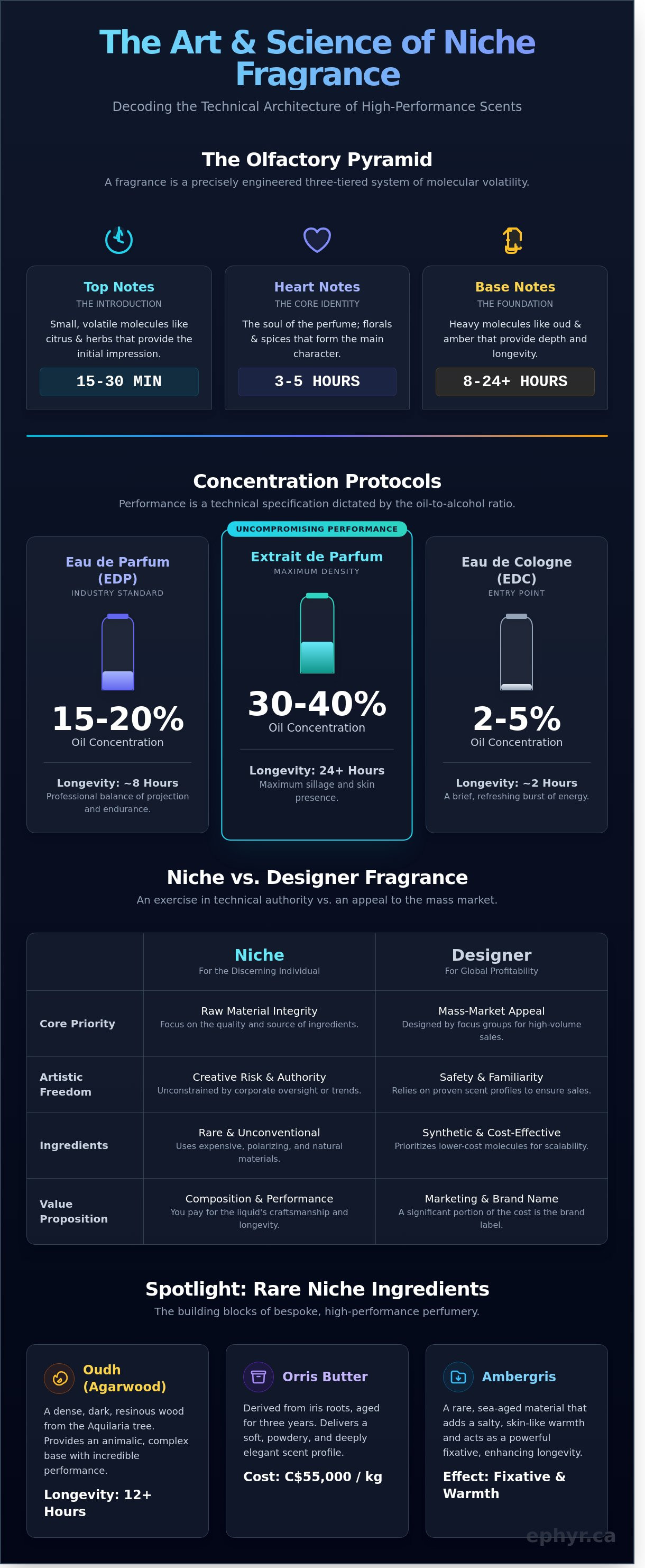
The Olfactory Architecture relies on a three-tiered system of volatility. Top notes are the first responders. Think of citrus, herbs, or light fruits. These molecules are small and fast. They provide an immediate hook but dissipate within 15 to 30 minutes. They're the initial handshake. Once they fade, the heart notes take over. This is the perfume's soul. Often composed of florals or heavy spices, these notes provide the core identity for three to five hours. Finally, the base notes arrive. These are the heavy hitters like oud, amber, or oakmoss. They provide the structural foundation and ensure the scent doesn't just vanish into the air. They're the long-term reliability of the composition.
Concentration Protocols: From Cologne to Extrait
Performance is dictated by the oil-to-alcohol ratio. This is a technical specification, not a suggestion. Eau de Cologne is the entry point, featuring a light 2% to 5% oil concentration. It's a brief burst of energy. Most niche fragrance enthusiasts prefer Eau de Parfum. At 15% to 20% concentration, it's the industry standard for a reason. It offers a professional balance of projection and 8-hour longevity. For those who demand uncompromising performance, Extrait de Parfum is the only choice. These blends often reach 30% or 40% concentration. They offer maximum sillage and can remain detectable on the skin for over 24 hours. It's a high-density experience for those who value precision over volume.
The Master Craftsman’s Perspective: Niche vs. Designer Fragrance
Designer scents target the masses. They rely on safety, focus groups, and high-volume sales to ensure global profitability. Niche perfumery is different. It’s an exercise in technical authority and creative risk. Houses like Amouage and Xerjoff don't chase seasonal trends; they engineer olfactory experiences for the discerning individual. These brands prioritize the raw material quality over the marketing budget. You might spend C$450 on a 50ml bottle, but you're paying for a 30% concentration of natural oils rather than a watered-down synthetic blend found in department store aisles.
High prices don't always guarantee a masterpiece. Some niche brands inflate costs through heavy crystal bottles or celebrity endorsements. Real value lives in the composition and the performance. A scent should last through a full workday in a climate-controlled office or a freezing Canadian winter night. Understanding the Niche vs. Designer Fragrance distinction helps you see past the label. It’s about the unseen details, much like the internal cable management in a high-end workstation. Your fragrance is a long-term investment in your personal brand. It's your signature.
Artistic Freedom and Unconventional Ingredients
Niche perfumers work without the constraints of corporate oversight. They use rare ingredients that designer brands find too expensive or too polarizing for a general audience. This freedom allows for a level of craftsmanship that feels bespoke and intentional.
- Oudh: A dense, resinous wood that provides a dark, animalic base that can last for 12 hours.
- Orris Butter: Derived from iris roots aged for three years, costing upwards of C$55,000 per kilogram.
- Ambergris: A rare, sea-aged material that adds a salty, skin-like warmth and incredible longevity.
Complex scents evolve. They move from bright top notes to deep, resinous bases over an eight-hour lifecycle. Linear scents remain static, smelling the same from the first spray to the dry down. For the professional who values precision, a complex fragrance offers a more rewarding narrative that changes with their environment.
The Role of the Independent Boutique
Mass-market retailers focus on rapid turnover and generic appeal. Independent boutiques in cities like Montreal and Toronto focus on the art of discovery. They offer curated collections that you won't find at every mall kiosk. This exclusivity ensures you don't smell like everyone else in the boardroom or the studio. It provides a sense of quiet confidence.
Authenticity is paramount. Buying from authorized Canadian retailers guarantees you aren't receiving a grey-market imitation or a degraded product. It’s about the bespoke feel of a scent that matches your specific aesthetic. Much like choosing precision-tuned hardware, selecting a niche scent is a deliberate act of curation. It signals a commitment to quality that transcends the ordinary and embraces the exceptional.
Decoding Your Profile: How to Identify Your Scent Signature
Choosing a scent is an exercise in technical calibration. It's a silent dialogue between the liquid and your biology. Think of your skin as a living resonator. It transforms a static fragrance into a personal broadcast. To begin this process, we utilize the Michael Edwards Fragrance Wheel. Developed in 1983, this tool provides a taxonomic map of the olfactory landscape. It allows you to move beyond simple preference into a space of technical precision. Your choice should reflect your internal aesthetic. It's the invisible layer of your personal architecture, much like the cable management in a high-end workstation.
A testing strip is a liar. It lacks warmth. It lacks moisture. On a paper card, a scent is a frozen snapshot. On your skin, it's a cinematic experience. The Olfactory Architecture: Understanding the Language of Fragrance reveals the complexity of these chemical layers. You aren't just wearing a smell; you're hosting a physical reaction. The heat from your pulse points drives the evaporation of top notes, while your skin's unique texture anchors the base.
Navigating the Major Fragrance Families
Woody and Oriental profiles offer structural depth. They utilize resins and heavy woods like Sandalwood or Oud to create a sense of grounded authority. These are the foundations of niche perfumery. For daily wear, Fresh and Citrus scents provide surgical precision. They use bergamot and neroli to cut through the ambient noise of a busy city. Modern niche houses now blend Floral and Gourmand notes with unexpected elements like saffron or leather. This creates a 360-degree sensory profile that feels sophisticated rather than sugary. It’s a bold choice for those who value complexity.
The Science of Skin Chemistry
Your skin pH, typically ranging from 4.7 to 5.7, dictates how molecules evaporate. Oily skin holds fragrance longer because the sebum traps the oils. Dry skin consumes it rapidly. Diet also plays a role. A 2006 study suggested that high-spice diets can alter sweat composition, which shifts how a scent projects. Climate is another variable to track. Montreal's humid summers will amplify heavy, resinous notes. A dry Calgary winter might mute them entirely. Follow this eight-hour protocol for every potential purchase:
- Hour 0: Apply to the pulse point. Don't rub the skin. Let the top notes settle.
- Hour 2: Evaluate the heart notes. This is the scent's true character and core identity.
- Hour 8: Check the base notes. If the dry-down is still present and pleasant, the build is solid.
Investing C$250 or more in a niche bottle requires this level of due diligence. It's about finding the specific formula that aligns with your biology. When the chemistry is right, the scent becomes a signature of excellence. It's an uncompromising standard of personal presentation.
Building a Fragrance Wardrobe: A Step-by-Step How-To
Think of your collection as a set of precision instruments. You don't use a hammer for a surgical cut. Each scent serves a specific psychological and environmental purpose. High-performance wardrobes require variety to combat olfactory fatigue. This is a physiological process where your brain filters out a constant scent after 15 to 20 minutes. Rotating your scents daily keeps your sensory perception sharp and ensures you actually experience the notes you paid for.
Preservation is a matter of chemical engineering. Light and heat are the primary enemies of fragrance integrity. Store your bottles at a consistent 16 to 18 degrees Celsius in a dark environment. Avoid the bathroom entirely; humidity fluctuations can degrade delicate top notes within 12 months. Application also requires a technical touch. Don't rub your wrists together. This creates friction heat that shears the molecular bonds of the scent. Spray from 15 centimeters away to allow for even distribution. Target pulse points for immediate projection, but apply to clothing fibers if you require 48-hour longevity.
Seasonal Calibration for the Canadian Climate
The Canadian climate demands extreme shifts in your scent profile. When the mercury hits -25 degrees Celsius in January, light florals simply vanish. You need the density of resins, oud, and heavy ambers to pierce the dry, frigid air. By July, the 80 percent humidity in southern Ontario turns those same heavy scents into cloying, oppressive weights. Transition to airy aquatics or sharp green vetivers. Temperature directly dictates the kinetic energy of the molecules. Higher heat leads to faster evaporation and much louder projection for your chosen cologne for men.
Occasion-Based Scent Selection
Professional environments require a polite sillage. Keep your scent bubble within a 60-centimeter radius. Choose clean, linear profiles like iris or neroli that project a sense of organized efficiency. Save the avant-garde animalics and smoky birch tar for evening events or gallery openings. For a truly unique identity, master the art of layering. Apply a heavy, woody base note first. Wait 60 seconds for the alcohol to evaporate. Follow with a brighter citrus top. This creates a bespoke aroma that is impossible to replicate. It is the ultimate expression of the Master Craftsman's eye for detail.
Naturally, a scent for a special evening event is best paired with an equally refined outfit. For those curating a complete luxury experience, services like Style Me Up provide access to designer dresses, offering a parallel approach to building a high-end wardrobe for key moments.
Ready to upgrade your daily kit? View the Ephyr collection for tools designed for peak performance.
The Path to Discovery: Mastering the Sampling Process
Blind buying a high-end bottle is a gamble that rarely pays off. You wouldn't purchase a bespoke workstation without verifying the component synergy; your olfactory wardrobe deserves the same technical scrutiny. We advocate for a strict "test before you invest" philosophy to eliminate buyer’s remorse. A fragrance sampler set acts as your laboratory. It provides the necessary data to understand how a composition evolves over hours, not seconds. At Ephyr, we provide 1ml samples as a standard of accessible luxury. These vials contain roughly 12 to 15 sprays, which is the perfect volume for a rigorous 48-hour wear test.
The Ephyr Protocol for Testing New Scents
Precision requires discipline. Never test more than three scents in a single session. Beyond this threshold, olfactory fatigue sets in, and your ability to distinguish top notes from base notes becomes compromised. Start with a paper blotter to analyze the structural integrity of the fragrance. If the initial profile resonates, move to a skin application. Your body chemistry is the final variable in the equation. Use perfume samples canada to observe how the scent reacts to your specific heat and pH levels throughout a full day of activity. This isn't just smelling; it's a performance audit.
Curating Your First Discovery Set
Building a discovery set is an exercise in tactical exploration. Select a diverse range of families to establish your baseline. We recommend choosing one bright citrus, one deep wood, and one resinous amber. Always include a "wildcard" scent that sits outside your comfort zone. This could be a polarizing leather or a sharp metallic floral. These outliers challenge your olfactory boundaries and often reveal hidden preferences. Document your reactions in a simple digital log. Note the longevity, the projection distance, and how the fragrance makes you feel at the six-hour mark. This data builds a personal database that makes future selections effortless.
Treat the search for your next scent as a rewarding journey rather than a transaction. It's a pursuit of functional art that defines your personal space. By mastering the sampling process, you ensure that every bottle on your shelf is an intentional choice. This is the Ephyr standard: meticulous, informed, and uncompromisingly refined. Enjoy the exploration.
Define Your Olfactory Architecture
Selecting a signature scent is a technical exercise in personal branding. You've moved beyond the surface to understand the complex layers of top, heart, and base notes. True mastery comes from recognizing the distinction between mass-produced scents and the artisanal precision of niche houses. By identifying your profile and building a functional wardrobe, you transform a daily routine into a deliberate act of craftsmanship. It's a shift from merely wearing a fragrance to curating an invisible, yet powerful, aura of quality.
Maison Ephyr serves as your technical partner in this pursuit. We're an official retailer for world-class houses like Amouage, Xerjoff, and Nishane. To ensure your selection is perfect, we provide expertly curated 1ml samples available nationwide. Our logistics network provides fast, reliable shipping across all Canadian provinces. There's no room for error when defining your aesthetic. We treat every bottle with the same meticulous attention to detail you'd expect from a bespoke studio.
Explore our curated collection of niche fragrance at Maison Ephyr
Take the next step in your journey toward olfactory excellence. Your new signature is ready for its debut.
Frequently Asked Questions
What is the difference between fragrance and perfume?
Fragrance is the broad category for any scented liquid, while perfume represents a specific technical grade. A true Parfum contains a 20 to 40 percent concentration of aromatic compounds. This high ratio ensures the scent lasts 8 hours or more. In the Canadian luxury market, these concentrations are the gold standard for enthusiasts who demand maximum performance from their investment.
How can I make my fragrance last longer on my skin?
Hydration is the primary driver of scent retention. Apply an unscented, lipid-rich moisturizer to your skin before spraying to create a molecular anchor. Scientific data shows that dry skin absorbs oils too quickly, while hydrated skin retains scent 30 percent longer. It's a simple matter of surface tension; the moisture keeps the fragrance molecules from evaporating prematurely into the air.
Is it better to spray fragrance on skin or clothes?
Skin is the ideal canvas for a complex olfactory evolution. The heat from your body allows the scent to move through its three distinct stages over 6 hours. Clothes offer a more static experience, though synthetic fibers like polyester can hold a scent for 48 hours. Be careful with high-concentration oils, as they can leave visible marks on delicate fabrics like silk.
Why does my perfume smell different than it did in the store?
Retail environments are saturated with an average of 50 different aromatic particles per cubic metre. This creates significant sensory interference. Once you're in a neutral space, you finally hear the base notes that take 60 minutes to stabilize on your dermis. Your home environment acts as a controlled lab where the true character of the blend is finally revealed without distraction.
How many fragrances should a person own?
A precision-engineered collection consists of 4 distinct profiles. You need one for high-stakes professional settings, one for evening complexity, and two to match seasonal thermal shifts. This 4-bottle rotation prevents your 10 million olfactory receptors from becoming desensitized. It's about building a functional wardrobe that covers every possible social or professional scenario you'll encounter in a Canadian calendar year.
What are the best places to apply fragrance for maximum sillage?
Target the carotid pulse points and the nape of your neck for optimal thermal projection. These areas maintain a consistent 37 degrees Celsius, which provides the kinetic energy needed for the fragrance molecules to travel. This technique creates a 1.5-metre radius of projection. It ensures your presence is felt through a sophisticated scent trail rather than an overwhelming cloud.
Does fragrance expire, and how should I store it?
A well-crafted scent remains chemically stable for 60 months if stored correctly. Keep your bottles at a constant 18 degrees Celsius, away from the 60 percent humidity levels found in most bathrooms. UV light is the greatest threat to your collection. Direct sunlight can degrade the delicate chemical bonds of top notes in as little as 180 days, turning a C$300 investment into a flat, metallic liquid.
What makes a fragrance "niche" compared to designer brands?
Niche fragrance houses prioritize raw material purity and artisanal complexity over mass-market appeal. While designer brands target the 80th percentile of consumers, niche creators focus on small-batch production and rare absolutes. This often results in a C$400 price point for a 50ml bottle. It reflects the cost of bespoke engineering and the absence of the synthetic fillers found in high-volume commercial scents.


