

The most convincing sandalwood perfume isn’t necessarily the one that smells most like freshly cut wood. When exploring sandalwood perfumes Canada shoppers can wear through shifting seasons, look for balance: creamy depth, considered projection, and a finish that feels distinctive rather than generically woody.
If you’ve struggled to distinguish a sandalwood impression from a specific sandalwood material, you’re not alone. “Mysore” can raise questions about origin and modern formulation, while Indian and Australian sandalwood are often associated with different textures. When buying luxury fragrances online, confidence in the retailer matters as much as finding a scent you enjoy.
This guide explains how sandalwood materials can differ, what to look for in a fragrance, and how to assess a niche composition before committing to a full bottle. Maison Ephyr offers 1ml fragrance samples and curated discovery sets, so you can explore niche scents at your own pace. First, the wood itself.
Key Takeaways
- Learn how sandalwood can contribute warmth, depth, and structure to a fragrance.
- Compare the commonly described profiles of Indian and Australian sandalwood, while remembering that origin alone does not determine the finished scent.
- Decide whether creamy, smoky, or green sandalwood best suits your preferences and the effect you want to wear.
- Use a sample wear test to follow a fragrance’s dry-down before choosing among sandalwood perfumes Canada has to offer.
- Explore how niche houses such as Xerjoff, Nishane, and Amouage approach fragrance composition, and check each scent’s notes individually.
The Architecture of Warmth: Why Sandalwood Defines Luxury
Some notes announce themselves. Sandalwood often works more subtly, giving a fragrance a sense of shape and continuity. Sometimes called “liquid gold” in perfumery, it can lend a composition smooth, lasting warmth without making it feel loud. That quiet structure is one reason it appears in niche fragrances, where each material contributes to the whole.
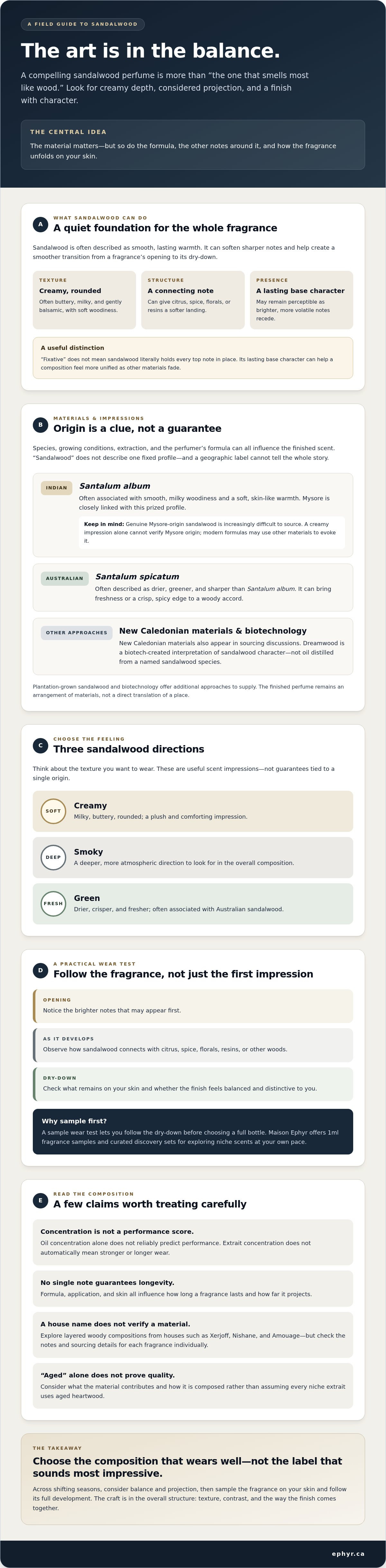
The word “sandalwood” can refer to different species and fragrance materials, not one uniform scent. The Sandalwood overview offers useful botanical background. In a perfume, the resulting character depends on the source material and how the perfumer builds around it. Sandalwood can soften sharper notes and create a smoother transition from the opening to the dry-down. It is often described as a fixative, but that doesn’t mean it literally holds every top note in place. Rather, its lasting base character can help the fragrance feel more unified as other materials fade.
The Olfactory Profile of True Sandalwood
Think buttery, milky, and gently balsamic, with soft woodiness beneath the creaminess. Many sandalwood materials contain low-volatility components, so their presence may linger as brighter, more volatile notes recede. This isn’t a mechanical slow-release system. It reflects the way materials evaporate at different rates, shaped by the full formula and individual skin.
That rounded profile can feel comforting in cold weather, but sandalwood isn’t only for winter. In warmer conditions, a lighter composition may feel smooth and understated rather than heavy. Across Canada’s seasonal shifts, consider a fragrance’s balance and projection, not just the note name.
Sandalwood as a Performance Foundation
In a well-built formula, brighter top notes may appear first while deeper woods remain perceptible later. Sandalwood can connect those stages, giving citrus, spice, florals, or resins a softer landing. The effect depends on the surrounding materials. No single note guarantees longevity.
Oil concentration matters, but it isn’t a reliable performance score on its own. Formula, application, and skin all influence how long a scent lasts and how far it projects. Extrait concentration does not automatically mean stronger or longer wear. Nor does the word “aged” alone prove quality. Consider what a material contributes and how it is composed, rather than assuming every niche extrait uses aged heartwood.
That distinction matters when choosing sandalwood perfumes Canada has to offer. A simple woody accord can suggest sandalwood, while a more layered composition creates dimension through contrast, texture, and balance. The craft is in the overall structure, not just the ingredient list.
Sourcing the Sacred: Understanding Sandalwood Varieties
“Sandalwood” doesn’t describe one fixed scent profile. Species, growing conditions, extraction, and the perfumer’s formula can all influence the finished fragrance, from soft and creamy to drier and greener. Origin is a useful clue, not a guarantee. A finished perfume is an arrangement of materials, not a direct translation of a place.
Sandalwood also has a long cultural history. The Perfume Society’s overview of sandalwood in spiritual traditions explores its heritage, scent profile, and sourcing concerns. For perfumers, the challenge is to create a particular character while making considered choices about the materials in a composition.
Mysore Sandalwood: The Creamy Legend
Indian sandalwood, Santalum album, is often treated as a benchmark for smooth, milky woodiness. Mysore is closely associated with this prized profile, but a creamy scent alone can’t verify that a perfume contains material from that region. Genuine Mysore-origin sandalwood is increasingly difficult to source, so modern formulas may use other materials to evoke its soft, skin-like warmth.
Amouage fragrances are worth exploring for layered woody compositions, but a scent impression isn’t proof of Mysore oil. Check the notes and sourcing details for the individual fragrance rather than relying on a house name or a “Mysore-style” description.
Australian and New Caledonian Alternatives
Australian sandalwood, Santalum spicatum, is often described as drier, greener, and sharper than Santalum album. That gives a perfumer another option: it can bring freshness to a woody accord or add a crisp, spicy edge instead of a plush, milky base. New Caledonian materials also appear in discussions of sandalwood sourcing, but geographic labels alone can’t predict the finished fragrance.
Plantation-grown sandalwood and biotechnology offer additional approaches to supply. Dreamwood is a biotech-created interpretation of sandalwood character, not oil distilled from a named sandalwood species. Sustainable farming can support more deliberate sourcing, though responsible practices depend on how a material is produced and traced.
When comparing sandalwood perfumes Canada has to offer, ask what role the wood plays. Does it feel creamy and enveloping, or dry and green? Origin can influence a fragrance’s character, but the supporting notes and the perfumer’s choices complete the picture. A 1ml fragrance sample is a practical way to explore a composition before choosing a full bottle.
The Three Pillars of Sandalwood: Creamy, Smoky, and Green
Think of these three pillars as a selection tool, not rigid fragrance categories. A perfume can move between moods as its supporting notes unfold. To find your fit, ask what you want sandalwood to contribute: softness, atmosphere, or clarity. That question is more revealing than the broad label “woody.”
The Creamy Gourmand Crossover
In a creamy gourmand, sandalwood can temper the sweetness of vanilla or milky accords, giving them a smoother, more grounded finish. The “Bianco Latte effect” describes this comforting style, but it doesn’t mean a fragrance contains sandalwood. If you’re considering a signature scent, notice whether the wood and sweetness stay in balance as the perfume settles. This plush character may feel inviting under winter layers, while a lighter composition can feel easier to wear indoors.
Spiced and Incense-Laden Sandalwoods
Cardamom can sharpen an opening, while frankincense can add a resinous, meditative dimension. Sandalwood may give these contrasting elements a shared foundation, making the result feel composed rather than simply spicy. Amouage is one niche house to explore for richly layered compositions. Check each scent’s notes individually, since a house’s style doesn’t mean every fragrance features sandalwood. These profiles may suit evening occasions or formal events when you want a more atmospheric presence.
The Green, Modern Interpretation
Green sandalwood leans toward crisp, leafy, or herbal accents. It offers a cleaner, more restrained mood for anyone who finds creamy sweetness too enveloping. This profile can also suit daytime settings, where you may prefer a fragrance that feels polished without overt warmth.
As you compare sandalwood perfumes Canada shoppers can explore, use these three moods to narrow your search, then assess the full composition. A smoky scent may feel elegant to one wearer and too intense to another. Your preferred balance is the most useful benchmark.
Choosing Sandalwood Perfumes Canada Has to Offer: A Sampling Guide
A sample turns fragrance shopping into a practical comparison. Maison Ephyr offers 1ml fragrance samples, so you can assess a scent on your own skin and in your everyday setting before choosing a full bottle. Keep your test simple: wear one fragrance at a time, note the conditions, and give the composition room to develop.
Build a Sandalwood Discovery Set
Choose three or four samples with clear contrasts: a sandalwood-led scent, a fragrance where sandalwood supports other notes, and compositions with different levels of sweetness or spice. Maison Ephyr’s curated discovery sets can also help you explore niche fragrances. Check the included scents to see whether they match your preferences. Sampling lets you compare how fragrances wear rather than relying on descriptions alone, reducing the chance of choosing a full bottle that doesn’t suit you.
Technical Testing: Skin vs. Paper
Use a paper strip for an initial impression, then test the fragrance on skin. Paper helps you compare openings without mixing scents on your body, while skin shows how the perfume develops in your personal wearing conditions. Don’t rub the application site, since that can disturb the fragrance and make comparisons less consistent.
The dry-down is the fragrance’s later, settled phase, when sandalwood’s lasting character may be easier to assess. Note your impressions at application, after the opening has softened, and again later in the day. An eight-hour observation window can provide a consistent comparison, but it isn’t a promise that every perfume will last that long.
Give yourself a full day between first testing and deciding. The “24-hour rule” is a pause for perspective, not a claim about how long the fragrance should last. The first ten minutes reveal only an early stage. Revisit your notes after the scent has settled, and compare sillage, the trail it leaves, with projection, how far it seems to radiate.
For a useful climate check, repeat the test on days with different humidity levels. Record the conditions and whether the fragrance feels closer or more noticeable, without assuming humidity alone explains the change. Explore Maison Ephyr’s fragrance samples and discovery sets to begin comparing sandalwood perfumes Canada-wide at your own pace.
The Maison Ephyr Standard: Curating the Best Sandalwood Scents
A house name is a starting point, not a shortcut. Amouage, Xerjoff, and Nishane each bring a distinct compositional style to niche perfumery, but sandalwood’s role varies from fragrance to fragrance. Check the notes and structure: is the wood central, or does it support florals, spice, or resins? That detail helps you choose by character rather than reputation alone.
Amouage: A Layered Approach
Amouage fragrances are worth exploring for compositions with depth and contrast. In a woody scent, notice how sandalwood-like warmth interacts with resins and brighter notes as the fragrance develops. Don’t assume every Amouage perfume features sandalwood, or that a creamy profile confirms a particular wood source. Maison Ephyr is an official Amouage retailer, providing Canadian fragrance enthusiasts with an authorized source for the brand’s offerings. Read the notes for the individual scent and assess its character on skin.
Xerjoff: Italian Artistry and Contrast
Xerjoff offers another perspective on balance and texture. Citrus or florals can brighten a woody composition, while richer supporting notes may make it feel more enveloping. The effect depends on the individual fragrance, so check its description rather than assuming a collection or concentration guarantees a particular profile or performance. Maison Ephyr is also an official Xerjoff retailer, making the retailer’s status one factor to consider when choosing where to shop.
Nishane brings a further point of comparison. Explore its fragrances by their listed notes and overall character instead of assuming every offering is sandalwood-led. Across these houses, the useful question is simple: does the composition’s balance match the mood you want to wear?
Maison Ephyr curates niche fragrances for customers across Canada, with national shipping and a selection that includes Amouage, Xerjoff, and Nishane. Explore the curated niche fragrance selection to find a composition that fits your preferences. Let the craftsmanship catch your eye, then let the fragrance itself make the decision.
Find the Sandalwood That Feels Like Yours
The right sandalwood fragrance is a study in balance: creamy or green, quiet or incense-warmed, always shaped by the materials around it. Understanding those differences makes it easier to choose among sandalwood perfumes Canada shoppers can explore, while a sample shows how the composition develops on your own skin.
Maison Ephyr is an official retailer of Amouage and Xerjoff, with niche fragrances, 1ml samples, and discovery sets to help you explore before choosing a full bottle. National shipping makes the boutique’s selection available to fragrance enthusiasts across Canada.
Start with curiosity, not a note list alone. Explore Maison Ephyr’s niche fragrance selection and discover which sandalwood mood feels most like you. Your next signature scent may be closer than you think.
Frequently Asked Questions
What is the best sandalwood perfume for the Canadian winter?
The best choice is a sandalwood fragrance with a warm, creamy, or resinous profile that you enjoy wearing close to the skin. Cold, dry conditions can make a scent feel different from how it does in warm weather, so test it on your skin before choosing a full bottle. Compare the opening with the later dry-down, and consider how noticeable you want the fragrance to be indoors.
Is there a difference between sandalwood and cedarwood in perfumes?
Yes. Sandalwood is often described as creamy, milky, and softly balsamic, while cedarwood tends to suggest a drier, sharper, pencil-shaving-like woodiness. Those are broad impressions, not guarantees: species, extraction, and the surrounding notes all shape the result. A perfume may also use materials that create an impression of either wood without relying solely on the natural ingredient. Sampling is the clearest way to compare them on your skin.
Why are niche sandalwood perfumes more expensive than designer ones?
Niche fragrances may involve distinctive formulas, carefully selected materials, and a brand’s particular approach to composition and presentation. Natural sandalwood sourcing can also influence a formula, but the word “sandalwood” alone doesn’t explain a perfume’s price or prove its ingredients. Compare the fragrance’s composition, concentration information, and source rather than assuming every niche scent contains rare wood or lasts longer. A sample can help you decide whether its character feels worth the commitment.
Does sandalwood perfume last longer on skin or clothes?
Wear time varies with the formula, fabric, skin, and application, so neither surface guarantees longer wear. Skin lets you experience how a fragrance changes with your body, while fabric may hold some scents differently. Test cautiously on an inconspicuous area first, since perfume can mark delicate or light-coloured materials. For a fair comparison, apply the same sample to skin and a fabric swatch, then note how the scent develops over time.
Can I buy authentic Amouage sandalwood perfume in Canada?
Yes. Maison Ephyr is an official retailer of Amouage and serves customers across Canada through its online shop. This supports confidence in the retail source, but check the notes and current availability of a specific fragrance before purchase. Not every Amouage scent is necessarily sandalwood-focused. If you’re unsure about the profile, read the fragrance description or try a sample where available before choosing a full bottle.
What are the best sandalwood perfume samples for a beginner?
Start with contrasting profiles rather than searching for one universally “best” sample. Try a creamy sandalwood, a smoky or incense-led composition, and a greener interpretation. Include a fragrance where sandalwood is more subtle if you want a useful comparison. Maison Ephyr offers 1ml fragrance samples and curated discovery sets. Wear each sample separately and give it time to develop before deciding which style suits you.
Is Mysore sandalwood still used in modern perfumes?
Mysore sandalwood is associated with Indian sandalwood, Santalum album, and its creamy, soft character. However, a perfume that smells creamy or is described as “Mysore-style” doesn’t prove it contains oil from Mysore. Sourcing constraints make direct origin claims worth checking carefully, and modern formulas may use other materials to evoke a similar impression. Look for clear ingredient or sourcing information rather than relying on scent alone.
How should I store my sandalwood perfume to maintain its quality?
Store the bottle in a cool, dry place away from direct sunlight and frequent temperature changes. Keep it capped securely after use, and avoid leaving it in a bathroom where warmth and humidity can fluctuate. A drawer or closed cabinet can provide a steadier environment than a sunny shelf. Handle the bottle gently, and follow any storage guidance supplied by the fragrance house.

Article by
Dmitrii Savishin
Dmitrii Savishin is the founder of Maison Ephyr and Parfum Exquis, two Canadian destinations dedicated to the world of niche perfumery. With years of experience discovering exceptional fragrance houses from around the globe, Dmitrii shares expert insights on perfume trends, fragrance notes, luxury brands, and the art of choosing the perfect scent. His mission is to make niche perfumery more approachable while helping readers discover fragrances that leave a lasting impression.


