

That $300 bottle of Amouage isn't a static liquid. It's a precisely timed chemical reaction engineered to evolve on your skin over eight hours. You've likely felt the frustration of a luxury purchase that smells divine at the counter but turns unrecognizable by noon. It's difficult to describe your preferences to experts when generic descriptors feel too vague for the complexity in the bottle. Understanding perfume notes is the only way to bridge the gap between a marketing list and the actual performance of a scent.
You deserve a better ROI on your niche fragrance collection. We'll show you how to decode the olfactory architecture of brands like Xerjoff and Nishane with professional precision. This guide explores the evaporation science behind top, heart, and base notes. We also examine how the 2026 EU allergen labeling expansion is currently forcing a massive shift in ingredient transparency. You'll learn to predict a fragrance's lifecycle before the first spray. This ensures every discovery set or 1ml sample you buy is a calculated investment in your personal style.
Key Takeaways
- Decode the engineering of scent by learning how molecular weight controls the exact moment each ingredient becomes perceptible to your senses.
- Gain technical mastery in understanding perfume notes to forecast how a composition shifts from its initial 15-minute impression to its final dry down.
- Utilize the Fragrance Wheel as a professional navigation tool to map relationships between citrus sparks, green notes, and deep woody configurations.
- Practice isolated smelling techniques on blotters to develop the sensory precision required to identify individual components within a complex artisanal blend.
- Shift from casual consumer to Master Craftsman by learning to evaluate the internal logic and durability metrics of niche fragrance architecture.
The Anatomy of Scent: Why Understanding Perfume Notes Matters
Think of a fragrance as a blueprint for an invisible structure. It isn't a static cloud of aroma. It's a calculated sequence of molecules detaching from your skin at different speeds. Master perfumers don't just mix smells; they manage volatility. Understanding perfume notes starts with recognizing that every ingredient has a specific molecular weight. Light molecules, like those in citrus or mint, are high-energy and escape quickly. Heavier molecules, like resins or musks, cling to the surface for hours. This isn't just art. It's high-end engineering applied to the senses.
When you read a note list for a scent like Bois Imperial, you aren't looking at a literal list of ingredients. You're looking at a map of impressions. A peach note might actually be a complex blend of synthetic isolates and natural extracts. The note is the effect; the raw material is the hardware. By treating fragrance as functional architecture, you stop chasing vague smells and start evaluating the structural integrity of the composition. Every spray is a performance of physics.
The Language of the Nose
Smelling is a cognitive exercise. Your brain interprets chemical signals based on memory and context. If you lack the vocabulary to describe what you're smelling, you'll always struggle to find your signature scent. Precision matters. Instead of saying a perfume is fresh, a professional identifies specific green or aquatic facets. This level of detail allows you to evaluate niche boutiques with quiet confidence. You aren't just a consumer. You're an evaluator of quality who understands how scent profiles are constructed.
Notes vs. Accords: The Internal Configuration
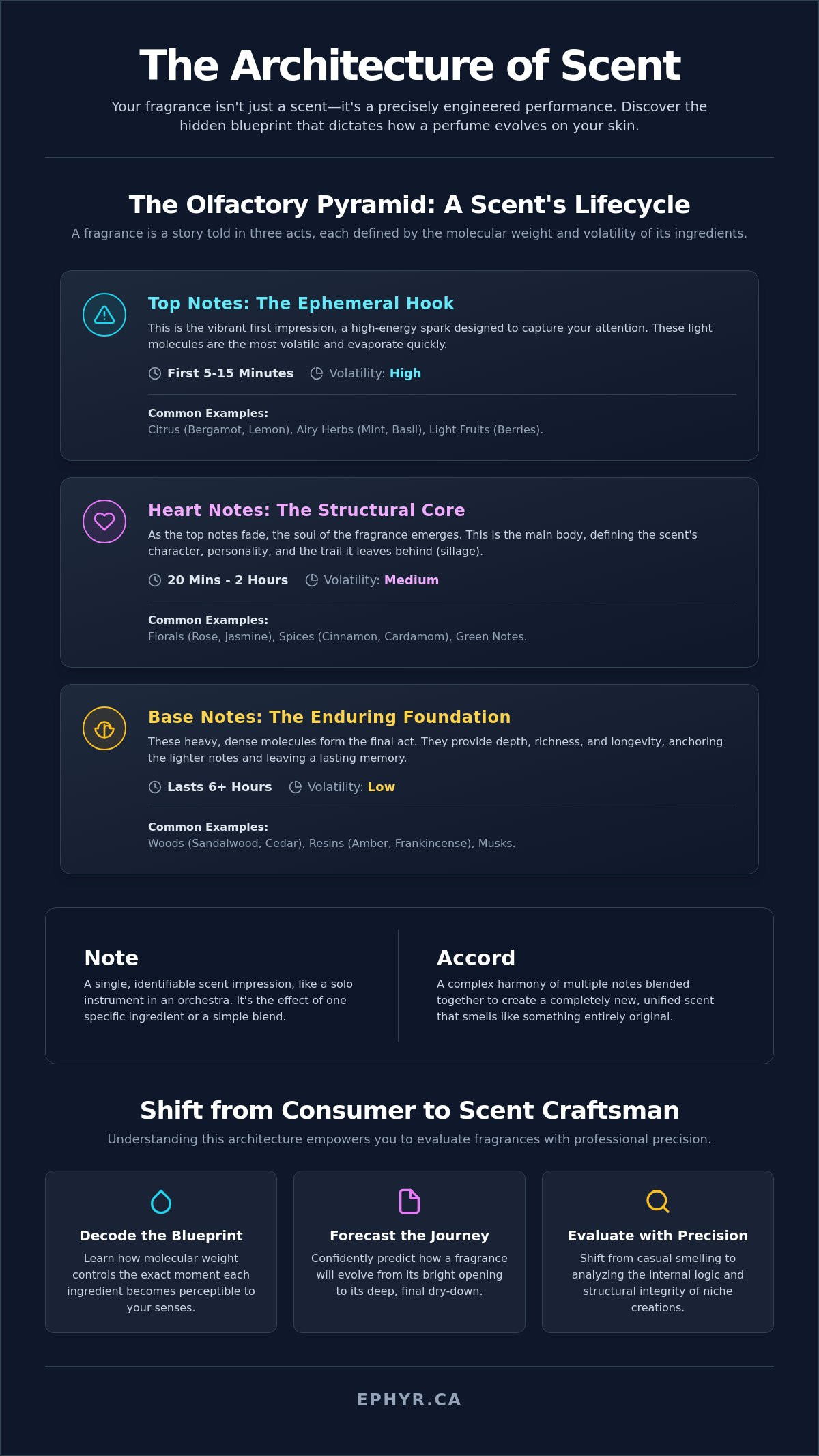
A single note is a solo instrument. An accord is the full symphony. When a perfumer combines jasmine, rose, and ylang-ylang, they create a floral accord that smells like a flower that doesn't exist in nature. This is the olfactory pyramid in action. Master craftsmen often use ghost notes to bridge these layers. These are subtle additives that enhance a primary ingredient without being explicitly detectable. It's about optimizing the internal configuration so the transition from top to base is seamless. Understanding perfume notes gives you the ability to see these hidden joints in the architecture.
- Top Notes: High volatility, immediate impact, short duration.
- Heart Notes: Medium volatility, the core character of the scent.
- Base Notes: Low volatility, provides the foundation and longevity.
The Olfactory Pyramid: Deciphering Top, Heart, and Base Notes
The olfactory pyramid functions as a technical timeline. It is the choreographed sequence of a scent’s lifecycle. Understanding perfume notes means recognizing that a fragrance is a dynamic performance rather than a static asset. While a painting remains fixed, a perfume evolves. It moves through three distinct phases defined by molecular volatility. This structural progression ensures the scent remains engaging from the first spray to the final trace.
Top Notes: The Ephemeral Hook
The top notes are the initial 5 to 15 minutes of the experience. They serve as the transient first impression. Common materials include citrus, light fruits, and airy herbs. These molecules are the most volatile. They escape the skin quickly. Their technical role is twofold. First, they mask the sharp, medicinal scent of the carrier alcohol. Second, they create the psychological hook. It is the high-frequency spark that grabs your attention before the deeper architecture reveals itself.
Heart Notes: The Structural Core
As the top notes fade, the heart emerges. This usually happens around the 20-minute mark. This is the soul of the fragrance. It defines the core personality. Heart notes are composed of florals, spices, and heavier fruits. They act as a critical buffer. They smooth the transition between the volatile top and the heavy base. This layer also dictates sillage. Sillage is the scent trail you leave behind. It is the projection of the fragrance's internal configuration to those around you. It represents the scent's true identity.
Base Notes: The Enduring Echo
The base notes are the foundation. They provide longevity for 6 hours or more. This is where The Chemistry of Perfume Notes becomes most apparent. Base notes use heavy molecules like woods, resins, and musks. They act as fixatives. These materials anchor the more volatile top notes to your skin. This slows their evaporation. The final dry down is highly dependent on skin chemistry. Individual pH levels and oil content interact with these heavy molecules to create a unique final signature.
Linear fragrances maintain a consistent profile from start to finish. They are predictable. Complex fragrances, common in niche houses like Amouage or Xerjoff, are engineered to transform. They tell a story. If you want to observe this evolution without committing to a full bottle, exploring discovery sets allows you to track these transitions across several days. This is the most efficient way to master the logic of high-end olfactory engineering.
Exploring Fragrance Families: From Citrus Spark to Woody Depth
Imagine a schematic for the senses. The Fragrance Wheel is the industry's primary tool for mapping the relationships between different scent families. It organizes chaos into logic. By grouping ingredients based on their shared characteristics, the wheel simplifies the process of understanding perfume notes. It allows a collector to move beyond simple reactions toward a technical evaluation of woody-oriental structures or citrus facets. It is the difference between a casual observer and a master evaluator.
Fresh families act as the high-performance cooling systems of the olfactory world. Citrus, Green, and Water notes are engineered for peak performance in high heat. They rely on light molecular weights for an immediate, refreshing impact. Floral families occupy a much larger spectrum. They range from the sheer transparency of a morning rose to the carnal, heavy-duty presence of white flowers like tuberose. This diversity is why understanding perfume notes and their chemical origins is essential; it explains how the same floral note can be rendered as either a whisper or a roar depending on its internal configuration. Understanding Fragrance Chemistry provides the foundational knowledge required to see these invisible shifts in density.
Amber and Woody families represent the heavy-duty engineering of the fragrance world. These are the load-bearing walls of any composition. Woody notes like cedar, oud, and sandalwood provide a dry, architectural stability. Ambers offer a resinous warmth that lingers long after the top notes have evaporated. They provide the density required for a scent to survive an entire evening. They are the base upon which the rest of the olfactory structure rests.
Niche Nuance: Complex Categories
Gourmand scents represent a modern shift in olfactory engineering. They use notes like chocolate, caramel, and honey to create an edible, comforting profile. Fougère is a more traditional structure. It is the definitive framework for cologne for men. It uses a specific contrast of lavender, oakmoss, and coumarin to mimic a "fern-like" freshness. Chypres offer even more complexity. They create a sophisticated tension between bright citrus tops and dark, mossy bases. These categories require a disciplined nose to fully appreciate their internal logic.
The Animalic and Resin Dimension
Musk and Ambergris provide the human element. They add warmth and a skin-like depth that synthetic-only scents often lack. Resins and Balsams are the ultimate markers of exclusivity. These materials, often referred to as the "Gift of Kings," are a hallmark of Amouage perfume. Their density ensures a slow burn. They communicate luxury not through volume, but through the enduring weight of their presence on the skin. It is functional art at its most refined.
How to Train Your Nose: Practical Exercises for Scent Identification
Training your nose is like calibrating a precision instrument. It requires a disciplined methodology. You don't just "smell" a fragrance; you analyze its internal configuration. This is the foundation of understanding perfume notes. Start with the isolated smelling technique. Use professional blotters. Dip the strip and label it with the exact time. Smell it immediately, then again at 15 minutes, 1 hour, and 6 hours. This process allows you to track the molecular decay of the ingredients. It makes the invisible architecture of the scent visible to your senses.
Comparative analysis is the next level of mastery. Take two fragrances that feature the same primary note, such as the rose used in different Xerjoff or Casamorati compositions. One might be green and metallic, while the other is jammy and dense. Smelling them side-by-side forces your brain to isolate specific facets of the ingredient. Blind testing is equally vital. Remove the labels. Ignore the marketing. Focus purely on the olfactory hardware. Does the scent feel textured or smooth? Is the transition between layers seamless or jagged? This removes brand bias and centers your evaluation on performance.
Building Your Mental Library
Focus on one fragrance family per week. This prevents olfactory fatigue and ensures deep immersion. If you're studying "Woody" notes, spend seven days smelling nothing but cedars, sandalwood, and ouds. Connect these scents to specific memories. Perhaps a specific cedar note reminds you of a boutique studio in the Pacific Northwest. This hardwires the recognition in your brain. Always finish by testing on skin. Your body heat is the ultimate lab environment. It provides the final data point on how the notes interact with your unique chemistry.
The Role of Raw Materials
A master craftsman understands the difference between natural and synthetic molecules. Naturals are complex and multifaceted. Synthetics are precise and stable. Both are essential for high-end engineering. Smelling pure essential oils helps you identify these building blocks within a finished accord. You can easily build a professional training kit using perfume samples canada. These 1ml vials are the blueprints you need to practice understanding perfume notes in a controlled setting.
Keep a scent journal to document your findings. Record the transitions every hour for a full day. Note the exact moment the top note vanishes and the base note begins its long-term echo. This disciplined habit turns a casual interest into professional-grade expertise. To begin calibrating your nose with the world's finest ingredients, explore our curated discovery sets and start your first comparative analysis today.
Curating Your Collection: Navigating Niche Artistry
Niche perfumery is not about mass appeal. It is about high-fidelity resolution. In the designer market, ingredients are often blurred to ensure a safe, generic profile. Niche houses take the opposite approach. They prioritize the clarity and purity of individual components. Understanding perfume notes in this context allows you to see the textures of the composition. You can identify the jagged edges of a raw vetiver or the creamy density of authentic sandalwood. You are looking for technical excellence. You want a scent that maintains its structural integrity from the initial spray to the final trace.
If you are looking to acquire scents with this level of technical resolution, you can explore E-commerce Fragrance Sales options for signature collections that prioritize quality and performance.
The Master Craftsman approach is a shift in mindset. It means viewing your collection as a long-term investment. One bottle of high-concentration extract offers more value than five generic eaux de toilette. Quality over volume. When you enter a niche perfume boutique, do not just smell the air. Inquire about the extraction methods. Ask about the regional heritage of the raw materials. Use your technical vocabulary to navigate the selection. This signals that you value the engineering logic behind the project. It ensures you leave with a scent that functions as a piece of wearable art.
The Power of the Discovery Set
Buying a full bottle on a whim is a high-risk strategy. Disciplined collectors use luxury fragrance samples canada to pressure-test a composition. You must live with a scent to understand its performance metrics. Observe how it reacts to your skin during a long day. See how it projects in different environments. This is the only way to decode the house style of a brand. For example, Xerjoff Perfumes often features a signature Italian brightness paired with immense durability. You cannot rush this evaluation.
Final Selection: The Logic of Choice
Your signature scent should align with your functional needs. A heavy, resinous Amouage is a winter powerhouse. It provides a warm, protective barrier. A crisp citrus from the Casamorati line is built for high-performance freshness in summer. Understanding perfume notes gives you the confidence to make these distinctions. You will know exactly why a scent works for you. It is a match between your unique chemistry and the fragrance’s internal configuration. It is a calculated decision.
The next step is to move from theory to experience. Explore the curated vault at Maison Ephyr. We prioritize depth of service over breadth of volume. Every item in our catalog is an individually tuned instrument. Find the one that resonates with your architectural vision today.
Mastering the Architecture of Aromatic Precision
You've moved beyond the surface levels of scent. You now recognize that a fragrance is a choreographed sequence of molecular weights. It is a performance of volatility. Top notes act as the high-frequency spark while base notes provide the enduring, heavy-duty echo. By maintaining a scent journal and practicing comparative analysis, you've begun the transition from a casual wearer to a professional evaluator of functional art. Understanding perfume notes is the structural foundation for a high-performing collection. It ensures every luxury purchase is a calculated investment rather than a sensory gamble.
You've learned to decode the internal configuration of complex accords and navigate the Fragrance Wheel with technical certainty. As an official retailer for Amouage and Xerjoff, Maison Ephyr provides the raw materials for your continued education. We offer a curated niche selection for the discerning nose and expert fragrance guidance for Canadian enthusiasts. Don't leave your olfactory journey to chance. It is time to apply this methodology to your own skin.
Begin your olfactory education with a Maison Ephyr Discovery Set and start calibrating your senses today. Your signature scent is waiting to be decoded.
Frequently Asked Questions
What is the most important note in a perfume?
The heart note is often called the "soul" of the scent, but no single note is most important. A fragrance is a functional system. The base provides the load-bearing support while the top provides the initial spark. True mastery lies in the balance of the entire accord. If the transition between these layers fails, the structural integrity of the perfume collapses regardless of individual ingredient quality.
Why does my perfume smell different after an hour?
Your perfume evolves because of varying evaporation rates. Top notes are designed to be transient. After an hour, these light molecules have escaped into the air. This reveals the heart notes, which represent the scent's true character. This progression is a deliberate part of the engineering process. It ensures the fragrance tells a story on your skin rather than remaining a static, one-dimensional aroma.
Can I identify perfume notes just by smelling the bottle?
Smelling the bottle is an unreliable metric for quality. You are only perceiving the most volatile top notes or perhaps oxidized residue around the nozzle. To begin understanding perfume notes, you must spray the liquid. Use a blotter or your skin to allow the alcohol to evaporate. This is the only way to observe the internal configuration and the full lifecycle of the olfactory pyramid.
What are "synthetic" notes and are they lower quality?
Synthetic notes are precision-engineered molecules. They are not lower quality. In niche perfumery, synthetics like Ambroxan or Hedione are used for their unique performance metrics and stability. They allow perfumers to create specific textures that natural extracts cannot achieve. These isolates are the cutting-edge hardware of the fragrance world. They provide the clarity and sillage that define modern luxury scents.
How many notes are typically in a single fragrance?
A single fragrance often contains between 30 and 100 individual raw materials. The note list you see is a curated map of the most prominent impressions. This simplified guide is essential for understanding perfume notes without needing a degree in organic chemistry. It focuses on the dominant accords that the user will actually perceive during the scent's eight-hour performance window.
Why do some notes last longer on my skin than others?
This comes down to molecular volatility. Base notes like sandalwood or musk have high molecular weights. They move slowly and cling to your skin's oils. Citrus and floral top notes are lightweight and high-energy. They disperse quickly. Your skin chemistry, including temperature and hydration levels, acts as the catalyst that dictates how fast these different molecules detach and enter the air around you.
What is the difference between a note and an ingredient?
An ingredient is the literal raw material, such as a natural essential oil or a synthetic isolate. A note is the descriptive effect that material produces. For example, a perfumer might use several different ingredients to create the single note of a peach. Ingredients are the internal components. Notes are the professional vocabulary we use to describe the final aesthetic result of the assembly.
How can I learn to distinguish between different floral notes?
Practice side-by-side comparative analysis. Smell a "green" rose like those found in specific Casamorati blends against a "spicy" rose. Focus on the facets. Is it airy, metallic, or honey-like? By isolating these secondary characteristics, you hardwire the differences in your brain. This disciplined approach turns a vague floral impression into a precise technical identification of the specific flower's olfactory profile.

Article by
Dmitrii Savishin
Dmitrii Savishin is the founder of Maison Ephyr and Parfum Exquis, two Canadian destinations dedicated to the world of niche perfumery. With years of experience discovering exceptional fragrance houses from around the globe, Dmitrii shares expert insights on perfume trends, fragrance notes, luxury brands, and the art of choosing the perfect scent. His mission is to make niche perfumery more approachable while helping readers discover fragrances that leave a lasting impression.


