

What if “maceration” means two different things, depending on who’s using the word? If you’ve searched “what is maceration in perfume” and found conflicting answers, the confusion is understandable. In perfumery, maceration can describe extracting scent from raw materials, while fragrance discussions also use it to mean resting a blended perfume. It’s often used interchangeably with maturation, even though the terms may refer to different stages.
Context makes the distinction clearer. This guide explains how maceration is used in perfume-making, how it differs from maturation and ageing, and what those processes may mean for a fragrance’s scent. It also separates production from letting a newly purchased bottle rest at home. A few days on a shelf aren’t a guaranteed fix for a perfume you don’t enjoy.
You’ll learn what changes you might notice, which claims deserve caution, and how to assess a fragrance over time without relying on myths. Sampling gives you a practical way to experience a scent from its opening through its later notes. The goal is a clearer understanding, not a promise that every perfume will transform.
Key Takeaways
- What is maceration in perfume? The answer depends on context: it can mean extracting scent from raw materials or resting a blended fragrance.
- Perfumery terms such as maceration, maturation, and ageing aren’t always used consistently, so identify the process being described.
- A finished bottle resting at home isn’t the same as a maker’s production process, and it isn’t a guaranteed way to improve a fragrance.
- Distinguish gradual scent changes from oxidation, which refers to a fragrance’s interaction with oxygen.
- Try a fragrance sample or discovery set to assess how a scent wears before choosing a full bottle.
What Is Maceration in Perfume? A Clear Definition
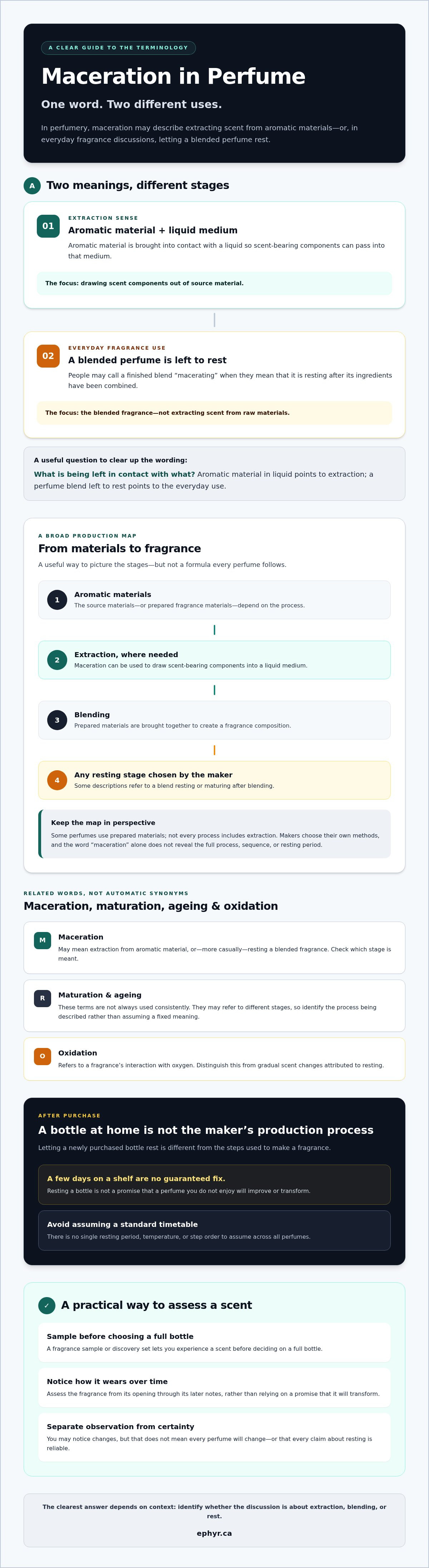
In perfumery, maceration can mean soaking aromatic material in a liquid to draw out scent. In everyday fragrance discussions, it can also mean letting a blended perfume rest. The intended meaning depends on the production context. These are distinct stages, even though people may use the same word for both.
So, what is maceration in perfume? Start by asking what is being left in contact with what. If aromatic material is steeped in a liquid medium, the term refers to extraction. If someone says a perfume needs to “macerate” after blending, they may mean that the blend is being left to rest. This second use is common in consumer conversations, but it shouldn’t be mistaken for a universal technical definition.
What Does Maceration Mean in Perfumery?
At its most basic, maceration involves bringing aromatic material into contact with a liquid so that scent-bearing components can pass into that medium. The general idea is similar to the broader definition of Maceration, which describes soaking a solid in a liquid to soften it or extract components. In perfumery, the material, liquid, and method depend on the process being used.
This distinction matters because perfume-making doesn’t follow one fixed sequence. Some processes involve extracting aroma from source materials; others use ingredients that have already been prepared. The word alone doesn’t tell you which method was used or whether a particular finished perfume underwent maceration in this extraction sense.
Why Do People Use the Word for Finished Perfume?
In casual fragrance discussions, “maceration” often describes a finished blend resting after its ingredients have been combined. People may use it to explain a scent that seems different after some time, or to suggest that a new bottle should be left alone before judging it. In this context, they’re talking about the blended perfume, not extracting aroma from raw materials.
The overlap can make advice sound more precise than it is. A post-blending rest and extraction from aromatic material aren’t interchangeable just because both involve time and contact between substances. Perfumery terminology varies among makers and in everyday conversations, so it’s more useful to identify the stage being discussed than to insist that one use is always correct. The next sections explain how resting relates to maturation, ageing, and a bottle in your own home.
How Maceration Fits Into the Journey From Materials to Perfume
A fragrance takes shape through a series of decisions, not one universal recipe. Depending on the materials and production method, scent may first be extracted from aromatic matter, or a perfumer may work with fragrance materials that are already prepared. Blending comes later as a separate step: arranging those materials into a composition.
In broad terms, the journey may move from aromatic materials, to extraction where needed, to blending, and then to any resting stage chosen by the maker. This is a useful map, not a formula every perfume follows. A brand or perfumer determines its own production methods, and the word “maceration” alone doesn’t reveal the full process.
Maceration of Aromatic Materials
In the extraction sense, maceration means placing aromatic material in a suitable liquid medium so that some scent-bearing components can pass into it. The exact materials and method depend on the process. This differs from blending prepared fragrance materials, where the goal is to combine ingredients into a chosen scent rather than draw components out of source matter.
Think of these as two different operations: obtaining aromatic components, then composing with them. The distinction is useful, but it doesn’t tell you which extraction method a particular perfume used. Specific claims about materials or liquids require reliable, process-specific information.
Blending, Resting, and the Finished Fragrance
During blending, a perfumer brings prepared materials together to create a fragrance composition. Some descriptions then refer to the blend resting or maturing. That’s a different stage from extracting scent from raw aromatic material, even if casual discussions sometimes call both stages maceration.
There’s no single sequence or resting period to assume. A maker may use different methods depending on the fragrance and production choices. Without information from the maker, don’t treat a fixed duration, temperature, or step order as standard across all perfumes.
For readers asking what is maceration in perfume, the clearest answer is to identify the stage: extraction, blending, or rest. That frame helps separate a manufacturing description from claims about a finished bottle. If you’re more interested in how a fragrance wears than how it was made, fragrance samples offer a way to explore a scent over time.
Maceration vs. Maturation, Ageing, and Oxidation
Perfume terminology can blur together, especially when the same word is used for different stages. The most useful clue is the subject: is the description about extracting scent from materials, or about a finished blend changing over time? The terms below offer a practical guide, not a universal glossary. Usage can vary among perfumers, brands, and fragrance writers.
| Term | Common meaning in perfume discussions |
|---|---|
| Maceration | May refer to soaking aromatic material in a liquid to extract scent, or, informally, to a blended perfume being left to rest. |
| Maturation or resting | Often describes a period after blending when a fragrance is left undisturbed. The wording and intended process can vary. |
| Ageing | A broad term for changes that occur as a fragrance or its materials grow older. It doesn’t identify one specific cause or outcome. |
| Oxidation | A chemical process involving reaction with oxygen. It’s distinct from simply allowing a fragrance to rest. |
Are Maceration and Maturation the Same Thing?
Not necessarily. In an extraction-focused description, maceration means aromatic material is in contact with a liquid medium. Maturation usually points to time after ingredients have been blended, though some informal writing uses “maceration” for that rest too. If the terms seem interchangeable, check what the text describes: source materials or a finished blend.
That context is more reliable than treating either word as a fixed label. A description that says a perfume was “macerated” may not reveal whether it means extraction or post-blending rest. Without further detail from the maker, it’s best not to infer a specific production step.
How Is Oxidation Different From Resting?
Resting describes time passing; oxidation describes a chemical reaction involving oxygen. They aren’t synonyms. Oxygen exposure can contribute to changes in a fragrance, but noticing a difference in smell doesn’t prove oxidation occurred. Perception can vary between smelling occasions, and a scent change alone can’t identify its cause.
Storage-related change is also different from a maker’s chosen production process. A bottle kept over time may encounter conditions that differ from those used during manufacture, but that doesn’t mean every change is oxidation or that the result will be an improvement. When asking what is maceration in perfume, keep the stages distinct: extraction, resting, ageing, and oxidation describe different ideas, even when everyday language overlaps.
Does Perfume Need Maceration After You Buy It?
No, you don’t need to macerate a perfume at home, and letting a bottle sit isn’t a guaranteed way to improve it. The maker’s production process and a customer’s care of a finished bottle are different things. A fragrance may already have gone through the steps chosen by its maker before it reaches you. Leaving it unopened or setting it aside doesn’t recreate those steps.
This is where the term can cause confusion. If someone says a new perfume needs time to “macerate,” they may mean they prefer to let it rest before forming an opinion. That’s a personal approach, not proof that the fragrance will become smoother, stronger, or more appealing. If you’re asking what is maceration in perfume, keep the production meaning separate from advice about a bottle at home.
Can Letting a New Bottle Rest Change Its Smell?
You might notice a difference between wears, but that doesn’t establish that resting caused a predictable transformation. Your skin, how much you apply, your surroundings, and your expectations can all affect how you experience a scent. Even your memory of the first wear may be less precise than it feels.
Instead of waiting for a particular result, compare your impressions consistently. Wear the fragrance on separate occasions, apply it in a similar way, and jot down what stands out. If the scent still isn’t for you, more time isn’t a promise that it will become a favourite.
How to Assess a Fragrance Without Guesswork
A sample makes repeated testing more practical without asking you to commit to a full bottle. On each wear, note your first impression, what you notice later, and whether you enjoy the fragrance overall. Keep the notes simple. You’re tracking your experience, not diagnosing a chemical process or measuring guaranteed performance.
- Use a similar application approach each time.
- Record the setting and any noticeable differences in how you perceive the scent.
- Focus on your preference, not on whether the fragrance seems to match someone else’s description.
For more practical ideas, read this guidance on testing perfume samples at home. If you’d like to explore fragrances through samples, browse fragrance samples and assess each scent at your own pace.
Explore Perfume More Carefully: From Process to Personal Experience
Production terms can explain what may happen as a fragrance is made, but they can’t tell you whether you’ll enjoy wearing it. Knowing what is maceration in perfume helps separate extraction or a maker’s resting process from your own experience with a scent. The most useful test is personal: how does the fragrance smell to you on your skin during a normal day?
Notice what you actually enjoy rather than waiting for a bottle to transform. You might be drawn to a bright opening but prefer the softer scent that remains later, or find that a profile you admired on someone else isn’t right for you. Those impressions are valuable, even if they don’t explain the fragrance’s production history.
Why Sampling Helps You Understand a Fragrance
A sample lets you experience a fragrance on your own terms before choosing a full bottle. Wear it on separate occasions and notice which parts of the scent stand out to you. A sample is a practical way to explore, not a promise that it will reproduce every aspect of a full bottle’s ageing or performance. For more ideas, see this guide to luxury fragrance samples in Canada.
Choose a Fragrance Through Experience, Not Process Myths
Give your impressions room to take shape. If you’re comparing scents, try them separately and note what you like about each: the opening, the later impression, or the overall character. A few simple notes can help you compare more clearly than memory alone. There’s no need to decide that a fragrance must be macerating or improving for your preference to shift.
Maison Ephyr offers 1 ml fragrance samples and discovery sets for exploring scents before choosing a full bottle. Its selection includes niche fragrances from various independent and artisanal houses. These brand names describe what it sells, not who made or macerated the perfumes. Choose based on what you enjoy wearing, not on a process claim you can’t verify. When you’re ready, explore Maison Ephyr’s niche fragrance selection.
Explore Fragrance With Clarity and Confidence
So, what is maceration in perfume? The term may describe extracting scent from aromatic materials or, in everyday fragrance discussions, letting a blend rest. Its meaning depends on context. Maturation and ageing can also be used in different ways, while oxidation is a separate chemical process. A change in how a perfume smells doesn’t prove that a particular process caused it.
For a finished bottle, resting it at home isn’t a guaranteed way to improve the fragrance. Focus instead on what you enjoy: experience the scent on separate occasions and notice how it wears for you. Samples and discovery sets let you explore before choosing a full bottle.
Maison Ephyr offers fragrance samples, discovery sets, and expert guidance on fragrance selection. Explore Maison Ephyr’s curated fragrance selection and take your time finding a scent that feels right. Your own experience is the most useful guide.
Frequently Asked Questions
What is maceration in perfume?
What is maceration in perfume? It can refer to soaking aromatic material in a liquid medium to extract scent. In everyday fragrance discussions, the word is also used for a blended perfume left to rest. These are different stages, and the intended meaning depends on context. Check whether the description concerns source materials or an already-composed fragrance; the term alone doesn’t identify a maker’s exact method.
Is maceration the same as perfume maturation?
Not necessarily. In extraction-focused usage, maceration means aromatic material is soaked in a liquid medium. Maturation usually refers to time after blending, though some fragrance discussions use maceration informally for this resting stage. Usage isn’t fully consistent, so check what the writer means. If the subject is raw aromatic material, extraction is likely being described; if it’s a finished blend, the writer may mean resting or maturation.
Does perfume smell better after maceration?
There’s no guarantee that perfume will smell better after resting. A fragrance may seem different between wears, but that alone doesn’t establish that maceration caused a change. Your skin, application, surroundings, and expectations can influence what you notice. Judge the scent by your own experience rather than by a promise that it will improve. If you’re unsure, wear it on separate occasions and compare your impressions.
Can I macerate perfume at home?
You can leave a finished bottle undisturbed, but that isn’t the same as a maker’s production process, and it’s not a guaranteed way to improve the scent. In its extraction-focused sense, maceration involves aromatic material in a liquid medium. A consumer resting a finished fragrance is using the term differently. There’s no need to try to recreate an unknown manufacturing method; assess the perfume as it is and follow any care guidance from its maker.
How long does perfume maceration take?
There isn’t one standard duration that applies to every perfume or every use of the word. The time depends on the specific production method, and brands may use different processes. In consumer discussions, people may suggest leaving a bottle to rest, but that doesn’t establish a universal timeline or promise a change. Without details from the maker, treat exact time claims cautiously rather than assuming every fragrance follows the same schedule.
What is the difference between maceration and oxidation in perfume?
Maceration may describe extracting scent from aromatic material or, informally, resting a blended perfume. Oxidation is a chemical process involving a reaction with oxygen. They aren’t synonyms. A fragrance smelling different over time doesn’t prove oxidation occurred, and oxidation doesn’t mean the scent will improve. Keep production steps distinct from changes that may happen as a finished bottle is stored and used.
Does a perfume sample need to rest before I test it?
No special resting period is required before you begin assessing a sample. You can try it as received, then wear it on separate occasions to learn what you notice from the opening through later impressions. Your experience is more useful than waiting for a promised transformation. Keep your observations simple: note what you enjoy, what feels less suited to you, and whether your impression changes between wears.
Article by
Dmitrii Savishin
Dmitrii Savishin is the founder of Maison Ephyr and Parfum Exquis, two Canadian destinations dedicated to the world of niche perfumery. With years of experience discovering exceptional fragrance houses from around the globe, Dmitrii shares expert insights on perfume trends, fragrance notes, luxury brands, and the art of choosing the perfect scent. His mission is to make niche perfumery more approachable while helping readers discover fragrances that leave a lasting impression.


