
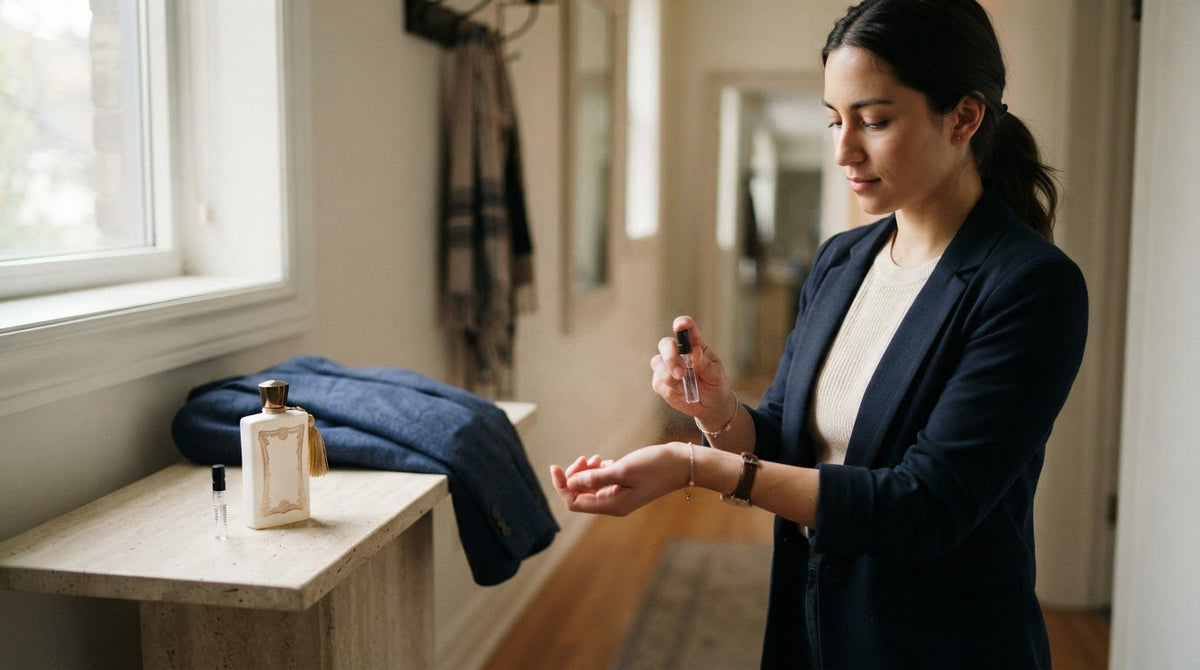
The best interview fragrance is often the one no one notices. Choosing what perfume to wear to a job interview starts with restraint: a clean, understated scent can feel polished without taking over the room, and wearing no noticeable fragrance is a sound choice too.
It makes sense to think carefully about what perfume to wear to a job interview. Interviews are close, focused conversations, and fragrance is personal. A scent that seems subtle outdoors may feel much stronger in a small meeting room or shared office.
This guide explains how to choose a composed, professional scent, adapt it to the interview setting, and apply it lightly. You’ll also learn how to test a fragrance beforehand and when skipping it is the more considerate choice. The aim is a thoughtful finishing touch that supports your presence, not one that arrives before you do.
Key Takeaways
- For conservative roles or close indoor interviews, choose a subtle scent or go without noticeable fragrance.
- Look for clean, understated notes that sit quietly rather than dominate the room.
- Test a fragrance on your wrist and give it a few hours to develop before deciding it suits you.
- Keep application restrained: no more than 1-2 sprays, applied lightly.
- Consider the interview setting and any fragrance policy; applying scent about 15 minutes beforehand can help it settle.
1. Does the same scent work for all job interviews?
No single scent suits every interview. For banking or law, choose a subtle fragrance or avoid a noticeable scent. In conservative settings, restraint is safer than a pronounced scent trail. At a creative studio, a more distinctive fragrance may suit your personal style. Keep it close and quiet: the interview is still a professional conversation.
The room matters as much as the role. A fragrance that feels restrained outdoors can become noticeable in a small boardroom, meeting room, or shared office. Use less for a compact space than you would for an open, well-ventilated setting. If the meeting moves between rooms, choose a scent that stays composed in close conversation.
Consider other people’s comfort. An interviewer may have fragrance sensitivities, allergies, or negative associations with a particular scent. Since you can’t know their preferences in advance, avoid a heavy cloud that lingers after you leave. In a panel interview, subtle application shows consideration for everyone sitting nearby.
A creative role can allow more personality, but “bolder” doesn’t mean overpowering. A distinctive scent may suit an interview at a design studio more than at a conservative law office. Keep it perceptible only at close range. Aim for a deliberate finishing touch, not a signature that competes with your work or distracts from your answers.
For a fresh interview impression, look for a clean, understated scent rather than a dense, room-filling composition. A light citrus or green impression can feel crisp; a soft musk can feel polished. These are examples, not rules. Test the fragrance on your wrist and wait a few hours to see how it develops on your skin.
What fragrance-free alternatives can you use instead of perfume? Choose fragrance-free deodorant, freshly laundered clothing, and unscented grooming products. These create a neat, prepared impression without adding perfume. Skip scented hair products and body lotions too: layering can create a noticeable scent even without perfume.
Are fragrance-free workplaces common in Canada? Some Canadian workplaces have fragrance-free policies, but practices vary by employer and setting. Read the interview instructions for guidance. If the organization asks people to avoid fragrance, follow that direction and skip perfume, cologne, scented lotion, and fragranced hair products.
When the setting is unclear, take the conservative approach. For a first interview, for example, arrive without a noticeable scent rather than testing an unfamiliar fragrance in close quarters. If you know a scent wears lightly on your skin, use that familiar option sparingly. A thoughtful choice keeps the conversation, not the fragrance, at the centre.
2. What fragrance notes work best for professional settings?
Choosing what perfume to wear to a job interview is about balance, not a single note. Citrus, green, soft floral, light woods, and restrained musk can create a composed impression. Consider how the notes work together: a crisp opening may feel fresh, while a gentle woody base adds structure. The finished fragrance should feel comfortable at close range, not just smell pleasant from a bottle or paper strip.
Scent can influence the atmosphere of a close conversation, but it cannot replace preparation. A familiar fragrance may help you feel at ease if it suits your preferences. The best answer to what perfume to wear to a job interview depends on the role, your clothes, and the setting. A soft floral might suit a tailored outfit, while a fresh green profile can feel natural in a relaxed studio.
Floral fragrances vary widely. Sheer rose or soft jasmine can feel delicate, while dense white florals may project more strongly. Woods offer a different character: cedar-like or dry accords can feel composed and structured. Musk can soften a blend and keep it close to the skin. Smell both the opening and the dry-down, since a subtle first impression may grow more pronounced as the fragrance settles.
For a fresh professional profile, explore citrus, green, or clean musk accords. A bright bergamot-like opening can feel crisp, while a sweet vanilla base may come across as warmer and fuller. Neither style is automatically right or wrong. The balance of the full composition, the amount applied, and the room’s size all affect how it comes across in conversation.
Your skin can change how a fragrance develops. Apply it to clean skin and notice whether citrus fades quickly, floral notes become more noticeable, or musk stays present. A paper blotter offers a useful comparison, but won’t show exactly how the scent wears on you. Try the fragrance during an ordinary day, then notice its character later and in close conversation.
A sample can make this assessment easier before you settle on a full bottle. A 1ml fragrance sample lets you experience the scent on your own skin and observe its development. Choose the profile that feels balanced beyond its first spray. That way, your fragrance remains a considered personal detail, while your experience and answers stay at the centre of the interview.
3. Notes to avoid in an interview
Skip fragrances that announce themselves before you do. For an interview in a small office, a strong oud or smoky leather profile can feel too prominent at close range. These notes aren’t inherently unprofessional; their intensity and projection can make them harder to control. Choose a quieter composition when you don’t know the room or interviewer’s preferences.
Very sweet gourmand accords can also dominate a focused conversation. Think of caramel, dense vanilla, or syrupy fruit notes in a fragrance that stays noticeable for hours. Sweetness itself isn’t the issue. A combination may feel heavy in a compact meeting room or clash with other scented products. If a perfume smells rich on a test strip, assess it on your skin before wearing it to an interview.
Use caution with sharp spice and smoky accords. A pepper-forward opening or prominent incense can feel dramatic, especially in a quiet office. A fragrance that works well at an evening event, for example, may draw attention during a morning interview. Smell the dry-down, not just the first spray. If the spicy or smoky character grows stronger as it settles, choose another option for the meeting.
Strongly projecting florals deserve the same scrutiny. A dense tuberose or heady white-floral profile may fill the space between you and an interviewer. That can distract from the conversation, even if you enjoy the scent. Test it at close range with someone you trust and ask whether they notice it before you mention wearing perfume. Choose a softer option if the fragrance leads the exchange.
Avoid stacking scented products without considering their combined effect. Fragranced deodorant, hair mist, body lotion, and perfume can create a louder blend than any one product. A scented lotion under a spicy fragrance, for example, adds another layer. Choose unscented grooming products when wearing perfume, or skip perfume if a scented product already lingers on your clothes.
Don’t experiment with an unfamiliar bottle on interview day. A fragrance can shift from bright citrus to a stronger woody or musky base as it develops. Test it on your skin during an ordinary day and notice how it smells later. If the scent becomes cloying, sharp, or persistent, leave it out of your interview routine.
Finally, don’t add extra sprays just because you can no longer smell your fragrance. Your perception may fade while the scent remains noticeable to others. If you can still detect it clearly during a close conversation, use less next time. For an interview, restraint keeps the focus on your answers, experience, and fit for the role.
4. Applying perfume or cologne lightly
For an interview, restraint is the application method. A light perfume or cologne should sit close, not fill the room. Use no more than 1-2 sprays, as a practical upper limit. In a small interview room, even one spray may be enough. The right amount depends on the fragrance’s strength and how it develops on your skin.
Apply fragrance to pulse points, where warmth helps release its scent. Common spots include the wrists and sides of the neck. Choose one area rather than spraying every point. One light spray on a wrist, for example, is more controlled than misting both wrists, your neck, and your clothing. Avoid rubbing your wrists together; let the fragrance settle naturally.
Use this simple sequence before leaving for the interview:
- Start with clean, dry skin. Apply unscented moisturiser first if you normally use one.
- Spray once from a short distance. Keep the nozzle directed at one pulse point, not toward your face.
- Pause before adding anything. Smell the fragrance at close range and consider the room where you’ll meet.
- Stop at a restrained level. Add a second spray only if the scent remains very faint and the fragrance is familiar.
Clothing changes how fragrance travels. A spray on a scarf or jacket can linger after you leave, then transfer to a chair or coat rack. For a close interview, applying it to skin gives you more control. If you prefer spraying clothing, test that method on an ordinary day first. Check a hidden area for marks, and don’t combine scented fabric products with perfume.
Layering can quietly increase a fragrance’s overall strength. A scented body cream, hair mist, and cologne each add another trail. Instead, pair perfume with unscented lotion and deodorant. If your shampoo or styling product already has a noticeable scent, skip the extra fragrance. The aim is one controlled impression, not several competing ones.
Application also depends on the interview format. A video call at home still puts you near the microphone and camera, so a restrained spray remains sensible. For an in-person panel, where several people may sit nearby, choose the lighter end of the 1-2 spray range. A familiar, mild fragrance is easier to manage than a powerful scent you haven’t tested.
Don’t reapply in the car or office lobby just because you’ve stopped noticing the fragrance. Your nose may adapt while the scent remains present to others. If you can clearly smell it during a close conversation, use less next time. A careful spray should complement your preparation, then let your words take the lead.
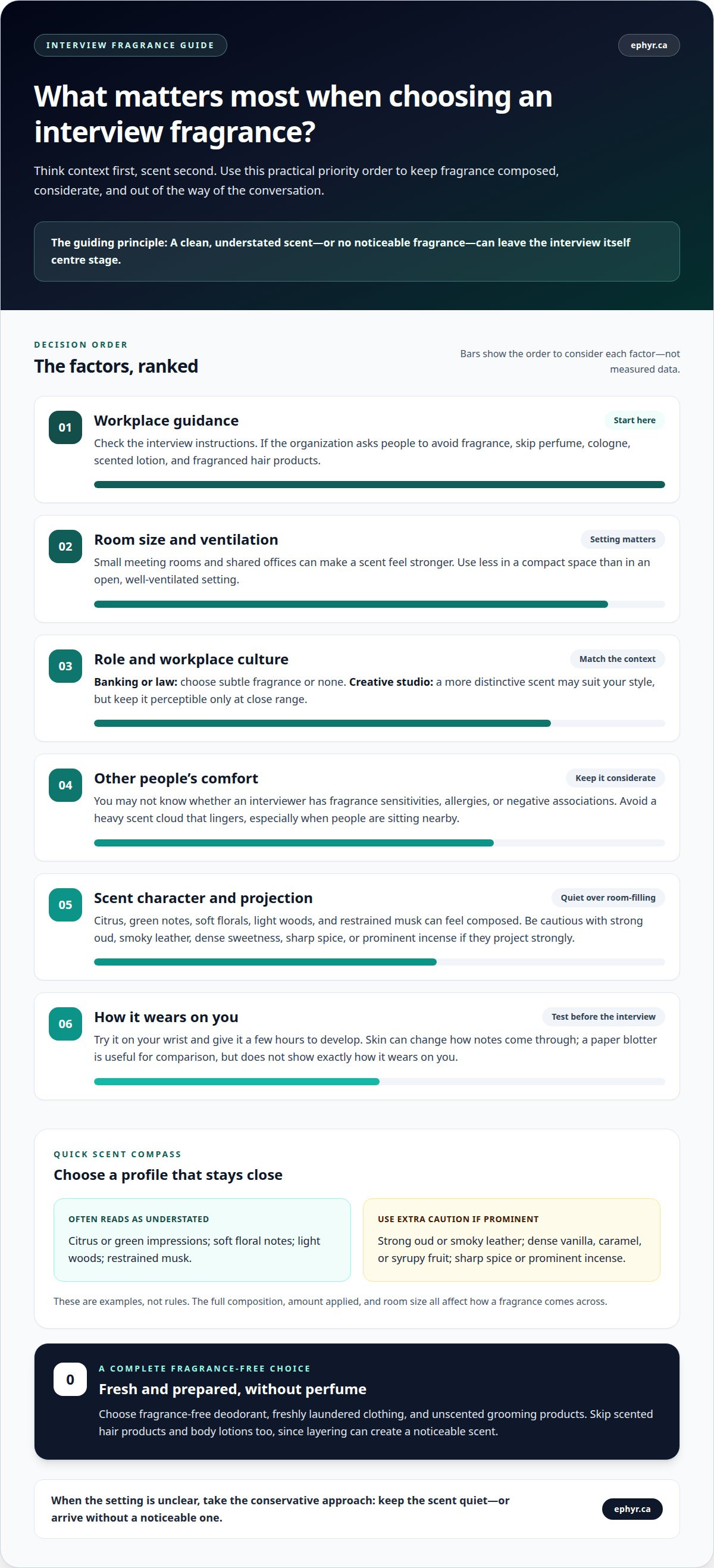
5. Perfume application advice for interviews
Timing gives fragrance a chance to settle before you meet the panel. Apply it about 15 minutes before going into the interview. That lets the opening notes soften during your commute or wait. Don’t spray again in the lobby. You may have become used to the scent, while it remains noticeable to someone meeting you for the first time.
Where should you apply perfume for a subtle scent? Use one light spray on a wrist or another pulse point, then let it dry. Avoid spraying your face, hands, or clothing, where fragrance may transfer during a handshake or linger on a chair.
Keep the dose controlled. Use no more than 1-2 sprays, and choose the lower end for a strong fragrance or a small interview room. A familiar cologne that wears close may need less than a delicate scent. Don’t add sprays simply because you can’t smell the fragrance yourself; your nose can adapt while other people still notice it.
Before applying anything, read the employer’s interview instructions for scent guidance. Some organizations have fragrance-free policies. If the instructions ask candidates to avoid fragrance, arrive without perfume or cologne. Choose unscented deodorant, lotion, and hair products too, since a fragranced grooming routine can leave a noticeable trail without a perfume spray.
Plan around the interview format. For an in-person meeting, consider the shared space and how close you’ll sit to the interviewer. For a video call, fragrance won’t reach the camera, so there’s no need to apply it for the meeting. If you’ll commute to an office visit afterward, keep the same restrained approach rather than layering scent before each appointment.
Use your commute as a final timing check. If you travel by bus or train, a strong spray can affect people nearby before the interview begins. Apply it only once in a private space, and let the fragrance settle before leaving. In winter, a coat or scarf can hold scent, so avoid spraying outerwear if you’ll wear it into the meeting room.
For an interview-ready fragrance routine, explore understated scent options and choose a familiar profile you can apply with control. A quiet finish is the point: arrive prepared, comfortable, and focused on the conversation.
Maison Ephyr: Bianco latte perfume
Maison Ephyr offers Bianco Latte perfume for readers considering a fragrance beyond the interview-day shortlist. A distinctive perfume can suit your personal collection, while an interview calls for a careful match between scent, setting, and application. Test any fragrance on your skin before wearing it in a close professional setting.
If you’re still exploring, Maison Ephyr also offers Xerjoff Fragrances, Nishane Fragrances, and Casamorati. Choose based on the character you enjoy and how quietly it wears, not just its first impression. For help exploring the available fragrance options, contact Maison Ephyr.
Choose a scent that feels like you
An interview can prompt you to notice how deliberately you choose a fragrance. Let it sharpen your sense of what feels comfortable, polished, and true to your style. The same approach can guide your choices beyond the meeting room, whether you're pairing a favorite scent with an ecru ruffled off the shoulder top for an evening event or keeping things understated for a quiet workday.
If you’re still considering what perfume to wear to a job interview, treat the decision as a personal edit, not a uniform. Maison Ephyr offers a curated selection of fine fragrances, each with a distinct character to explore. Take time to find a scent that suits your preferences and the moments you want it to accompany.
Contact Maison Ephyr for fragrance advice as you refine your choice. Walk into your next conversation feeling prepared, comfortable, and unmistakably yourself.
Frequently Asked Questions
But what about the perfume?
Perfume can be part of your interview preparation, but it doesn’t need to define your presence. Think of it like an accessory: it should fit the occasion without taking attention from what you’re saying. If you’re unsure, arrive without fragrance and focus on feeling prepared. Your clothing, punctuality, and thoughtful answers communicate professionalism more than a noticeable scent.
Should I wear fragrance to every interview?
No. Treat each interview as its own setting rather than following one fragrance rule automatically. If the employer’s instructions request fragrance-free attendance, respect that and avoid scented products. For a remote interview, fragrance won’t reach the interviewer through the screen, so wearing it is a personal choice. An unscented routine is a complete grooming choice, not an unfinished one.
Does the same scent work for all types of job interviews?
Not necessarily. A fragrance that feels comfortable at an outdoor networking event may seem too present in a quiet room with close seating. Consider the setting, interview format, and role. A group interview, for example, brings several people into the same space, making a restrained or fragrance-free choice considerate. Let the context guide your decision instead of relying on a single signature scent.
Does your scent make a difference when hiring managers?
A scent can contribute to someone’s first impression, but it can’t demonstrate your skills or determine whether you’re qualified. Hiring managers assess what you bring to the role, including your experience and responses. Fragrance is a personal detail, not a substitute for preparation. If scent feels like one more thing to manage, leave it out and focus on clear examples of your work.
How much fragrance should I apply?
Keep application restrained, and consider how concentrated or noticeable the fragrance feels on you. A spray that seems faint at home may become more apparent in a warm car or small meeting room. Don’t reapply during the commute just because you’ve stopped noticing it. If you have several interviews in one day, don’t add fragrance between appointments; the original application may still be present.
What fragrance notes work best for professional settings?
Notes alone can’t tell you how a fragrance will feel in an interview. The complete composition matters: a fresh opening may rest on a sweet or woody base that becomes more noticeable later. Read the note description as a guide, then assess the full wear on your skin. If you’re choosing between two options, prioritize the one that feels comfortable throughout the day.
What kind of notes should I avoid?
Avoid a fragrance whose strongest effect feels distracting to you or people nearby. Rather than ruling out an entire note family, consider its intensity and how it develops. A sweet fragrance, for example, may feel gentle at first but become dense as it settles. If an unfamiliar perfume changes sharply on your skin, save it for another occasion and choose a scent you know well.
Will this make a difference?
A thoughtful fragrance choice can help you feel composed, but it won’t replace interview preparation. Use the decision to remove distractions: choose a familiar scent, follow the employer’s fragrance guidance, or go without perfume. Then spend your preparation time reviewing the role and planning concise examples of your experience. The strongest impression comes from clearly communicating your fit.
Article by
Dmitrii Savishin
Dmitrii Savishin is the founder of Maison Ephyr and Parfum Exquis, two Canadian destinations dedicated to the world of niche perfumery. With years of experience discovering exceptional fragrance houses from around the globe, Dmitrii shares expert insights on perfume trends, fragrance notes, luxury brands, and the art of choosing the perfect scent. His mission is to make niche perfumery more approachable while helping readers discover fragrances that leave a lasting impression.


