
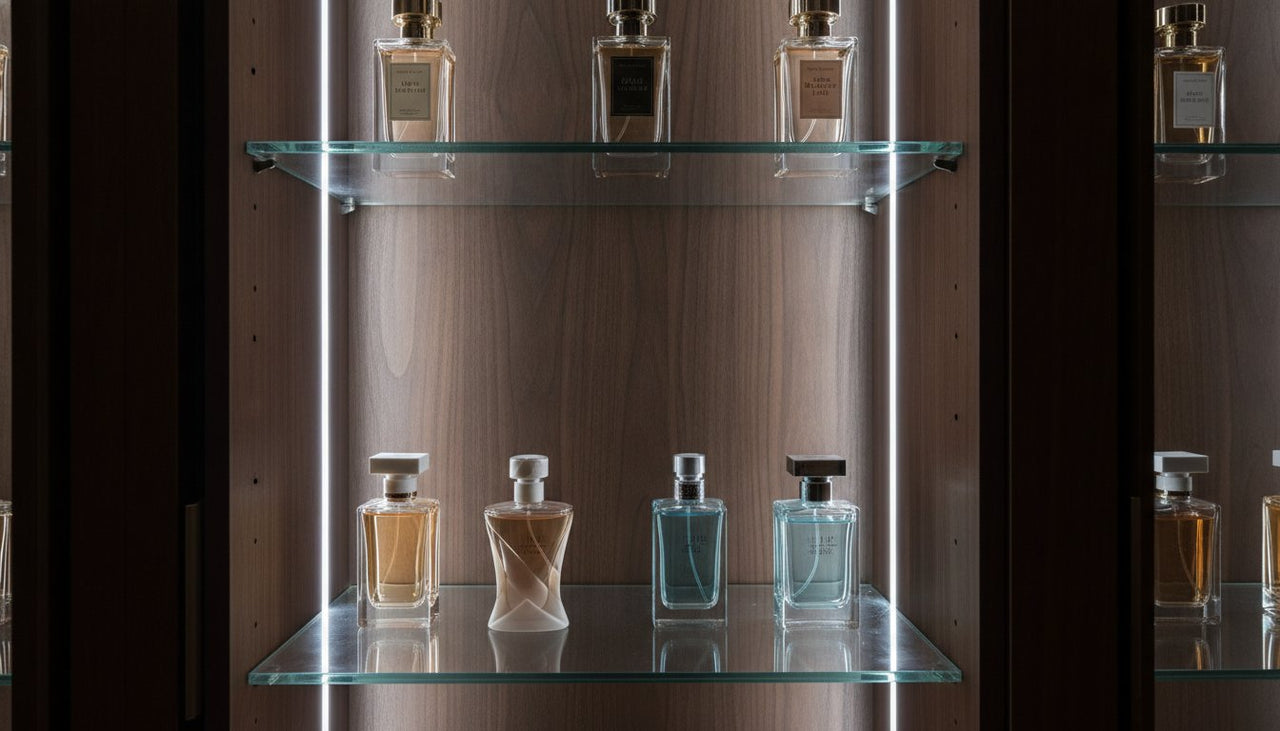
Heat above 75°F can destroy 60% of a perfume's top notes within a single year. It's a sobering reality for anyone who treats their collection as a serious investment. You've likely felt that sting of disappointment when a favorite bottle loses its edge or shifts into something unrecognizable. Deciding exactly where to store perfume shouldn't feel like a guessing game played with luxury goods. Whether you're balancing humidity levels below 60% or debating the merits of a dedicated fragrance fridge; the goal is absolute molecular stability. You deserve confidence that your Nishane or Amouage masterpieces will retain their intended profile for decades. This guide provides the precise engineering protocols you need to protect your olfactory assets from environmental decay. We'll break down the technical science of scent preservation and provide a definitive storage blueprint based on 2026 performance standards. Your collection is a functional art form. It's time to treat its maintenance with the same level of craftsmanship used to create it.
Key Takeaways
- Understand the chemical equilibrium of your fragrance to prevent oxidation from dismantling its complex olfactory pyramid.
- Identify the ideal environmental coordinates for where to store perfume to neutralize the silent threat of thermal turbulence.
- Separate performance-driven storage facts from marketing myths like the necessity of fragrance fridges or the impact of bottle agitation.
- Adopt the professional "Dark Closet Protocol" to ensure niche investments from houses like Xerjoff or Casamorati remain structurally sound for years.
The Silent Decay: Why Where You Store Perfume Dictates Its Life
A bottle of high-end fragrance is essentially a high-performance engine. It isn't just liquid in a glass vessel; it's a precise chemical equilibrium. Every molecule exists in a delicate suspension. When you disregard the technical requirements of where to store perfume, you invite environmental chaos into that arrangement. Oxidation is the primary antagonist here. This chemical process occurs when oxygen molecules penetrate the bottle and interact with the fragrance oils. It slowly dismantles the olfactory pyramid from the top down. It's a slow-motion collapse of the scent's architecture.
Mass-market designer scents are often engineered with heavy stabilizers to survive the harsh fluorescent lights of a department store. Niche extraits from houses like Amouage or Nishane are built differently. They utilize higher concentrations of natural raw materials. These materials are volatile. They're alive. From a Master Craftsman's perspective, your collection is a library of volatile art. It requires a curator's eye and a technician's discipline to maintain. If the storage environment is compromised, the very soul of the fragrance begins to fray.
The Molecular Architecture of Niche Scents
The complexity of niche perfumery is its greatest strength and its primary vulnerability. Artisanal brands like Xerjoff or Casamorati prioritize the purity of their ingredients. These natural oils react aggressively to oxygen and temperature shifts. The top notes vanish first. Citrus and light florals are the light-weight scouts of the perfume world. They're the most fragile. Once oxidation begins, these bright openings lose their vibrancy. You're left with a truncated, flat experience. Even if the heavier base notes like oud or amber seem stable, the intended balance is gone. Mastering the science of scent preservation is the only way to ensure your investment doesn't evaporate into chemical noise.
Signs Your Scent Has Surrendered to the Elements
Identifying a spoiled bottle requires a systematic diagnostic approach. Start with visual cues. Look for cloudiness or unusual sediment at the bottom of the glass. Discoloration is a major red flag. If your clear juice has turned a murky amber, the chemical bonds have shifted. The sniff test is your final confirmation. Does it smell like vinegar? Is there a sharp, metallic tang where there used to be a smooth transition? If the profile has warped, the molecular integrity has failed. Consulting with experts at a niche perfume boutique can help you recalibrate your senses and understand how to prevent future losses. Don't wait for the scent to turn. Proactive preservation is the hallmark of a true collector.
The Elemental Enemies: Light, Heat, and the Humidity Trap
Imagine your perfume as a liquid clock. Every photon of light and every degree of heat accelerates its gears. When considering where to store perfume, you aren't just looking for a convenient shelf; you're looking for a molecular bunker. UV radiation, thermal turbulence, and humidity act as a constant abrasive on the chemical structure of your scent. A single afternoon on a sun-drenched vanity can be a death sentence. It triggers a cascade of chemical breakdowns that no amount of cooling can later reverse. It's a cumulative decay that strips the soul from the bottle.
Ultraviolet Sabotage: Why Sunlight is Poison
Sunlight is a high-energy bombardment. Photons strike the aromatic compounds, triggering photochemical reactions that sever delicate chemical bonds. While synthetic molecules have some resilience, the natural oils found in niche extraits are highly vulnerable. Don't rely on tinted glass. Even dark bottles allow specific wavelengths to penetrate the liquid. Clear glass is even more demanding. It offers zero defense. If you leave a bottle of Bois Imperial in direct light, you're essentially cooking the formula. The top notes will sour, turning a bright opening into a dull, metallic mess.
The Bathroom Death Trap: Humidity and Heat Cycles
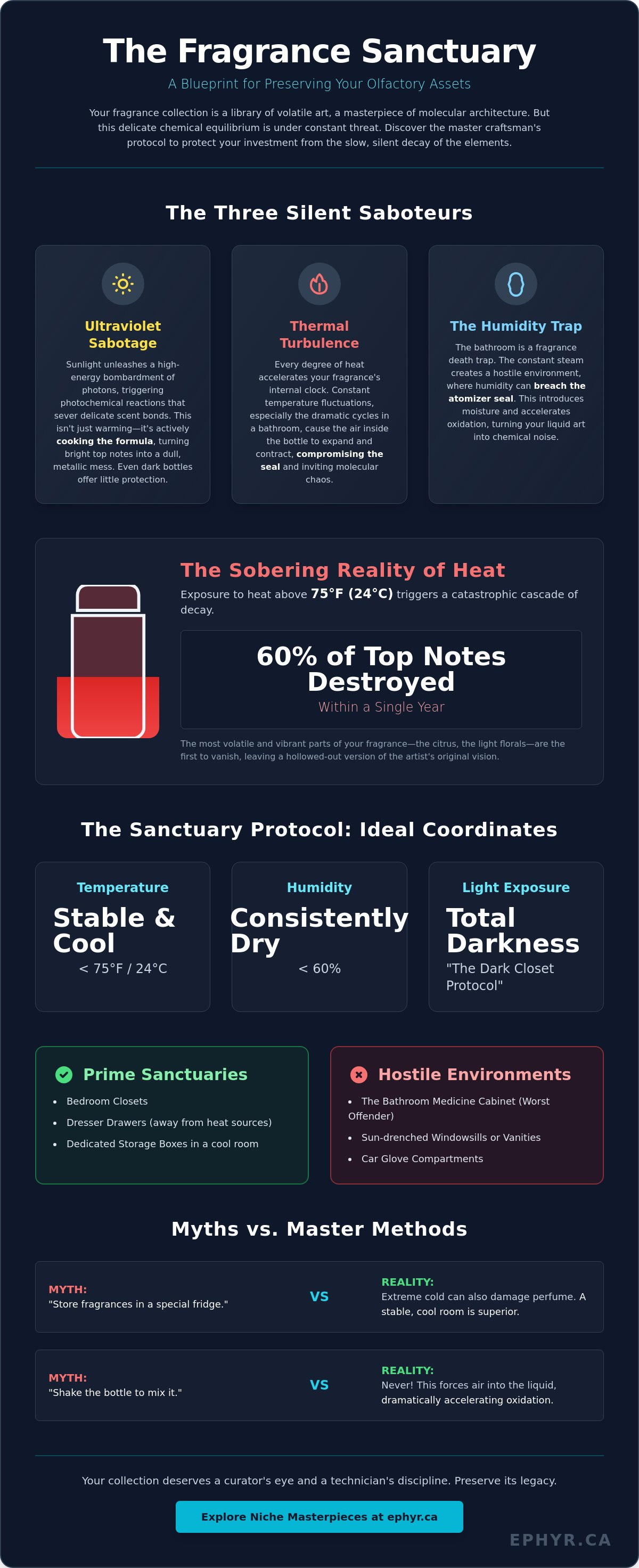
The bathroom is the most hostile environment in your home. It's a cycle of steam room conditions. Every shower creates a spike in temperature and humidity. This causes the air inside the bottle to expand and contract rapidly. This breathing effect can actually draw moisture through the atomizer seal. Humidity levels should remain below 60% to prevent seal degradation. When heat exceeds 75°F, you can lose 60% of a perfume's top notes in just twelve months. Deciding where to store perfume should never involve the medicine cabinet. It's a catastrophic choice for a luxury extrait.
To truly understand how to make your fragrance last, you must treat it like a vintage wine. Stability is the only metric that matters. If you've already noticed a shift in your collection, it might be time to start fresh with a curated discovery set to recalibrate your olfactory standards. Protecting your investment requires more than just a lid. It requires environmental discipline. One afternoon of neglect can undo years of careful preservation.
Myths vs. Master Craftsman Methods: The Great Storage Debates
The internet is a breeding ground for fragrance folklore. Much of it is dangerous to your collection. When you search for where to store perfume, you'll find influencers advocating for dedicated fridges while purists demand total darkness. The Master Craftsman ignores the noise and looks at the engineering. Your goal isn't just to keep the liquid cool; it's to maintain a constant, undisturbed state of matter. Stability is the only metric that matters. Any deviation from a controlled environment is a risk to the liquid's structural integrity.
The Refrigerator Debate: Chill or No Chill?
Fragrance fridges are often more aesthetic than functional. Extreme cold can be just as disruptive as high heat. The real threat isn't the temperature itself but the fluctuation. Removing a cold bottle from a 45°F fridge into a 75°F room causes immediate condensation. This moisture can compromise the atomizer seal or even the chemical balance of the juice. For long-term molecular stability, aim for a consistent range of 60°F to 70°F. If you must use a fridge for delicate natural formulations, keep it set to 45-55°F. Never treat it like a standard kitchen appliance. It's a precision tool, not a gimmick.
Kinetic Disruption: The Truth About Shaking
There's a persistent myth that shaking a bottle "wakes up" the scent. In reality, you're introducing oxygen into the liquid. This is aeration. It's the enemy of longevity. Excessive movement creates tiny air bubbles that increase the surface area of the liquid exposed to oxygen. This accelerates the oxidation process. Swirling is acceptable for discovery sets or 1ml fragrance samples; shaking is a structural violation. If your perfume has recently traveled or been shipped, let it rest. A 24-hour "still period" allows the molecules to settle back into their intended configuration. Kinetic energy has its place, but it isn't inside your perfume bottle.
Finally, consider the housing. Your original box isn't just packaging; it's a custom-engineered light shield. Discarding it for a "clean" aesthetic on an open shelf is a mistake. Similarly, decanting into travel atomizers is a high-risk maneuver. Every time you transfer liquid, you expose it to air and potential contaminants. This is why deciding where to store perfume is a decision that starts with the original vessel. Keep the seal intact as long as possible. A Master Craftsman values the integrity of the original build over the convenience of a smaller container.
Constructing Your Fragrance Sanctuary: Practical Storage Solutions
Setting up a sanctuary for your collection is an exercise in environmental engineering. You've already identified the enemies; now you need to build the defenses. The "Dark Closet" Protocol is the gold standard for serious collectors. It isn't just about finding a corner. It's about identifying the most stable microclimate in your home. When you decide where to store perfume, you're essentially looking for a vault that negates external variables. A deep, interior closet provides the thermal mass needed to resist outside temperature shifts. It's the most reliable way to ensure your liquid assets remain structurally sound.
Your original boxes are your first line of defense. Think of them as a custom suit of armor for your perfume. While it's tempting to display the intricate glasswork of a Xerjoff or Casamorati bottle, the cardboard housing provides a total UV blackout. For high-value vaults, intuition isn't enough. Use a digital hygrometer to monitor conditions. Keeping humidity below 60% and temperature between 60°F and 70°F ensures the internal configuration remains static. Data driven storage is the hallmark of a professional collector.
The Anatomy of a Perfect Scent Vault
Location is everything. Choose a spot away from external walls, which can radiate heat or cold depending on the season. Windows are non-negotiable zones of exclusion. Follow the "lower shelf" rule: since heat rises, the cooler air resides closer to the floor. This simple physics hack provides an extra layer of thermal protection. A climate-controlled environment is a year-round commitment. Consistency prevents the expansion and contraction that stresses the atomizer seals. Precision matters here.
Display vs. Preservation: The Collector’s Compromise
You don't have to hide everything. Use opaque trays or decorative cabinets with solid doors to block ambient light while keeping bottles accessible. A rotation strategy works best. Keep your "active" seasonal scents on a tray in a shaded area of your bedroom and move the rest into deep storage. If you love the aesthetic of the glass, showcase empty bottles on your vanity. Keep the full ones protected. This balance allows you to enjoy the art without risking the engineering. It's about maintaining the integrity of the juice above all else. If you're interested in selecting the right lighting for the rest of your home, read more.
If you're ready to build a collection worth protecting, explore our curated selection of niche fragrances and find your next long-term investment. Every masterpiece deserves a sanctuary.
Curating a Legacy: Protecting Your Niche Investment
With the niche perfume market projected to reach €4.85 billion in 2026, your collection is a significant financial and cultural asset. A legacy collection begins long before you decide where to store perfume. It starts with the structural integrity of the bottle itself. High-end perfumery is as much about the vessel's engineering as the liquid inside. Superior seal integrity and heavy, high-grade glass aren't just aesthetic choices; they are functional barriers against molecular decay. When you invest in a house like Amouage Perfume, you're acquiring a formula built for generational longevity. These compositions utilize high-grade resins and natural oils that mature with grace. Similarly, Xerjoff Perfumes sets the industry standard for hardware, using precision-milled caps and atomizers designed to minimize air intrusion. This is where high-end art meets industrial performance.
The expertise found at a niche perfume boutique is your most valuable diagnostic tool. These spaces act as laboratories of education for the modern connoisseur. A Master Craftsman understands that the provenance of a bottle dictates its future stability. Buying from authorized sources ensures the liquid hasn't been compromised by poor warehouse conditions or improper transit before reaching your hands. It’s the difference between a pristine, high-performance instrument and a damaged relic.
The Buying Process: Ensuring Freshness
Boutique sourcing is non-negotiable for the serious collector. Grey-market "bargain" sites often offload stock that has languished in unconditioned environments. This initial heat exposure can kickstart the oxidation process before you even break the seal. Always verify batch codes. Checking production dates ensures you're receiving the freshest possible batch for optimal shelf life. Authenticity isn't just about the scent profile; it's about the vacuum. Authorized retailers guarantee that the internal environment of the bottle remains pristine until that first spray.
Final Advice for the Modern Connoisseur
Treat your fragrance like a technical instrument. It requires calibration and environmental respect. There is a profound psychological reward in knowing your signature scent remains exactly as the perfumer intended. It’s a quiet confidence. Before you finalize your setup, perform a final environmental audit of your space. Check the light levels. Verify that humidity remains below 60%. Ensure the temperature is stable between 60°F and 70°F. Your collection is a living history. Protecting it is an act of disciplined craftsmanship. Your future self will appreciate the technical rigor you apply today. If you've mastered where to store perfume, you've mastered the art of olfactory preservation.
Secure the Future of Your Fragrance Collection
Preserving a high-end scent isn't an afterthought; it's a technical commitment to the craft. You've learned that thermal turbulence and UV exposure are the primary catalysts for molecular decay. By implementing the Dark Closet Protocol and rejecting the myths of the fragrance fridge, you ensure your investment remains structurally sound. Deciding where to store perfume is the final step in a journey that begins with sourcing elite engineering from the right hands. As an official retailer for Amouage, Xerjoff, and Nishane, we provide the expert guidance needed to navigate this complex landscape. We offer fast, secure shipping to collectors across all Canadian provinces, ensuring your next masterpiece arrives with its seal integrity perfectly intact. It's time to build a sanctuary that matches the quality of the liquid it holds. Explore our curated collection of masterfully engineered niche fragrances and start your next chapter with confidence. Your collection is a legacy. Treat it with the technical respect it deserves. You have the protocol. Now, curate with certainty.
Frequently Asked Questions
Can I store my perfume in the fridge to make it last longer?
Refrigeration is beneficial only for specific natural or citrus-heavy formulations that require a stable 45 to 55°F environment. Most standard kitchen fridges are too cold and fluctuate too often. The real danger is the condensation that forms inside the bottle when you move it between the cold fridge and a warm room. For the majority of niche collections, a consistent room temperature is the safer engineering choice.
How long does a bottle of perfume typically last if stored correctly?
An opened Eau de Parfum generally maintains its structural integrity for 3 to 5 years. Natural perfumes have a tighter window of 2 to 4 years due to their volatile ingredients. If you maintain strict environmental controls, you can push these boundaries. Some collectors report that well-sealed extraits remain pristine for over a decade when protected from light and heat cycles.
Does perfume really expire or just change its scent?
Perfume undergoes a chemical shift rather than a traditional expiration. Oxidation dismantles the molecular bonds of the fragrance oils, leading to a permanent change in the olfactory profile. While the liquid is rarely harmful to the skin after this shift, the artistic intent is lost. You'll notice the bright top notes vanish, replaced by a flat, metallic, or vinegary aroma.
Is it okay to keep perfume in its original box?
The original box is a custom-engineered light shield and should always be retained. It provides a total UV blackout that prevents photons from triggering photochemical decay. When you are deciding where to store perfume, the box acts as a portable sanctuary. It allows you to organize your collection on a shelf without exposing the glass to ambient light damage.
What happens if I leave my perfume in a hot car?
A hot car acts as an oven that rapidly cooks the fragrance's chemical structure. Temperatures inside a vehicle can spike well above 100°F, causing the liquid to expand and potentially compromise the atomizer seal. This extreme thermal stress can destroy the delicate top notes of a high-end extrait in just a few hours. The damage is cumulative and irreversible.
Can I store my perfume in the bathroom if it is in a cabinet?
Even a closed cabinet cannot fully insulate a bottle from the humidity spikes of a bathroom. Daily showers create a "steam room" effect that pushes humidity levels above the recommended 60% threshold. This moisture can seep into the bottle and degrade the fragrance oils over time. It's best to move your collection to a bedroom closet where the air remains dry and stable.
Does the colour of the perfume bottle affect how it should be stored?
Bottle opacity determines the level of environmental discipline you must apply. Clear glass offers no defense against UV radiation, making it the most vulnerable vessel in your collection. While darker glass provides a minor filter, it isn't a total shield. Regardless of the glass tint, where to store perfume should always be a space that guarantees total darkness for maximum molecular stability.
How can I tell if my perfume has gone bad?
Start with a visual diagnostic to check for cloudiness, unusual sediment, or a darkened liquid color. The ultimate test is the olfactory profile. If the scent opening feels sharp, plastic, or reminiscent of nail polish remover, the chemical equilibrium has failed. A spoiled perfume loses its transition between notes, resulting in a flat, one-dimensional smell that lacks its original complexity.
Article by
Dmitrii Savishin
Dmitrii Savishin is the founder of Maison Ephyr and Parfum Exquis, two Canadian destinations dedicated to the world of niche perfumery. With years of experience discovering exceptional fragrance houses from around the globe, Dmitrii shares expert insights on perfume trends, fragrance notes, luxury brands, and the art of choosing the perfect scent. His mission is to make niche perfumery more approachable while helping readers discover fragrances that leave a lasting impression.


