

A great fragrance isn't just a smell. It's a structural masterpiece of invisible architecture. Most enthusiasts search for a signature but end up with scents that dissolve into a synthetic whisper after an hour. You've likely felt the frustration of a perfume that promises a rugged cedar forest but delivers a shallow chemical trail instead. It's often difficult to distinguish between the heavy structural timber of a base note and the sharp, herbal electricity of an aromatic top.
We believe your scent should function like a high-performance instrument. This guide reveals the technical precision behind woody aromatic fragrances so you can find a niche masterpiece that actually lasts. We'll show you how to identify the premium ingredients used by master craftsmen at houses like Amouage and Nishane. You'll also learn how the 2025 IFRA 51st Amendment has reshaped the industry's approach to ingredient quality. We're moving past the marketing fluff to explore the olfactory pyramid and the engineering logic of the world's finest scents. It's time to treat your fragrance as a long-term investment in artisanal excellence.
Key Takeaways
- Learn how to distinguish the structural timber of noble woods from the volatile spark of herbal aromatics in high-end scent construction.
- Identify the "high-frequency" ingredients like rosemary and mint that provide the immediate impact and sharp clarity of an olfactory masterwork.
- Discover why cedarwood acts as an architectural beam, providing the dry strength and internal configuration needed for a balanced, sophisticated scent.
- Understand the technical metrics of sillage and projection to ensure your woody aromatic fragrances bond effectively for maximum skin-contact durability.
- Explore the curated engineering of niche houses like Xerjoff and Amouage to find a signature that reflects your personal aesthetic and professional standards.
Defining the Woody Aromatic Architecture
Think of woody aromatic fragrances as a form of liquid engineering. This category exists at the precise intersection of structural timber and volatile herbal elements. In the eyes of a Master Craftsman, these aren't just pleasant smells; they're functional art. The wood provides a dense, reliable foundation. The aromatics provide the kinetic energy, or the spark, that brings the structure to life. While many mass-market retailers pigeonhole this category as exclusively masculine, that's a narrow perspective. Modern niche perfumery treats these compositions as architectural statements. They're gender-neutral landscapes defined by their strength and clarity. The journey begins with a sharp, herbal freshness that gradually settles into a profound, resonant depth.
The Olfactory Blueprint
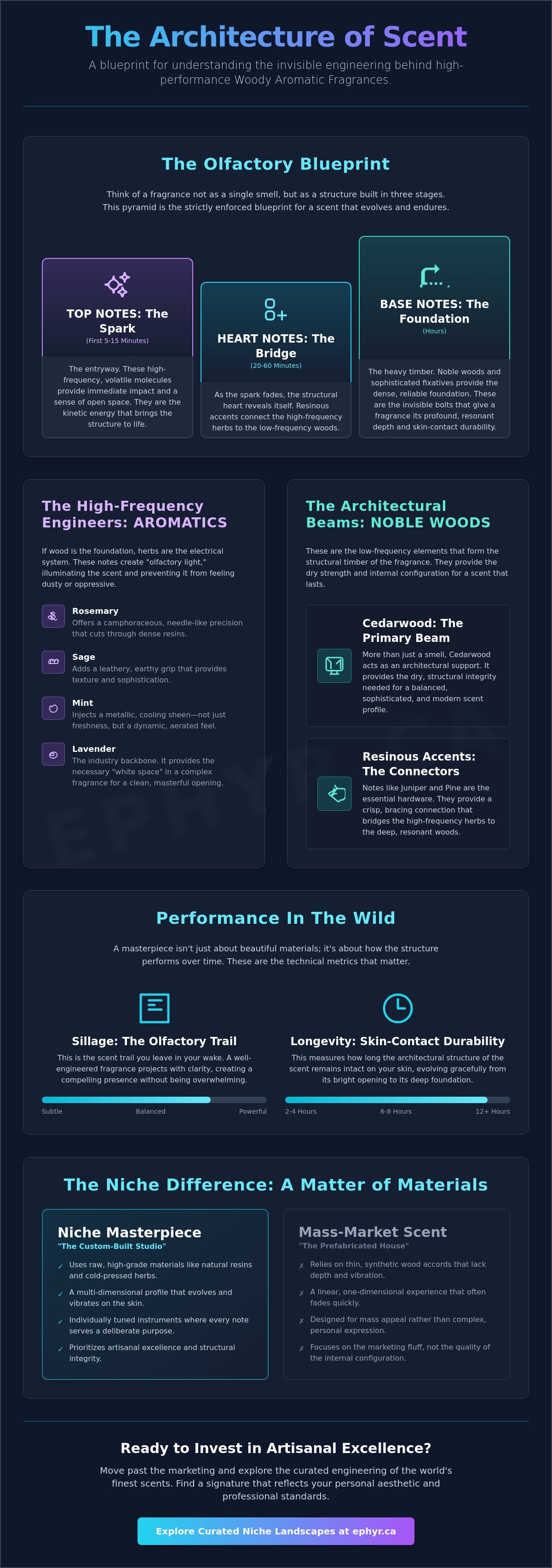
Every great build starts with a blueprint. In this sector of the olfactory families, the three-tier pyramid is strictly enforced. Aromatic notes like lavender, rosemary, or sage serve as the entryway. They're the first thing you encounter; they're designed to provide immediate impact and a sense of open space. As these high-frequency molecules evaporate, the structural heart reveals itself. This is where the transition occurs. To maintain this structural integrity over eight or twelve hours, we rely on sophisticated fixatives. These aren't fillers. They're the invisible bolts that keep the aromatic spark tethered to the heavy wood base.
Why Niche Matters
The difference between a mass-market scent and a niche masterpiece is found in the internal configuration. Designer scents often rely on thin, synthetic wood accords that lack vibration. Niche houses like Amouage or Xerjoff use raw, high-grade materials that offer a multidimensional profile. These are individually tuned instruments. When you visit a niche perfume boutique Toronto enthusiasts trust, you'll notice the density of the liquid itself. Niche woody aromatics prioritize the raw power of natural resins and cold-pressed herbs. This results in a fragrance that doesn't just sit on the skin; it evolves with it. It's the difference between a prefabricated house and a custom-built studio. Every note serves a purpose. Every layer is intentional.
The Anatomy of Aromatics: Herbs and Greenery
If the wood is the foundation, herbs are the electrical system. In the world of woody aromatic fragrances, notes like lavender, rosemary, sage, and mint function as high-frequency elements. They provide the immediate impact that greets your senses. Master craftsmen use these green notes to create "olfactory light." Without them, a heavy cedar or sandalwood base can feel dusty or oppressive. These aromatics illuminate the internal configuration of the scent. They ensure the composition remains aerated and dynamic. They prevent the "olfactory stall" where a scent becomes too heavy to move or evolve on the skin.
These ingredients are the high-speed processors of the fragrance world. Rosemary offers a camphoraceous, needle-like precision that cuts through dense resins. Sage adds a leathery, earthy grip that provides texture. Mint isn't just for freshness; it adds a metallic, cooling sheen to the green profile. Together, they create a sense of movement. They bridge the gap between the initial spray and the long-term dry down. If you want to experience this high-frequency engineering firsthand, exploring Discovery Sets is the most efficient way to see how these notes interact with your unique skin chemistry.
The Lavender Standard
Lavender is the backbone of the aromatic world. It is the industry standard for a reason, but not all lavender is engineered the same. French lavender offers a refined, floral sweetness that softens sharp edges in a composition. It is often preferred for its high linalool content. Bulgarian lavender is different. It is more rugged, earthy, and herbal. It provides a medicinal clarity that feels sophisticated rather than rustic. This ingredient creates a clean opening that doesn't feel like soap; it feels like a freshly drafted blueprint. It provides the necessary "white space" in a complex fragrance.
Resinous Accents
Juniper and pine act as the bridge. They connect the low-frequency woods to the high-frequency herbs. These notes provide a crispness that is essential for performance. In the shifting climates of Canada, these resinous accents are vital. They cut through the damp air of spring and the biting cold of winter. They maintain the structural integrity of the spicy woody olfactory family without losing their edge. These notes are the structural bolts of the scent. They ensure the transition from the herbal spark to the timber foundation is seamless and stable.
Structural Integrity: The Role of Noble Woods
Every architectural masterpiece needs a frame. In woody aromatic fragrances, that frame is built from noble woods. We don't use the word "noble" lightly. It refers to materials that possess a specific density and chemical stability. Cedarwood is our architectural beam. It provides a dry, clean strength that keeps the composition from sagging. Unlike mass-market synthetics, high-grade cedar has a "pencil-shaving" sharpness that feels precise and intentional. It creates a verticality in the scent, lifting the herbal notes we discussed earlier and giving them a place to rest.
Purity isn't just a luxury; it's a performance metric. With the IFRA 51st Amendment enforcement in late 2025, the industry has faced tighter restrictions on ingredients like Geraniol and Eugenol. A master craftsman doesn't see these as hurdles. They're benchmarks for quality. Using high-grade, compliant resins ensures that the structural integrity remains intact without relying on banned allergens. If the raw material is low-grade, the entire olfactory structure collapses within hours. Patchouli acts as the bedrock in these builds. It's earthy, damp, and dark. It gives the fragrance a sense of gravity and historical weight.
Sandalwood vs. Cedarwood
Cedarwood is for those who value clarity and a "dry" profile. It's sharp. It's professional. Sandalwood is the creamy counterpoint. While cedar is vertical and sharp, sandalwood is horizontal and smooth. It provides a dense, milky performance that anchors the lighter elements. If your goal is a crisp, office-ready presence, cedar is your primary material. For a more intimate, long-lasting trail, look for sandalwood-heavy builds. You can find these specific technical configurations in our guide to cologne for men, which breaks down wood-heavy recommendations for different environments.
The Vetiver Variable
Vetiver is the secret weapon of the woody aromatic group. It's technically a grass, but its root system produces an oil that behaves like a wood. It has a dual nature. It's smoky and earthy, yet strangely fresh. This makes it the perfect stabilizer. Vetiver molecules are large and heavy. They don't evaporate quickly. This makes them a key component for long-term durability on the skin. It acts as a fixative, binding the volatile herbs to the heavy woods. It's the glue that holds the blueprint together. Without it, the "spark" of the aromatics would have nothing to hold onto.
Performance in the Wild: Sillage and Longevity
Performance in niche perfumery isn't a matter of chance. It's a result of deliberate molecular engineering. When we discuss how woody aromatic fragrances behave, we look at two primary metrics: projection and sillage. Projection is the reach of the scent, or how far the molecules travel from your skin into the immediate environment. Sillage is the aerodynamic wake of a scent. It's the invisible trail left behind as you move through a room. While the herbal "spark" provides the initial projection, the noble woods we've discussed act as the ballast. They ensure the fragrance doesn't just vanish into the air but maintains a consistent presence for eight to twelve hours.
The Canadian climate serves as the ultimate stress test for any olfactory structure. Cold, dry air is notorious for stripping moisture from the skin. This lack of humidity causes volatile top notes to evaporate at an accelerated rate. In these conditions, a fragrance can feel "muted" or thin. Woody aromatic compositions are uniquely suited for this environment. The heavy molecules in cedar and sandalwood bond to the skin's lipids more effectively than citrus or floral notes. They provide a thermal stability that keeps the herbal elements tethered even when the temperature drops. To ensure your scent survives the elements, follow this performance checklist when testing a new build:
- The Reach: Does the scent project at least an arm's length during the first two hours?
- The Evolution: At the four-hour mark, can you still detect the herbal "spark" or has it collapsed into a flat wood base?
- The Wake: Does the fragrance leave a detectable trail in your path after six hours of wear?
Engineering for Longevity
Concentration levels dictate the internal pressure of the fragrance. An Eau de Toilette is designed for a quick burst of energy, while an Eau de Parfum or an Extrait offers a denser molecular configuration. In woody compositions, these higher concentrations allow the base-heavy notes to act as permanent anchors for the volatile aromatics. This prevents the "fade-out" effect common in mass-market designer scents. You aren't just wearing a smell; you're wearing a calibrated system of release.
The Discovery Process
Skin chemistry is a biological reality, not a marketing myth. Your skin's pH levels and lipid content will warp the scent profile of even the most stable fragrance. This is why we advocate for testing via luxury fragrance samples Canada enthusiasts use to vet their collections. Testing a 1ml sample over several days allows you to observe how the woods and herbs react to your specific biology. Before committing to a full-scale investment, explore our range of perfume samples Canada to find the exact technical match for your skin. Secure a discovery set today to begin your technical evaluation.
The Ephyr Selection: Curated Niche Landscapes
Maison Ephyr does not operate as a high-volume warehouse. We function as a boutique studio. Every entry in our catalog is an individually tuned instrument, selected for its technical merit and structural integrity. For the enthusiast seeking the peak of woody aromatic fragrances, curation is the final step in the engineering process. We've vetted the global market to bring only the most resilient and imaginative builds to Canada. This selection isn't about trends. It's about identifying the internal configuration of a scent and ensuring it meets our proprietary benchmarks for excellence. From the resinous depths of Oman to the citrus-sharp precision of Italy, these are the landscapes we've mapped for your collection.
Amouage: The Gift of Kings
In the hierarchy of olfactory architecture, Amouage remains the pinnacle. Their compositions are characterized by a density that mass-market brands cannot replicate. A primary reason for this is their use of Omani silver frankincense. This isn't just a top note; it's a structural resin that provides a smoky, mineral foundation for the entire build. Consider "Beach Hut Man" as a technical study in contrast. It pairs a high-frequency ivy and mint opening with a heavy vetiver and patchouli base. It's a rugged, green landscape engineered for maximum durability. Similarly, "Reflection Man" uses rosemary and cedarwood to create a clean, metallic sheen that projects with professional certainty. These aren't just perfumes. They're high-performance assets.
Xerjoff: Olfactory Artistry
If Amouage is about density, Xerjoff is about Italian precision. Their approach to woody aromatics is clinical yet imaginative. The "1861" collection, particularly Renaissance, is a masterclass in blending high-grade citrus with dry, herbal woods. They prioritize the raw power of their materials. Every bottle in the "Join the Club" series, such as 40 Knots, showcases a proprietary method of layering salty, woody notes with green aromatics. The result is a scent that feels like a custom-built instrument. It's balanced, sophisticated, and capable of maintaining its sillage even in the most demanding environments. This is the intersection of raw technology and luxury goods.
The "Bois Imperial" phenomenon from Essential Parfums also deserves your attention. It's a masterwork of minimalist elegance. By focusing on a high-grade Akigalawood note, it achieves a dry, peppery woodiness that feels modern and uncluttered. It's a functional art piece designed for daily use. Whether you're exploring the bold offerings of Borntostandout or the refined textures of Nishane, Maison Ephyr serves as your Master Craftsman curator. We provide the technical expertise to help you find a signature that doesn't just smell good but performs with structural authority. Every 1ml sample or full bottle is a long-term investment in your personal architecture.
Construct Your Signature Landscape
You now understand the internal configuration of an olfactory masterpiece. High-end woody aromatic fragrances aren't just pleasant scents; they're resilient structures built from noble woods and high-frequency herbs. We've explored how cedar provides the structural frame while aromatics provide the kinetic energy. This technical logic is what ensures your fragrance survives the dry Canadian air and projects with quiet confidence. Every note serves a specific purpose in the overall architecture of the scent.
As an official retailer for Amouage, Xerjoff, and Nishane, we provide the high-performance hardware for your identity. We offer authentic 1ml discovery samples for precise biological testing and fast shipping across Canada to ensure your collection evolves at speed. Don't settle for synthetic echoes that fade before noon. Explore our curated collection of woody aromatic masterpieces to find a build that matches your professional standards. It's time to invest in a signature that reflects your appreciation for artisanal engineering. We look forward to helping you blueprint your next great discovery.
Expert Insights on Woody Aromatic Fragrances
What is the difference between woody and woody aromatic fragrances?
Woody fragrances focus primarily on the dry, resonant base of timber like cedar or sandalwood. Woody aromatic fragrances integrate a secondary layer of "green" energy through herbal elements. This addition transforms a static, heavy scent into a dynamic composition with a sharp, vibrating opening. The aromatics act as a light source for the dense wood, providing movement and aeration to the overall structure.
How long should a high-quality woody aromatic fragrance last?
A well-engineered niche fragrance should provide active performance for 8 to 12 hours. This duration depends on the concentration levels and the molecular weight of the base notes. While the herbal spark might settle after four hours, the noble woods should maintain a clear skin-level presence throughout the day. If a scent vanishes within three hours, the structural integrity is likely compromised by low-grade synthetics.
Are woody aromatic scents suitable for all seasons?
These compositions are exceptionally versatile across the Canadian calendar. The herbal freshness provides clarity during the high heat of summer, while the dense wood foundation offers the necessary weight for winter. It's a year-round structural solution for your collection. You don't need to swap your signature as the temperature shifts because the internal configuration adapts to different thermal environments effortlessly.
Can women wear woody aromatic fragrances?
Gender is irrelevant in high-end olfactory architecture. Many modern niche builds prioritize clean lines and herbal precision over traditional floral or musky stereotypes. These scents appeal to anyone who values a professional, grounded, and sophisticated presence. It's about the aesthetic of the build and the quality of the materials, not the gender of the user. Many women prefer the disciplined, calm energy of a wood-heavy profile.
What are the most common "aromatic" notes in niche perfumery?
Beyond the standard lavender and rosemary, niche houses often utilize clary sage, thyme, and basil. These ingredients offer a more complex, leathery, or spicy profile than mass-market greenery. They provide a textured "grip" that helps the scent bond to the underlying wood. These notes function as the electrical system of the fragrance, providing the kinetic energy required to keep the heavy base notes from becoming stagnant.
How do I test a woody aromatic scent to ensure it works with my skin chemistry?
Use a 1ml discovery sample to observe the fragrance over a full 24-hour cycle. Apply the scent to clean skin and avoid rubbing the area, which can break down the delicate herbal molecules. Monitor how the transition from the herbal top to the woody base occurs over the first four hours. This allows you to evaluate the sillage and projection in your specific environment before committing to a full bottle.
Why are niche woody aromatics more expensive than designer ones?
The cost reflects the purity of the raw materials and the complexity of the internal configuration. Mass-market brands often use thin, synthetic wood accords to cut costs and maximize volume. Niche houses invest in high-grade resins and cold-pressed herbs that meet strict IFRA standards while maintaining a multidimensional profile. You're paying for a finely tuned instrument that offers superior longevity and a more sophisticated evolution on the skin.


