
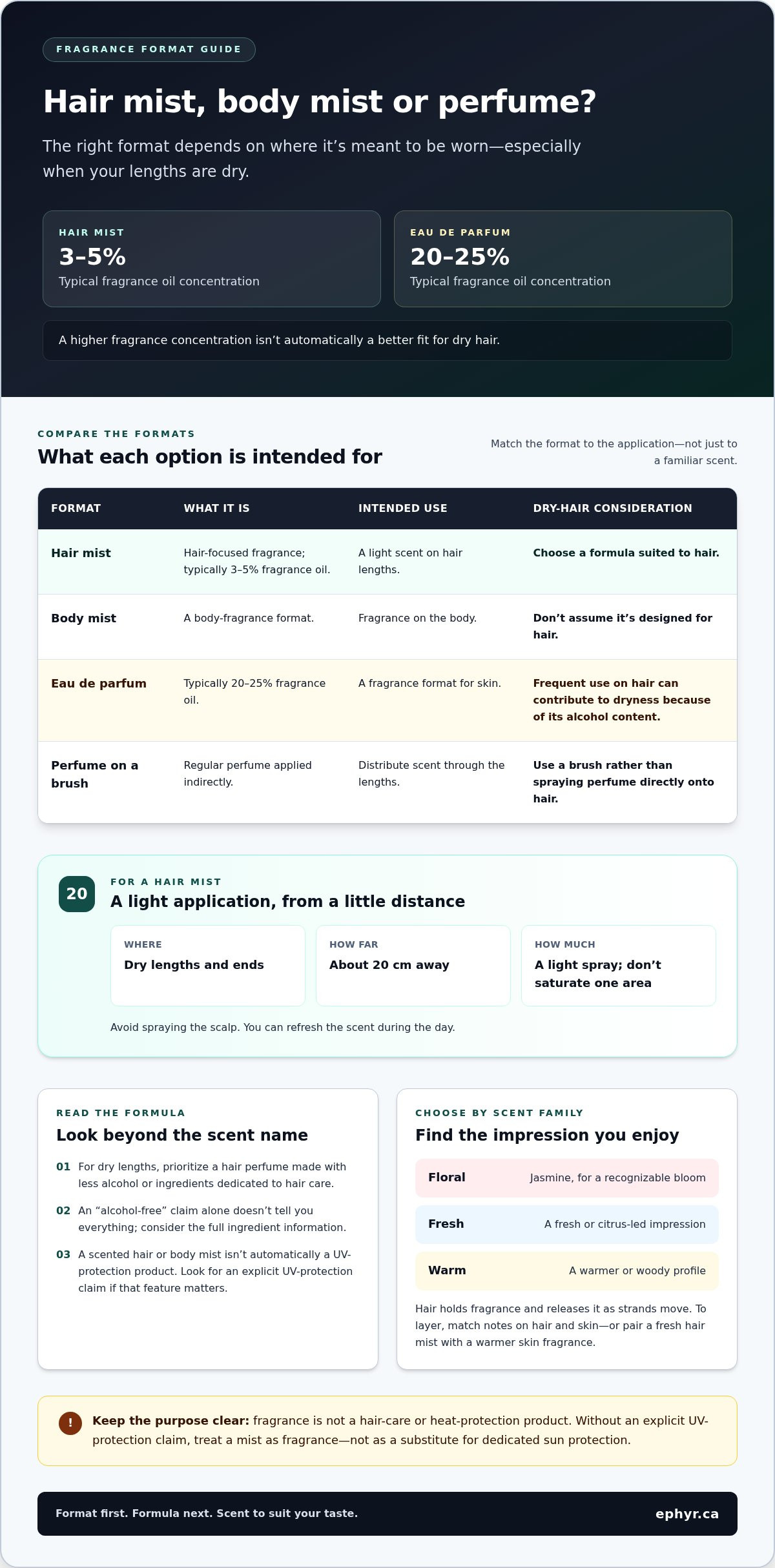
The best hair perfume for dry hair is a hair-specific mist with less alcohol or ingredients designed for hair care, rather than a regular eau de parfum. Hair mists typically contain 3 to 5% fragrance oil, compared with 20 to 25% in eau de parfum. The higher concentration isn’t automatically the better fit for dry lengths.
It’s easy to assume that a hair mist, a body mist and a perfume are interchangeable when they share a scent. But where and how a fragrance is intended to be worn matters, especially when your hair already feels dry.
This guide compares hair and body mists with other fragrance options, explains what to consider in a formula and how frequent use of alcohol-rich fragrance may affect hair. You’ll also find a practical way to compare sizes and prices, then weigh scent, formula and value before choosing.
Key Takeaways
- Compare a hair mist’s intended use and fragrance concentration with regular perfume before choosing what to apply to dry lengths.
- Learn how formula and alcohol content can affect dry hair, and what to look for when reading product details.
- Apply hair perfume to dry lengths and ends from about 20 cm away, rather than spraying the scalp.
- Use the comparison of formats, bottle sizes and prices to weigh convenience and value for the Canadian market.
- Follow the decision guide to narrow your options by formula, scent preference and how you plan to wear the fragrance.
How is a hair perfume different from other fragrances?
A hair perfume is designed to leave fragrance on your hair without weighing it down. A hair mist typically contains 3 to 5% fragrance oil, while eau de parfum typically contains 20 to 25%. That difference helps explain why a hair fragrance is usually a lighter format than the perfume you apply to skin.
Hair also wears scent differently. Strands hold fragrance and release it as they move, so a subtle jasmine mist can leave a soft trail when you turn your head. For a more lasting impression, layer a hair mist with a related skin fragrance. Choose matching notes, such as jasmine in both, or pair a fresh hair mist with a warmer scent on skin for contrast.
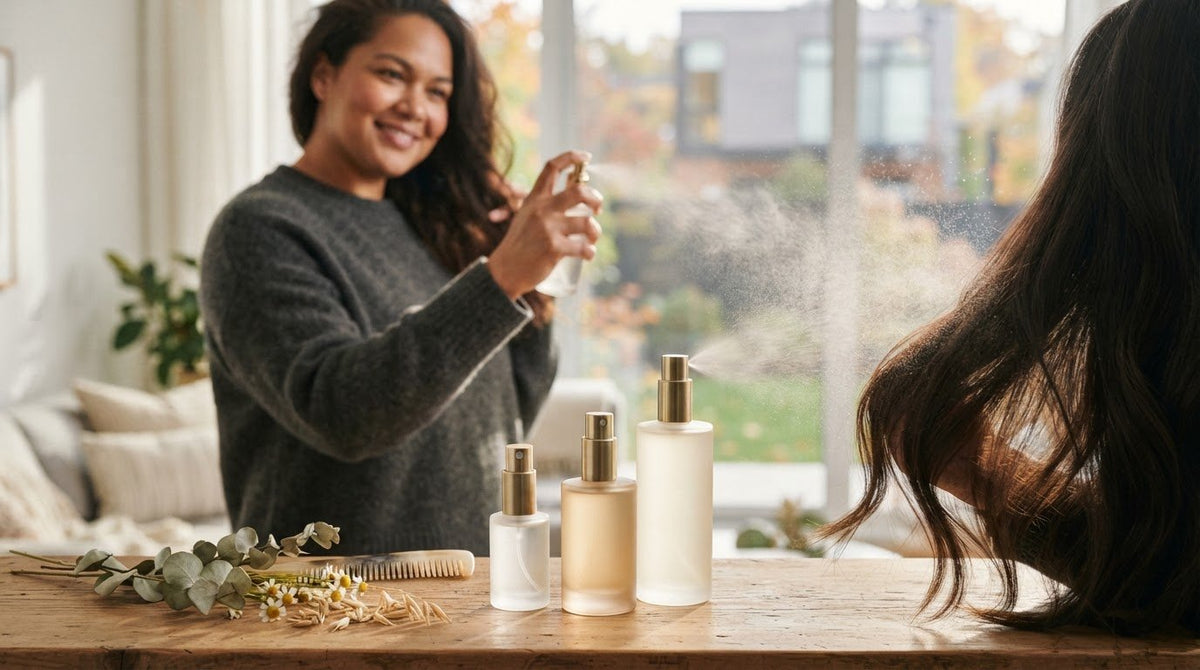
For dry hair, apply the mist to dry lengths and ends, avoiding the scalp. Hold the bottle about 20 cm away and use a light spray rather than saturating one area. You can refresh it during the day. If you want to use regular fragrance, spray it onto a brush and comb through the lengths instead of applying it directly to your hair.
Fragrance and UV protection serve different purposes. A scented hair or body mist isn’t automatically a UV-protection product. If that feature matters to you, look for an explicit UV-protection claim. Without one, treat the mist as fragrance, not as a substitute for dedicated sun protection.
Organize hair perfume options by scent family, not just by bottle. A floral option such as jasmine suits those who enjoy a recognizable bloom. A fresh or citrus-led mist gives a different impression, while a warm or woody fragrance adds depth. If you want to coordinate with a skin fragrance without choosing a full bottle, try a sample first.
| Option | Format and fragrance | Best use | Dry-hair consideration |
|---|---|---|---|
| Hair mist | Hair-focused; typically 3 to 5% fragrance oil | Light scent on lengths | Choose a formula suited to hair |
| Body mist | Body fragrance format | Fragrance on the body | Don’t assume it’s designed for hair |
| Eau de parfum | Typically 20 to 25% fragrance oil | Skin fragrance | Use a brush rather than spraying directly |
| Fragrance on a brush | Regular perfume applied indirectly | Distribute scent through lengths | Avoid concentrated direct application |
Choose a hair mist for direct use on hair, a body mist for the body, or apply your favourite eau de parfum to a brush to distribute its scent lightly through your hair.
Editor-tested hair perfume recommendations
Build your shortlist around two checks: the scent profile you enjoy and whether the formula is intended for hair. These criteria help distinguish a hair mist from regular parfum, without assuming every scented mist performs the same way.
Which hair perfumes last longest without drying out hair? Look for a hair perfume made with less alcohol or ingredients dedicated to hair care, then consider how its scent develops as your hair moves. How long a fragrance lasts depends on the formula and application; choosing a stronger regular perfume isn’t a substitute for a hair-focused product.
Scent-Profile Recommendations
If you prefer florals, look for a hair mist with notes such as jasmine. This offers a clear, familiar direction compared with fresh, citrus-led scents or warmer, woody profiles. The point is to match the scent family to your taste, not to assume floral formulas are more nourishing or last longer.
To narrow your options, decide whether you want a light, clean impression or a more noticeable trail. Hair releases fragrance with movement, so a scent that feels subtle at first may become more apparent as strands shift. Compare the listed notes and choose a profile you’ll be happy to notice throughout the day.
Unisex Hair Perfume Picks
Unisex hair perfumes are a useful starting point if you prefer choosing by scent rather than a gender label. Compare the actual notes: jasmine-led florals, fresh accords and woody scents each create a different impression, whatever the marketing says.
This approach differs from choosing a fragrance by a familiar brand or a “for him” or “for her” label. If a name such as Sol de Janeiro is already part of your scent vocabulary, use it to recall the profiles you gravitate toward, not as proof that a particular product suits dry hair. The formula still matters.
Long-Lasting, Non-Drying Picks
For dry lengths, prioritize a hair perfume formulated with less alcohol or hair-care ingredients over regular eau de parfum. Frequent use of eau de parfum on hair can contribute to dryness because of its alcohol content. An alcohol-free claim alone doesn’t tell you everything about a formula, so consider the full ingredient information.
Apply fragrance sparingly: mist the lengths and ends rather than the scalp, and avoid saturating one section. If you want to wear a regular fragrance, applying it to a brush is another way to distribute scent through your hair. Neither approach makes fragrance a hair-care or heat-protection product.
Use this shortlist as a comparison tool, not as a ranking based on invented wear tests. For each option, note its scent family, whether it’s designed for hair, and what the formula says about alcohol or hair-care ingredients. A floral mist may suit someone seeking jasmine; a fresh or woody profile may better match someone else’s preferred scents.
Then choose a format that fits your routine. A dedicated hair fragrance is intended for hair, while a body mist is made for the body; the labels aren’t interchangeable. To layer scents, pair compatible notes on hair and skin, keeping the hair product’s formula and directions in mind.
Hair perfume ingredients and potential drying effects
When dry hair is part of the decision, formula matters more than the fragrance name. Frequent use of eau de parfum on hair can contribute to dryness because of its alcohol content. Hair perfumes are often made with less alcohol or ingredients dedicated to hair care. That makes the ingredient list more useful than a beauty claim on the front of the bottle.
Are hair perfumes suitable for colour-treated, curly, or sensitive-scalp hair? A fragrance label alone doesn’t establish compatibility with colour-treated or curly hair, and a scented product isn’t automatically suitable for sensitive scalps. Apply hair perfume to the lengths and ends, not the scalp, and review the product’s stated ingredients and directions before use.
Some formulas are described as alcohol-free and as not drying hair out. Treat that wording as a formula claim, not a promise that every hair type will respond identically. Read the full ingredients: hair-care ingredients may distinguish a hair perfume from regular fragrance, while notes such as sandalwood describe its aroma, not its conditioning effect.
- Alcohol: Frequent eau de parfum use on hair can contribute to dryness.
- Hair-care ingredients: Their presence can signal a formula designed with hair in mind.
- Fragrance notes: Jasmine or sandalwood identifies scent character, not moisture performance.
- Product claims: “Alcohol-free” describes a formula claim; it doesn’t make fragrance a conditioner.
When shopping, separate conditioning claims from fragrance descriptions. A product can smell like sandalwood without offering conditioning benefits. Likewise, evaluate a formula described as nourishing by its listed ingredients and directions, not by scent or packaging alone. This keeps the comparison focused on what the formula says it does.
For a practical routine, start with dry hair and apply a light mist to the lengths and ends. Keep it away from the scalp, then let the fragrance settle before deciding whether to refresh it. Repeated layering increases exposure to the formula, so follow the directions and pay attention to how your hair feels.
Curly and colour-treated hair may call for different care routines, but hair perfume remains a fragrance product, not a replacement for conditioning or colour-care products. If your routine includes leave-in care, apply it as directed and use fragrance separately. This keeps the purpose of each formula clear.
Choose the formula first, then the scent. For dry hair, a hair perfume with less alcohol or dedicated hair-care ingredients is a more relevant starting point than regular perfume chosen only for its fragrance. Reading the ingredients carefully helps distinguish scent design from hair-care function.
Hair perfume prices and bottle sizes
In Canada, the best budget choice depends on the formula and format, not price alone. Compare the listed price with the bottle’s stated volume, then consider whether the product is made for hair. A lower-cost body mist isn’t automatically a better buy for dry lengths.
Rather than rely on a general price range for hair perfumes in Canada, compare your options by format and intended use. Choose a smaller size, if available, when testing a scent. Consider a larger bottle only when you already enjoy the fragrance and its formula suits your hair routine.
Start with the bottle label. Note the price in Canadian dollars, the volume, and whether the product is described as a hair perfume or body mist. Divide the listed price by the stated volume to compare value per unit. This helps compare formats, but doesn’t tell you how much fragrance each application uses.
For a lower-commitment approach, look for a small format or sample, if offered. This lets you test whether citrus, vanilla or another profile suits your taste before choosing a full-size bottle. A sample helps you explore the scent; it doesn’t prove how the formula will perform on dry hair.
A useful mid-range strategy is to compare two hair-specific options with similar volumes. Check their ingredient information and scent character side by side. One might lead with citrus; another might feel sweeter, with vanilla. The better balance comes from matching the formula to your needs, not choosing by bottle design or a familiar name such as Cheirosa.
For a premium purchase, consider whether the fragrance format is intended for hair. A large eau de parfum bottle may offer more product, but frequent use of alcohol-rich perfume on hair can contribute to dryness. A larger volume doesn’t change the product’s intended use or make it a hair-care formula.
- Trial: Choose a small format when you’re still deciding whether a scent suits you.
- Value: Compare price per stated volume, then consider formula and intended use.
- Routine: Reserve larger formats for scents you already enjoy and formulas suited to hair.
Keep a simple comparison note with each option’s volume, listed price, scent profile and formula description. For example, record “citrus, hair mist” beside “vanilla, eau de parfum” to make the difference clear. The lowest price per volume may not offer the best balance if the product isn’t designed for hair.
Canadian shoppers can use this method without relying on generic budget labels or imported price assumptions. Prices and bottle sizes vary by product, so compare the details shown for each option in C$. Choose by intended use first, then scent and value. For dry hair, a suitable hair formula is a stronger starting point than a large bottle of regular fragrance.
What are the best hair perfumes for dry hair available in Canada?
In Canada, start with hair-specific fragrance mists whose formulas suit dry lengths. The best choice is the one that fits your hair-care priorities and scent preferences, not simply the most familiar perfume name. Compare product type, formula details, scent and bottle size before deciding.
Build a practical shortlist by category, without treating body fragrance as hair perfume. Hair mists are intended for hair; body mists are intended for the body. Regular eau de parfum is designed as a skin fragrance, so it isn’t automatically right for frequent use on dry strands.
- For dry lengths: Prioritize hair-specific formulas that mention less alcohol or ingredients dedicated to hair care.
- For a familiar scent: Look for a hair version from a fragrance house you already enjoy.
- For scent exploration: Compare floral, citrus, vanilla, or woody profiles before choosing a full-size format.
- For a cautious routine: Apply a light amount to the lengths and ends, keeping it away from the scalp.
Use the same comparison method for every option. First, identify whether the label says hair mist, body mist or eau de parfum. Next, read the ingredients and directions. Then match the scent family to your preferences. A jasmine-led floral, for example, gives a different impression from a citrus profile, while a woody scent can feel more grounded.
Price and bottle size matter, but they don’t establish suitability for dry hair. Compare the listed volume and Canadian-dollar price, then consider the formula’s intended use. A larger bottle of regular perfume doesn’t become a hair-care product because it contains more fragrance. A smaller hair-specific mist may better fit a routine focused on dry ends.
For colour-treated or curly hair, keep fragrance separate from conditioning and styling. Choose a product labelled for hair, follow its directions, and apply it sparingly to the lengths. Avoid applying fragrance directly to a sensitive scalp. Scent and formula are separate considerations, so assess each rather than relying on a fragrance name alone.
Use this decision guide: choose hair-specific use first, formula second, scent third, then compare size and price. If you want to explore scent preferences before choosing a hair fragrance, browse fragrance options and samples as a separate step.
The best fit is a hair mist whose intended use and formula align with your routine. A favourite scent can narrow the shortlist, but the product label and ingredient details should guide your final choice in Canada.
The best options are hair-specific mists suited to dry lengths, with formulas that mention less alcohol or hair-care ingredients. Choose a scent profile you enjoy, and compare the product’s directions, size and price.
Maison Ephyr: Xerjoff Fragrances
Maison Ephyr offers Xerjoff Fragrances for readers who want to explore a distinctive scent beyond hair-specific mists. If you’re comparing fragrance profiles before choosing a hair perfume, its Fragrance Samples (1ml) offer a smaller format for experiencing a scent on skin. They’re fragrance samples, not hair products, so keep the formula distinction clear.
You can also explore Nishane Fragrances and Casamorati for different fragrance styles. Choose based on the notes you enjoy, then keep your dry-hair routine centred on products formulated for hair. A sample can help you decide whether a scent suits your preferences before wearing it as a personal fragrance.
Explore fragrance options and samples at ephyr.ca or contact Maison Ephyr.
Build a fragrance routine that feels like yours
Your next step is to decide what role scent should play in your daily routine. A hair mist can add a dedicated fragrance layer, while a skin perfume can express a separate mood. Keep those choices distinct, and let your preferred notes guide the combination.
The best hair perfume for dry hair is one that suits both your scent preferences and hair-care priorities. Think of fragrance as personal style, not a substitute for conditioning. A polished routine can pair a hair-specific mist with a skin fragrance you already enjoy, or incorporate mindful beauty rituals from platforms like holyteesbyavin.com that complement your daily self-care.
For a new scent direction, Maison Ephyr offers Xerjoff Fragrances and Nishane Fragrances. Explore these fragrance houses as you refine the notes you want to wear, then choose a hair product based on its intended use.
Contact Maison Ephyr for fragrance advice and take the next step toward a scent routine that feels considered, personal and entirely your own.
Frequently Asked Questions
Which hair perfumes are moisturizing and suitable for dry or damaged hair?
A hair perfume isn’t automatically a moisturizer, even when it’s made for hair. For dry or damaged lengths, favour a hair-specific formula that describes hair-care ingredients, and distinguish moisturizing claims from fragrance notes. Vanilla or jasmine, for example, tells you about the scent, not its conditioning effect. Keep conditioning products in your routine, and use fragrance as a separate finishing touch.
What ingredients should I look for or avoid in hair perfume for dry hair?
Look for a formula intended for hair, with less alcohol or ingredients dedicated to hair care. Read the full ingredient list rather than relying on words such as “nourishing” on the front label. Fragrance notes such as sandalwood describe the scent, not how the formula treats hair. If your scalp is sensitive, apply fragrance to the lengths and ends, away from the scalp.
Do hair perfumes contain alcohol, and can alcohol worsen dry hair?
Some hair perfumes contain alcohol, and frequent use of eau de parfum on hair can contribute to dryness because of its alcohol content. Hair perfumes are often formulated with less alcohol or hair-care ingredients. Check the product’s ingredient information and directions, then consider how often you’ll use it. If you refresh the scent throughout the day, avoid repeatedly saturating the same section of hair.
How much do popular hair perfumes cost in Canada, and where can I buy them?
Hair perfume prices in Canada depend on the product, formula and bottle size, so compare current Canadian-dollar listings rather than relying on a general price range. Check the volume alongside the listed price to compare formats. Maison Ephyr offers hair mists through its online shop to customers across Canada. Choose a product labelled for hair and review its formula before adding it to your routine.
What is the difference between hair perfume, fragrance mist, and regular perfume for dry hair?
Hair perfume is designed for application to hair; “fragrance mist” can describe products intended for hair or the body, so check the label. Regular perfume, such as eau de parfum, is generally worn on skin. To wear its scent in your hair, apply it to a brush instead of spraying it directly onto strands. This keeps the product’s intended use clear.
Article by
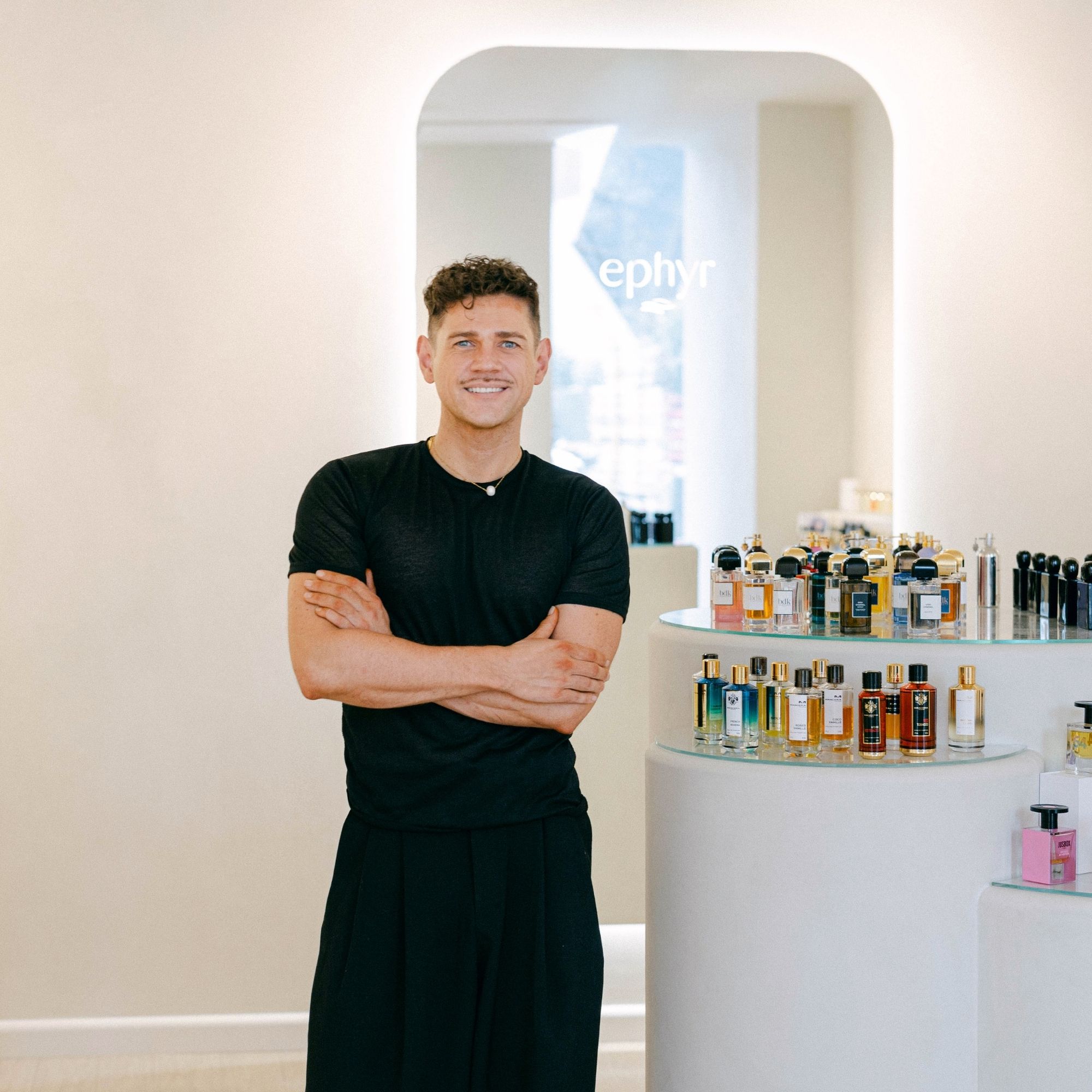
Dmitrii Savishin
Dmitrii Savishin is the founder of Maison Ephyr and Parfum Exquis, two Canadian destinations dedicated to the world of niche perfumery. With years of experience discovering exceptional fragrance houses from around the globe, Dmitrii shares expert insights on perfume trends, fragrance notes, luxury brands, and the art of choosing the perfect scent. His mission is to make niche perfumery more approachable while helping readers discover fragrances that leave a lasting impression.


