
A perfume flanker is a new interpretation of an existing fragrance. It keeps a recognizable connection to the original while changing the scent. In short, what is a flanker in perfume? It is a familiar identity with a reworked composition, not simply the same scent in another concentration or seasonal packaging.
The distinction can be easy to miss. A shared name or bottle may suggest a reissue, while a flanker may retain only part of the original’s character. It can emphasize a familiar facet, soften it, or take the scent in a new direction.
This guide explains how flankers relate to their originals, how to distinguish them from concentration changes and limited editions, and how the idea applies to niche perfumery. You’ll learn to read a fragrance’s lineage and judge whether a release offers a new interpretation or the same scent in a different form.
Key Takeaways
- A flanker builds on an existing fragrance, keeping a recognizable connection while changing elements of its scent.
- To distinguish a new interpretation from a concentration change, consider whether the scent signature itself has shifted.
- A limited edition may change only the packaging and availability period, while a seasonal flanker can introduce a different scent direction.
- Some flankers preserve the original’s defining character; others amplify or rethink one of its facets.
- Flankers appear in niche perfumery too, so fragrance lineage can be worth exploring beyond mainstream releases.
The relationship between a flanker and its original fragrance
A flanker is an offshoot of an existing fragrance. It maintains a clear connection to the original while changing its character. Dior’s Poison franchise illustrates how one original can inspire several interpretations.
The connection may show up in the name, bottle design, or notes, but the fragrance itself has a point of difference. Identifying what remains familiar helps you tell whether a release extends an established identity or stands apart.
Ways Flankers Differ from Originals
A flanker keeps a recognizable link to an original but adjusts its scent profile. A perfumer might emphasize one note, reduce another, or move the fragrance toward a different family. A familiar name, then, doesn’t guarantee a familiar wearing experience.
Dior released Poison in 1985, then built a franchise that includes Tendre Poison, Hypnotic Poison, Pure Poison, Pure Poison Elixir, and Midnight Poison. These releases illustrate how related fragrances can retain a family identity without reproducing one identical formula. The original provides a reference point; each flanker offers a distinct interpretation.
Nina Ricci Signoricci 2, released in 1975, is identified as an early flanker of 1966’s Signoricci. The gap between those releases illustrates that a fragrance relationship can extend beyond an immediate follow-up. A shared lineage, rather than a precise release schedule, is what links an original and its offshoot.
Trends Behind Related Releases
Brands revisit established scents with compositions that reflect changing fragrance preferences. A flanker might make a classic feel brighter, softer, or closer to another fragrance family. The connection explains why a new release can seem familiar without smelling identical.
A fragrance franchise can evolve in this way. Chanel Chance, Dolce & Gabbana Light Blue, Dolce by Dolce & Gabbana, Armani Acqua Di Gio, and Coach are lines with flankers. These examples span different fragrance identities, showing that flankers aren’t limited to one style or scent family.
Recognizing a Flanker
To tell whether a perfume is a flanker or a completely new fragrance, look for an explicit connection to an existing fragrance line, then compare its name, packaging, and scent profile. A shared name or design can signal a relationship, but the change in the fragrance itself is what makes the release an interpretation rather than simply a new format.
A flanker may share notes or bottle design with the original, but neither is essential. The relationship might come through the name, selected notes, visual identity, or a combination. Look at the fragrance’s lineage as a whole rather than relying on one matching detail.
Flankers are more common in mainstream perfumery, but niche fragrances can have them too. The same principle applies: a related release reworks an existing scent identity. Chanel Chance and Coach are examples of widely recognized lines with flankers. Whether a fragrance is affordable depends on its price and your budget, not its place in a fragrance line.
Flankers versus concentration and format variations
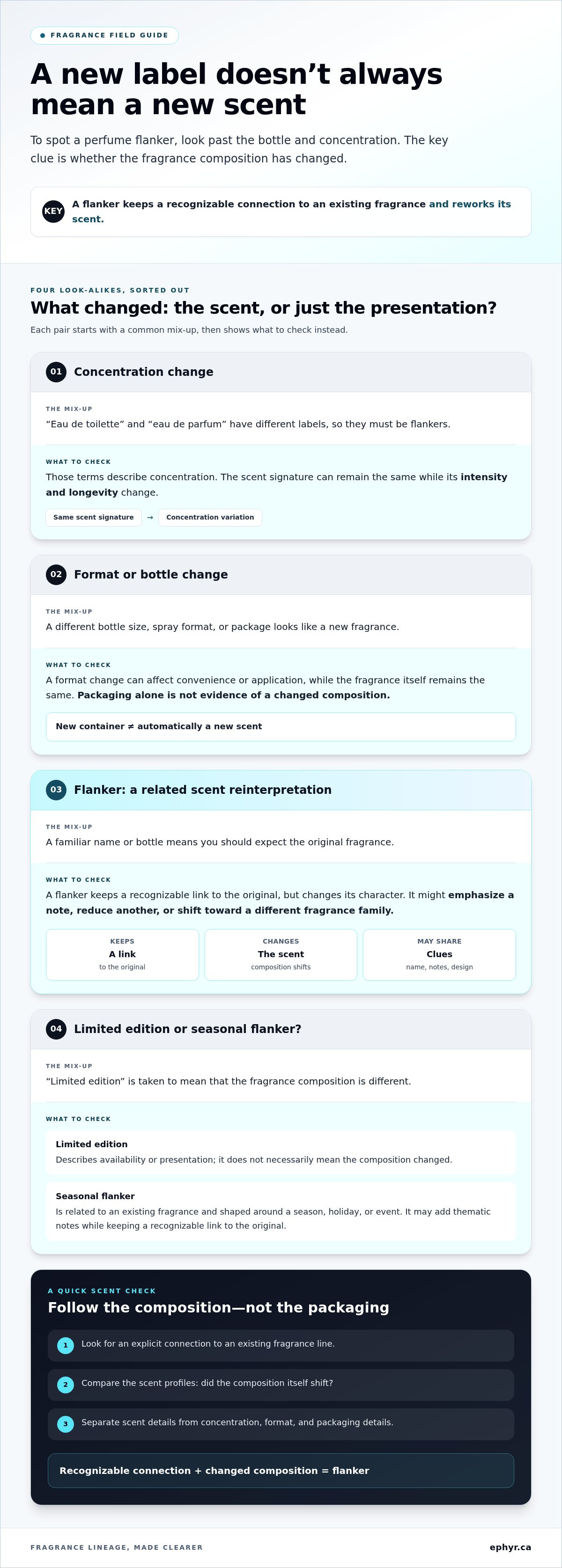
A flanker changes the composition; a concentration variation keeps the scent signature but changes its intensity and longevity. Two bottles with different labels can smell closely related without being separate interpretations. Compare the scent profiles, not just the packaging.
Terms such as eau de toilette and eau de parfum describe concentration, not necessarily different compositions. A concentration change can make the same scent signature seem more or less pronounced and affect how long it lasts. That difference alone doesn’t make a fragrance a flanker.
Think of concentration as adjusting the strength of an existing arrangement. A flanker is more like a new arrangement built around a recognizable idea: it may emphasize a note, reduce one, or shift toward another fragrance family. The original provides a reference point, while the changed composition gives the flanker its own character.
Format is separate, too. A fragrance in a different bottle size or spray format may still contain the same scent. A new container can change how convenient it is to carry or apply, but packaging alone doesn’t mean the composition has changed. Look for evidence of a scent difference before calling it a flanker.
- Concentration variation: the scent signature remains, while intensity and longevity change.
- Format variation: the presentation or container changes, while the fragrance itself can remain the same.
- Flanker: the fragrance composition shifts, while its connection to the original remains recognizable.
When comparing related releases, start with the composition described for each fragrance. Next, check whether the difference is presented as a scent reinterpretation or a concentration change. Finally, separate packaging details from scent details. A redesigned bottle may look like a new release, but its appearance can’t tell you whether the formula changed.
If an eau de parfum and eau de toilette share a scent signature, the difference is concentration, not a flanker. If a related release changes a prominent note or fragrance family, it fits the flanker idea more closely. The deciding factor is the composition, not the concentration label or bottle.
If you’re comparing unfamiliar scent profiles, explore fragrance compositions with attention to how each one is built.
Seasonal and limited-edition flankers
A seasonal flanker is both related to an existing fragrance and shaped around a particular season, holiday, or event. It may introduce thematic notes while keeping a recognizable link to the original. By contrast, “limited edition” describes availability or presentation, not necessarily a change in composition. Separating the terms clarifies what has actually changed.
Seasonal inspiration may shape the fragrance itself. A brand might give a winter interpretation a different emphasis from the original, or create a holiday version with notes suited to the occasion. These are general examples, not claims about a particular perfume. The key question is whether the scent has been reworked. If the composition changes while the connection to an original remains, it fits the flanker idea.
A limited edition is different when the fragrance stays unchanged. Its defining features are its packaging or period of availability. A bottle dressed for a holiday can therefore be a limited edition without being a flanker. The liquid is the key distinction: a changed scent suggests a new interpretation, while unchanged fragrance in special packaging signals a presentation-led release.
The categories can overlap. A seasonal release may also be limited edition, and a seasonal flanker may change the original’s scent while being available for a defined period. Ask two separate questions: does the composition differ from the original, and is the release limited by its packaging or availability? One answer describes the scent; the other describes its presentation or timeframe.
- Seasonal cue: Is the fragrance linked to a season, holiday, or event?
- Scent change: Does it introduce a different composition from its original?
- Edition cue: Is the fragrance unchanged, with packaging or availability setting it apart?
These checks help you avoid mistaking a festive bottle for a new scent. Holiday artwork alone doesn’t make a fragrance a flanker, and an altered scent alone doesn’t make it a limited edition. A release can be both. Since labels may emphasize one aspect, compare the fragrance description and presentation instead of relying on seasonal packaging.
A flanker can also be discontinued. This matters if a seasonal or limited release becomes a favourite: its connection to a fragrance line doesn’t mean it will remain on sale. Scent lineage and availability are separate facts. A familiar name may identify the lineage, while the release period affects how long the fragrance can be found.
Traditional flankers that retain an original’s scent signature
A traditional flanker retains a recognizable part of the original’s scent signature while extending or reworking it. Marc Jacobs Daisy Dream is presented as a flanker of Marc Jacobs Daisy. Use the original as a reference: notice what feels familiar and what the newer fragrance handles differently. A flanker can preserve the central character without reproducing every aspect of the scent.
The difference may come from amplifying or subverting a key facet. An amplified facet feels more prominent in the fragrance’s overall impression; a subverted one takes the original idea in a contrasting direction. Neither breaks the lineage. Instead, each makes the relationship more nuanced than a simple copy or replacement.
Marc Jacobs Daisy and Daisy Dream make a useful pair to consider, but their names alone don’t explain how their compositions compare. Treat the original as a baseline and the flanker as a deliberate variation. Ask which qualities carry through, which feel more pronounced, and whether the balance changes. This keeps the comparison focused on scent rather than packaging or naming alone.
A lighter flanker may suit daytime wear if a signature scent feels overwhelming for everyday use. It offers the possibility of a related interpretation that feels more comfortable in a particular setting, without leaving the original’s general identity behind. Not every flanker is lighter, and lighter doesn’t automatically mean better. It is simply one way to create an alternative for a particular preference.
- Start with the original: identify the overall character you associate with Marc Jacobs Daisy.
- Compare the flanker: notice whether a familiar facet remains, becomes more prominent, or feels reinterpreted in Daisy Dream.
- Consider the setting: decide whether the new balance suits the occasions when you’d wear the original.
This comparison distinguishes continuity from sameness. If Daisy Dream brings Daisy to mind but has a different balance, that’s the logic of a traditional flanker: a recognizable signature reshaped for another experience. If you prefer the original’s exact effect, a related release may not replace it. If you want familiar character with a shift in emphasis, comparing the two can be worthwhile.
It also changes how you read a fragrance line. Marc Jacobs Daisy isn’t just a name repeated across bottles; Daisy Dream represents a related creative direction. Look for continuity in the overall impression, then note the variation. That balance helps explain how flankers can offer people who value an original a distinct expression rather than an identical scent.
Flankers in niche perfumery
Flankers are more common in mainstream perfumery, but they exist in niche perfumery too. The distinction concerns a fragrance’s relationship to another scent, not the size or positioning of its house. Niche releases can revisit an existing fragrance identity just as mainstream lines can. Don’t assume that a smaller or more independent perfume house has no related releases.
Niche flankers may be harder to identify when a shared franchise name or obvious bottle design doesn’t signal the connection. Check how the house presents the fragrance and whether its description links it to an earlier scent. Then compare the compositions. A recognizable element may carry through, while a changed note or fragrance family gives the new release its own profile.
Imagine a niche house revisiting an earlier woody fragrance with a brighter emphasis. The new scent might retain the original’s central character while shifting its balance. That would be a related interpretation, not simply another concentration or bottle format.
To choose or test a perfume flanker, compare it with the original on your skin. Notice which facets feel familiar and which change as the scent develops. A small sample can make this side-by-side assessment easier before you commit to a full bottle.
- Start with the lineage: identify the original fragrance the niche release is connected to.
- Compare the composition: note shared facets and any shift in emphasis or fragrance family.
- Test both scents: wear the original and flanker separately, then compare how each develops on your skin.
This comparison is useful because niche perfumery often appeals to people seeking a distinctive point of view. A flanker doesn’t automatically dilute that identity. It can show how a house revisits its creative framework, keeping a recognizable element while exploring a new direction. The original provides context; the variation reveals what the perfumer chose to change.
For a direct comparison, focus on the original and its related release, not the label “niche” alone. A shared name, stated lineage, or recognizably related composition can help establish the connection. Then decide whether the variation adds something you want, such as a different balance or a more suitable everyday profile. Explore Bianco Latte perfume as another fragrance to consider through its own scent profile.
Maison Ephyr: Xerjoff Fragrances
Maison Ephyr offers Xerjoff Fragrances for readers exploring how luxury scent compositions differ. You can also discover Nishane Fragrances and Casamorati as you consider the character and style of each fragrance house. For a more measured introduction, Maison Ephyr’s 1ml fragrance samples let you experience a scent before choosing a full bottle. They’re useful when you want to assess how a fragrance develops on your skin and whether its character suits your preferences. A sample doesn’t establish that a fragrance is a flanker, but it can help you make a more informed comparison when exploring related scents. Browse the fragrances and samples to find a direction worth testing. Contact Maison Ephyr to explore the collection.
Choose your next scent with intention
Understanding what a flanker in perfume means gives you a clearer way to explore a fragrance house. Rather than choosing by name alone, notice which scent details appeal to you, then look for compositions that suit your preferences. Your next favourite may reflect a familiar style or a completely new direction.
Maison Ephyr offers curated selections from world-renowned niche fragrance houses. Its 1ml fragrance samples offer a way to experience a scent before deciding whether it belongs in your rotation. Take your time with the comparison. A considered choice often begins with one small discovery.
Explore fragrances and contact Maison Ephyr to find a scent direction that feels right for you.
Frequently Asked Questions
Edition and re-edition: what is a flanker?
A flanker in perfume is a related release that offers a new interpretation of an existing fragrance. A re-edition may simply bring an earlier scent back, rather than change its composition. To distinguish them, compare the scent itself, not only the release name or packaging. If the fragrance remains unchanged, its return alone doesn’t make it a flanker. A re-edition with a revised scent and clear lineage may also be a flanker.
The Purpose of a Flanker: Why Are They Created?
Brands create flankers to renew interest in a familiar fragrance line and offer a different scent direction. Someone who likes the original gets another version to consider, perhaps with a changed balance or fragrance family. A wearer might enjoy a line’s overall character but prefer a variation for a particular mood or setting. The connection keeps the original relevant while giving the franchise room to evolve.
What does “flanker” mean in perfumery?
In perfumery, “flanker” means a fragrance connected to an existing release, rather than a wholly separate scent. The term describes a relationship within a fragrance line, not a particular concentration or ingredient. A name, packaging, or shared scent element may signal that relationship, but none proves the composition is unchanged. When comparing product descriptions, look for whether the new perfume is presented as an interpretation of an earlier fragrance.
How does a flanker differ from the original fragrance?
A flanker changes the composition while retaining a recognizable link to the original. The difference may be subtle or noticeable, so don’t assume a familiar name means the fragrances smell alike. Compare the listed notes and overall scent profiles. A release that emphasizes a different fragrance family, for example, may feel distinct while still belonging to the same line.
What are common types of perfume flankers, such as Eau de Parfum, Intense, and Sport?
Eau de Parfum, Intense, and Sport are label terms, not guaranteed flanker categories. Eau de Parfum may describe concentration, while Intense or Sport may accompany a changed composition. The label alone doesn’t settle the question. Compare the fragrance description with the original: if only concentration or format changes, it’s a variation; if the scent is reworked within the same line, it may be a flanker.
Why do perfume brands release flankers?
Brands release flankers to keep a successful fragrance line visible while exploring a new creative direction. A related scent may appeal to someone whose preferences differ from the original’s profile, without requiring them to leave the franchise. It can also adapt a classic to contemporary preferences. For shoppers, a new release may offer a useful alternative, but a familiar name doesn’t guarantee the original’s exact scent experience.
What are well-known examples of fragrance flankers?
Mugler has created flankers of Angel, Alien, and Aura. These examples show how related releases can develop around more than one established fragrance line from the same house. To explore a particular example, identify the original, then consider how its related releases are positioned. This comparison helps distinguish a fragrance’s lineage from unrelated perfumes with a similar style or note.
Are perfume flankers typically discontinued or limited editions?
Some flankers are discontinued, but “flanker” doesn’t mean “limited edition.” A fragrance may be a permanent part of a line, appear for a limited period, or be discontinued later. For example, a seasonal scent may be a limited run while another related release remains in the collection. Treat lineage and availability separately: a connection to a popular original doesn’t guarantee that a flanker will stay available.

Article by
Dmitrii Savishin
Dmitrii Savishin is the founder of Maison Ephyr and Parfum Exquis, two Canadian destinations dedicated to the world of niche perfumery. With years of experience discovering exceptional fragrance houses from around the globe, Dmitrii shares expert insights on perfume trends, fragrance notes, luxury brands, and the art of choosing the perfect scent. His mission is to make niche perfumery more approachable while helping readers discover fragrances that leave a lasting impression.


