
Why does a C$400 bottle of niche fragrance vanish before your first meeting while a different blend lingers for 12 hours? It's a question of structural integrity. Most enthusiasts ask how long does perfume last without realizing that longevity is engineered, not accidental. You've likely felt the sting of an expensive scent fading into a whisper within sixty minutes. It's a premium investment that feels like it's evaporating into thin air before you've even left the house.
We agree that performance is non-negotiable. A fragrance is a functional piece of art that should maintain its presence from your morning coffee to your final evening engagement. This guide reveals the architectural secrets behind scent endurance. You'll learn to decode the technical gap between an Eau de Parfum and a pure Extrait. We'll provide professional application protocols to ensure your fragrance performs at its peak. From molecular weight to skin hydration, we're dissecting the science of the "unseen" to help you master the art of the long-wear scent.
Key Takeaways
- Master the duality of time. Learn to distinguish between the ticking clock of a single wear and the long-term structural integrity of your bottle.
- Unlock your skin’s hidden chemistry. Discover how your unique biology dictates how long does perfume last and why your pulse points are only the beginning.
- Build a moisture barrier for your scent. Explore the professional "priming" phase and strategic placement techniques that anchor volatile molecules for all-day endurance.
- Invest in raw material density. Understand the Ephyr Standard and why the architectural secrets of niche houses like Xerjoff outperform mass-market marketing.
The Duality of Time: Wear Life vs. Shelf Life
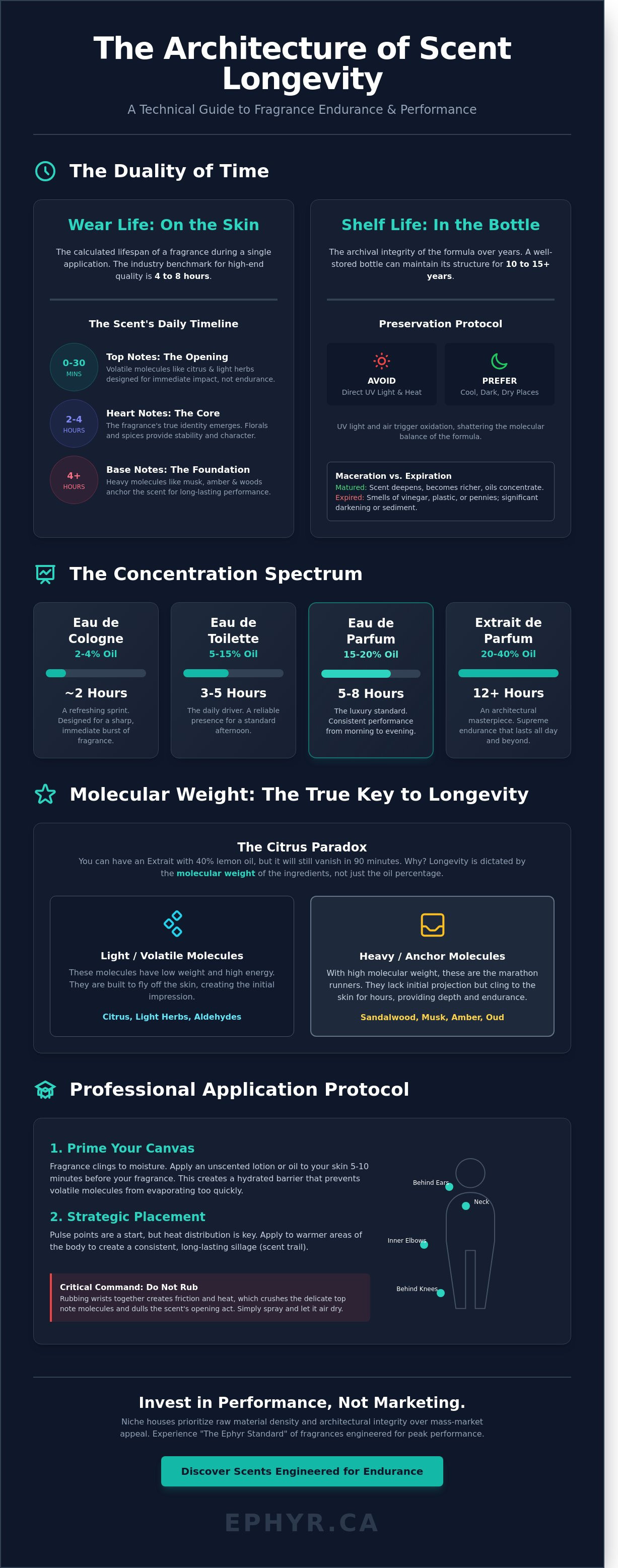
Time defines the master craftsman’s work. In perfumery, this timeline is split into two distinct categories. We analyze wear life versus shelf life. One measures daily performance on the skin. The other measures archival integrity inside the glass. When asking how long does perfume last, you're really asking about the stability of chemical bonds. A standard wear window of 4 to 8 hours represents the industry benchmark for high-end quality. It’s the calculated sweet spot where projection meets endurance.
The expiration date on your box is often a myth. Perfume doesn't simply die after 36 months. It evolves. Much like a bespoke workstation, a fragrance can actually improve with age through a process called maceration. The oils become more concentrated. The profile deepens. You only encounter true expiration when the molecular structure collapses. This results in a loss of "The Ephyr Standard" of performance, turning a refined tool into a redundant liquid.
The Daily Timeline: What to Expect from Your Scent
The first 30 minutes are a volatile dance. This is the stage of top notes. Citrus, light herbs, and bright aldehydes hit the air with high energy. They’re designed for impact, not endurance. By the 2 to 4-hour mark, the heart of the fragrance emerges. This is the core identity. Florals and spices stabilize the scent during this middle phase.
The dry down is the final act. This is where base notes like musk, amber, and heavy woods take command. These are the marathon runners of the olfactory world. Their molecular weight is higher, allowing them to cling to the skin long after the top notes have evaporated. The specific perfume concentrations you choose, such as an Eau de Parfum versus a lighter Eau de Toilette, will determine how quickly these transitions occur.
The Bottle’s Journey: How Many Years Will It Last?
The 3 to 5-year "official" expiry date is a corporate safety net. In reality, a well-stored bottle can maintain its integrity for 10 to 15 years. Some vintage extraits remain viable for decades. Precision storage is the deciding factor. Air and UV light are the primary antagonists. They trigger oxidation, which shatters the delicate balance of the formula.
- Visual Cues: Look for significant darkening or the presence of sediment.
- Olfactory Cues: A "turned" scent smells like vinegar, burnt plastic, or old pennies.
- Maceration: A deeper, richer scent without the "off" notes indicates a positive evolution, not a failure.
True craftsmanship prioritizes long-term reliability. If your fragrance has lost its top notes but still retains a beautiful heart and base, it hasn't expired. It has matured. Understanding how long does perfume last allows you to treat your collection as a long-term investment rather than a disposable commodity. Precision in storage yields excellence in performance.
The Architecture of Persistence: Concentrations and Molecules
Fragrance is a performance. Like a precision-engineered workstation, its output depends on the quality of its components and the exactitude of its assembly. Understanding how long does perfume last requires looking past the marketing and into the molecular structure of the juice itself. It's a balance of chemistry and art where weight determines endurance.
The Concentration Spectrum
Oil concentration serves as the technical baseline for longevity. It's the raw power behind the scent. In the Montreal boutique scene, we categorize these by their percentage of aromatic compounds.
- Eau de Cologne (2-4% oil): A sharp, 2-hour burst. This is a refreshing sprint, not a marathon.
- Eau de Toilette (5-15% oil): The 3-5 hour daily driver. It provides a reliable presence for a standard afternoon.
- Eau de Parfum (15-20% oil): The luxury standard. Expect 5-8 hours of consistent performance.
- Extrait de Parfum (20-40% oil): An architectural masterpiece. These often exceed 12 hours on the skin.
Higher percentages don't always guarantee a better experience. A heavy Extrait might sit close to the skin like a private secret. Conversely, a well-tuned Eau de Toilette can project across a room with surprising intensity.
Why Ingredients Matter More than Percentages
We call it the Citrus Paradox. You can fill a bottle with 40% pure lemon oil, but it will still vanish in ninety minutes. Light molecules like bergamot and lime are built to fly. They lack the structural integrity to stick. The question of how long does perfume last is often answered by the weight of its base notes rather than the concentration on the label.
Heavyweight molecules like sandalwood or Amouage frankincense act as anchors. These resins and musks are fixatives. They slow down the evaporation of lighter notes by essentially tethering the scent to your skin. This is where the Master Craftsman shines. They use these dense materials to create a foundation that supports the entire scent pyramid for hours.
Modern chemistry adds another layer of performance. Perfumers use synthetic boosters to extend the life of delicate florals that would otherwise wilt in the heat. While FDA regulations on fragrance safety ensure these compounds meet strict standards, their primary role is optimization. Niche houses often prioritize higher-quality natural oils over cheap fillers. These oils absorb into the skin at a different rate, creating a bespoke profile that evolves throughout the day.
When you invest C$400 in a niche fragrance, you're buying a calculated release of molecules. Every spray is a timed event. If you want to experience how these technical elements perform in a real-world environment, browse our professional selection to find a scent that matches your pace.
The Biological Variable: Why Your Skin is a Fragrance Critic
Your skin is a living, breathing laboratory. It doesn't just hold scent; it edits it. When asking how long does perfume last, the answer usually depends on your personal lipid profile. Oily skin acts as a natural adhesive. The sebum on the epidermis traps fragrance molecules, slowing their release into the air. Dry skin lacks this structural grip. It absorbs the carrier alcohol rapidly, causing the scent to "flash off" before the heart notes even develop. Precision in hydration is the first step toward longevity.
Body temperature functions as the engine of evaporation. High metabolic rates act like a thermal accelerator. If your resting body temperature sits closer to 37.5°C than the standard 37°C, you'll experience intense projection but a shorter total wear time. It's thermal optimization in reverse. Additionally, your internal chemistry dictates the evolution of the juice. A 2016 study in Evolution and Human Behavior confirmed that diet impacts sweat composition. High water intake (aiming for 3 litres daily in the Canadian climate) keeps the skin barrier resilient, preventing the "thirst" that causes dry skin to consume scent molecules.
Skin Type and Scent Retention
The science of pH is the ultimate gatekeeper. Skin typically sits between 4.7 and 5.7 on the pH scale. High acidity can sharpen delicate floral notes, making them lean metallic or sour. Moisture acts as a primer for your fragrance hardware. Applying an unscented, oil-based lotion creates a synthetic lipid layer that mimics the retention of oily skin. For maximum duration, consider applying to hair or fabric. These are "cool" surfaces that lack the heat-driven evaporation of the skin, allowing the top notes to persist for hours longer than they would on a pulse point.
The Psychology of Scent: Olfactory Fatigue
Your brain is a master of data management. It uses neural adaptation to "mute" constant stimuli, protecting your senses from overload. This is the "Ghosting" effect. You might think your signature scent has vanished, but you've simply become nose-blind to the frequency. To determine how long does perfume last on your skin, use the "Compliment Test." If a colleague notices your fragrance six hours after application while you smell nothing, the performance is intact. Skip the coffee beans at the counter. They only add more sensory noise. Fresh air is the only way to reset your olfactory palate. It's a clean reboot for your senses.
Mastering the Sillage: Professional Techniques for All-Day Wear
Application is a technical discipline. To maximize how long does perfume last, you must treat your skin as a high-performance substrate. Fragrance molecules require a stable environment to thrive. Dry skin is the enemy of longevity; it acts as a vacuum, absorbing the oils and silencing the scent. The priming phase is your first line of defense. By applying an unscented emollient or a high-quality moisturizer, you create an occlusive barrier. This moisture seal prevents the skin from drinking the perfume, allowing the scent to radiate outward rather than disappearing into the pores.
Precision matters. The "Strike" method involves direct application to pulse points for heavy Extrait de Parfums. This concentrated approach ensures the scent anchors deeply. Conversely, the "Cloud" method works best for lighter concentrations, allowing a fine mist to settle evenly across larger surface areas. Before committing C$350 to a full-sized bottle, sophisticated collectors utilize luxury fragrance samples canada to benchmark performance. Testing a sample in the specific humidity of the Canadian climate is the only way to guarantee a scent meets your standards for endurance.
The Precision Application Protocol
- Step 1: Hydrate. Apply an unscented lotion immediately following a warm shower. The residual heat opens your pores, while the lotion provides the necessary grip for the fragrance oils.
- Step 2: Target Heat Zones. Move beyond the wrists. Apply to the inner elbows and the back of the neck. These areas generate consistent heat and experience high movement, which helps project the scent trail as you walk.
- Step 3: The No-Rub Rule. Never rub your wrists together. This common mistake creates friction that spikes the temperature of the oil. This heat prematurely breaks down the delicate top-note molecules, effectively ruining the scent's intended evolution.
Advanced Layering and Fabric Hacks
Layering is structural reinforcement for your scent profile. Start with a matching body oil to build a dense foundation. This creates a multi-dimensional effect that adds hours to the wear time. For a 24-hour presence, utilize the "Lining Secret." Lightly mist the interior lining of your blazer or a wool scarf. Fabric is less volatile than skin; it holds onto the base notes far longer, ensuring your signature remains even after the skin-scent has faded.
Strategic rotation is equally vital. If you wear the same fragrance for more than 10 days, you will likely experience olfactory fatigue. Your brain begins to filter the scent as background noise. By switching between three distinct profiles, you keep your senses sharp. This ensures you can actually appreciate how long does perfume last on your own skin. It is about maintaining the integrity of the experience from the first spray to the final dry-down.
Ready to elevate your olfactory presence? Discover the Ephyr Standard.
Investing in Performance: The Niche Advantage
The Ephyr Standard prioritizes raw material density over marketing hype. We curate brands that treat scent as a technical achievement. Within our collection, we look for high oil concentrations and stable molecular structures. This focus directly impacts how long does perfume last on your skin. Mass-market scents often rely on top-heavy formulas that vanish quickly. Niche houses take a different path. They invest in base notes that provide a structural foundation for the entire day.
Consider Xerjoff as a primary example. This house is a masterclass in Italian longevity. Since its founding in 2003, Xerjoff has utilized rare resins and high-grade woods that anchor the fragrance. These ingredients don't just smell better; they perform better. Because of this technical density, niche perfumes require fewer sprays. One application of a potent extrait often outperforms six sprays of a generic eau de toilette. It's about precision dosing rather than sheer volume.
The Economics of Quality
Quality is a calculated investment. A C$400 bottle providing 12 hours of wear is mathematically more efficient than a C$100 bottle that fades in 60 minutes. You consume the product at a slower rate. The craftsmanship extends to the hardware itself. Premium cologne for men features high-specification atomizers. These deliver a controlled, fine mist that maximizes surface area coverage without wasting a drop. This ensures the durability of the scent cloud from the first minute to the eighth hour. We see this mechanical excellence across our range. It exists in the resinous, heavy-hitting depths of Nishane and the airy yet persistent compositions of Essential Parfums.
Your Journey to a Lasting Signature
Personal chemistry is the final variable in the longevity equation. We encourage using perfume samples canada to conduct a longevity stress test. Wear the scent during your morning commute. Monitor its performance in a temperature-controlled office. Observe how it evolves during a workout. This discovery phase allows you to identify the specific DNA that bonds with your skin.
Longevity is a partnership between the perfumer’s art and the wearer’s ritual. It's a dialogue between chemistry and craftsmanship. When you choose a scent built on the Ephyr Standard, you're choosing a fragrance that respects your time and your presence. We invite you to explore our curated national collection online to find your next enduring signature.
Master the Art of Olfactory Endurance
Fragrance is a precision instrument. You've discovered that understanding how long does perfume last isn't a matter of chance; it's a matter of molecular architecture. High-concentration extraits, often containing 20% to 40% aromatic compounds, provide the structural integrity needed for a scent to persist through a full 12 hour day. Your skin serves as the final critic, where hydration levels can either amplify or mute the performance of your chosen scent profile. Professional application isn't just a ritual; it's a technical optimization of your personal sillage.
We believe in hardware that performs. Ephyr bridges the gap between raw technical power and the refined world of niche perfumery. As an authorized retailer for legendary houses like Amouage and Xerjoff, we offer an expertly curated selection where every bottle meets the Ephyr standard of excellence. We provide premium fragrance samples with national shipping across Canada, allowing you to calibrate your collection with surgical precision. Stop settling for scents that vanish by noon. It's time to invest in a signature that commands the room from the first spray to the final dry down.
Explore the Ephyr Collection: Discover scents built for endurance
Step into a world where performance is the only metric that matters.
Frequently Asked Questions
Is it true that rubbing your wrists together 'breaks' the perfume molecules?
Rubbing your wrists doesn't physically break perfume molecules, but it does ruin the olfactory architecture by generating friction heat. This thermal spike causes the delicate top notes to evaporate 30% faster than a natural dry down. It's a matter of precision. To preserve the intended scent profile, simply mist and let the alcohol evaporate naturally. This maintains the structural integrity of the fragrance, ensuring the master craftsman's intended transition remains intact.
Why does my perfume last all day on my clothes but only two hours on my skin?
Your skin is a living, thermal engine that metabolizes oils, while fabric acts as a static, porous reservoir. Scientific tests show that synthetic fibers like polyester can retain scent for 48 hours because they lack the 37 degree Celsius heat that drives evaporation on human skin. Skin pH and moisture levels also dictate how long does perfume last. For maximum performance, mist your clothing to create a long lasting scent trail that survives the Canadian winter chill.
Does the colour of the perfume indicate how long it will last?
A darker hue often signals a higher concentration of base notes like resins, balsams, or vanillin, which naturally possess lower volatility. While 85% of fragrance color comes from the raw ingredients, some are tinted for aesthetic appeal. Deep ambers and rich golds typically indicate a dense molecular structure. These heavier molecules take longer to detach from the skin, often providing 10 plus hours of performance compared to clear, citrus heavy compositions.
How much perfume should I actually apply for it to last 8 hours?
Achieving an 8 hour performance window typically requires 3 to 5 strategic sprays depending on the concentration. For an Eau de Parfum, apply two sprays to pulse points and one to the nape of the neck. Precision application is better than over saturation. A single 100ml bottle provides roughly 1,000 sprays, meaning a 5 spray daily routine lasts exactly 200 days. This calculated approach ensures a consistent presence without overwhelming your environment.
Can I make a cheap perfume last longer by layering it with Vaseline?
Layering with an occlusive barrier like Vaseline can extend the life of a budget fragrance by up to 25%. The petrolatum creates a moisture locked surface that prevents the skin from absorbing the perfume oils too quickly. It's a functional hack for the Canadian climate where dry air often strips scent away. Apply a thin layer to pulse points before spraying. This technical adjustment turns a volatile scent into a more stable, long wearing investment.
What is the longest-lasting perfume note used in niche perfumery?
Oud, or agarwood, remains the undisputed champion of longevity in niche perfumery, often detectable 24 hours after application. This resinous powerhouse has a massive molecular weight that resists evaporation even in harsh conditions. In a 2022 industry study, base notes like oud and Mysore sandalwood showed a 40% slower decay rate than floral heart notes. It's the ultimate anchor for any bespoke fragrance, providing a foundation of uncompromising performance and depth.
Does keeping perfume in the fridge actually make it last longer?
Storing perfume in a dedicated beauty fridge at a constant 12 degrees Celsius significantly extends its shelf life. Heat and light are the primary catalysts for chemical degradation, breaking down the delicate esters over time. By maintaining a stable, cool environment, you prevent the oxidation that turns a premium scent sour. This is professional grade maintenance for your collection. It ensures every spray remains as crisp and potent as the day it was handcrafted.
Why can others smell my perfume when I can't smell anything at all?
You're likely experiencing olfactory fatigue, a biological reset where your brain ignores constant stimuli to stay alert for new scents. Research indicates this sensory adaptation can occur within 15 minutes of continuous exposure. Even if you can't detect the notes, the molecular trail remains active for those around you. Understanding how long does perfume last requires trusting the chemistry rather than your own nose. It's a sign of a well engineered, high performance fragrance.


