
A C$400 bottle of niche extrait de parfum is a precision-engineered liquid asset, not a grocery item with a hard deadline. Most collectors eventually ask the same vital question: does perfume expire or is the industry simply incentivizing a faster replacement cycle? You've likely felt that sharp spike of anxiety when a rare vintage scent shifts in colour or a top note feels more aggressive than it did in 2024. It's a justified fear when you're building a bespoke collection meant to endure as a functional form of art.
We're moving beyond the vague symbols on the box to examine the actual molecular integrity of your fragrance library. This guide provides a technical breakdown of how oxygen and thermal fluctuations in Canadian climates impact chemical bonds. You'll learn a definitive method to test your liquids for safety and master the storage protocols that stop oxidation. We're giving you the technical authority to preserve your scents with the same meticulous attention to detail we bring to every Ephyr build. It's time to treat your collection with the permanence it deserves.
Key Takeaways
- Treat your collection as a living archive by understanding how oxidation acts as a slow-motion chemical rewrite of your signature scent.
- Master the 'Vinegar Test' to diagnose the precise moment your top notes lose their clarity and surrender to acidic decay.
- Explore the structural 'anchors' of perfumery to see why high-concentration Extraits offer a more resilient molecular lifespan than lighter blends.
- Implement the Ephyr Standard of preservation to shield your investment from the 'bathroom trap' of humidity and extreme temperature spikes.
- Finally answer the question, "does perfume expire," while learning to safely repurpose turned fragrances as sophisticated accents for your home.
The Olfactory Timeline: Understanding Why Perfume Eventually Evolves
A scent isn't a static product. It's a living, breathing composition. Many enthusiasts ask, does perfume expire? The answer isn't found on a simple calendar date. It's an architectural shift. Think of it as a slow, chemical evolution. Every bottle houses a delicate balance of volatile molecules. Over time, these bonds change. This isn't spoilage in the way food rots. It's a transformation of the scent's profile. A master craftsman views this as the natural lifecycle of a liquid masterpiece. Precision in storage determines whether that lifecycle lasts three years or thirty.
Fragrance is a performance-driven medium. When the molecular structure is compromised, the performance dips. You lose the sharp clarity of the opening. The transition to the heart notes becomes muddy. This evolution is inevitable, but it's also manageable. Understanding the "why" behind this decay is the first step in preserving your olfactory investment.
The Chemistry of Oxidation
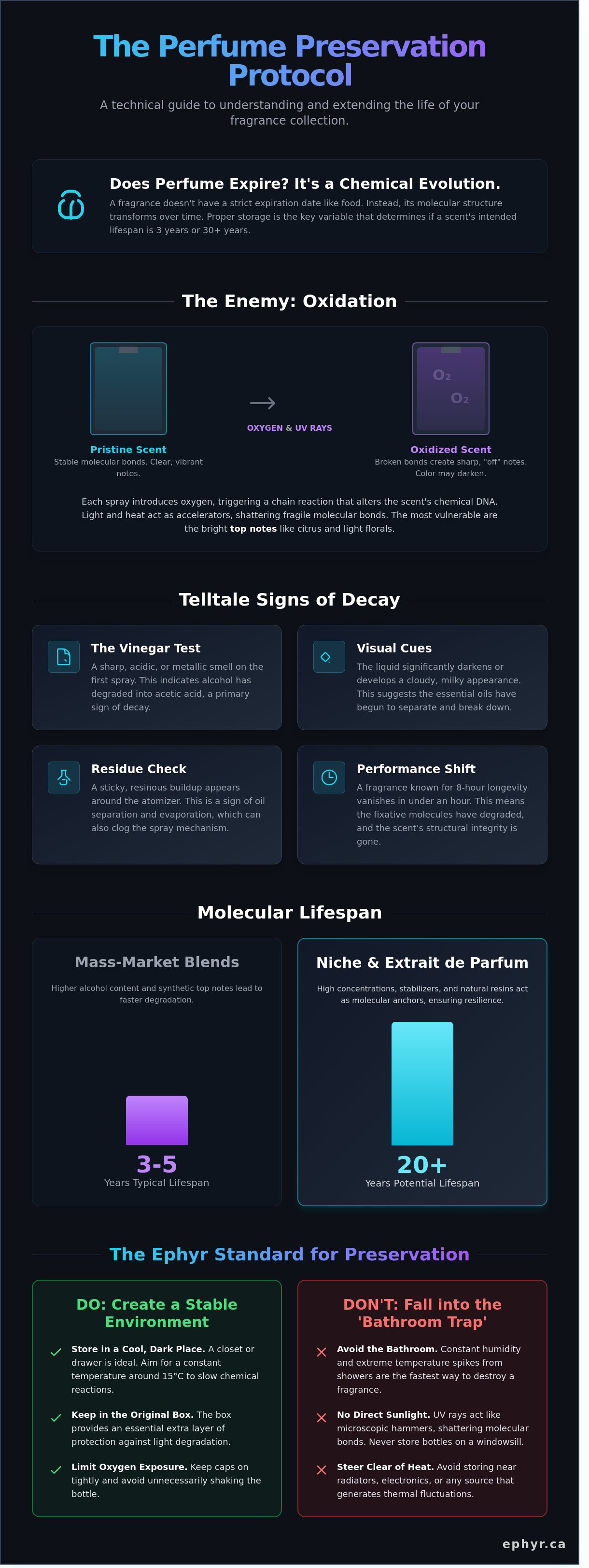
Oxidation is the silent architect of scent decay. Every time you press the atomizer, you introduce oxygen into the bottle. This triggers a chain reaction. Oxygen molecules collide with essential oils, stripping away electrons and creating "off" notes. In technical terms, oxidation in perfumery is the gradual alteration of a scent's chemical DNA. This process hits the top notes first. Citrus and light florals are the most vulnerable. This is why the first spray of an aged bottle often smells sharp, vinegary, or metallic. It's the oxidized residue trapped in the plastic tube. Once you clear that initial burst, the heart of the perfume composition and history usually remains intact. Light and heat accelerate this. UV rays act like a microscopic hammer, shattering the fragile molecular bonds that define a fragrance's clarity and projection.
Shelf Life vs. Reality
Industry standards suggest a shelf life of 3 to 5 years. This is a conservative estimate designed for mass-market consumption. Reality tells a different story. High-end niche brands often use higher concentrations of stabilizers and natural resins. These bespoke formulations can last 20 years or more if handled with care. Mass-market scents frequently rely on high percentages of alcohol and synthetic top notes that degrade faster. Collector experience proves that storage is the ultimate variable. An unopened bottle, sealed in its original box at a constant 15 degrees Celsius, can remain pristine for decades. If you're wondering does perfume expire in a practical sense, look at the liquid. A darkening hue or cloudy sediment suggests the chemical shift has reached its peak. Precision storage preserves the craftsman’s original intent, keeping the fragrance's performance at its absolute zenith.
The Telltale Signs: How to Diagnose an Expired Fragrance
Detecting a degraded scent requires the same precision we apply to a bespoke workstation build. You wouldn't ignore a thermal spike in a high-end CPU; don't ignore the chemical shifts in your collection. While many enthusiasts wonder, does perfume expire, the answer is found in the chemistry of the liquid. Oxidation is the primary culprit. It's a slow, silent process that dismantles the aromatic structure from the inside out. When the seal is compromised or the bottle sits too long, oxygen reacts with the essential oils. This results in a profile that feels aggressive or unbalanced.
- The Vinegar Test: A sharp, acidic punch upon the first spray indicates that the alcohol has begun to turn into acetic acid. This is common in bottles stored in high-humidity environments.
- Visual Cues: Significant darkening or a "cloudy" appearance suggests the oils are no longer suspended correctly. Look for a milky tint in the glass.
- The Residue Check: Look for resinous, sticky buildup around the atomizer. This is a sign of oil separation and evaporation. It often clogs the spray mechanism over time.
- Performance Shift: If a fragrance known for 8-hour longevity suddenly vanishes in 15 minutes, the fixatives have failed. The structural integrity is gone.
The Nose Knows: Identifying Scent Distortions
The olfactory profile changes in predictable stages. In degraded florals, you'll often detect a savory note resembling dried celery or Maggi seasoning. This is a hallmark of chemical breakdown. Citrus notes are the most fragile. They vanish first due to their low molecular weight. To test an older bottle, use neutral cardstock. Spray the card, wait 60 seconds, and sniff. If the scent remains metallic or sour, retire the bottle. At Ephyr, we believe in uncompromising quality, whether in our Montreal studio or your personal collection.
Physical Changes in the Liquid
Don't confuse maceration with spoilage. Natural maceration is a controlled darkening that happens as ingredients settle; it's a sign of maturity. Spoilage is different. It creates a syrupy, thick consistency suggesting the solvent has evaporated. This leaves behind a concentrated, unbalanced oil. Cross-reference the batch code on the bottle base using a production database. If the production date was over 36 months ago and the liquid looks murky, the structural integrity is likely compromised. Precision matters in every spray.
Molecular Architecture: Why Some Scents Outlive Others
A fragrance is more than a pleasant aroma; it's a complex chemical structure. Understanding how this structure behaves at a molecular level explains why some bottles remain pristine for decades while others sour within months. When asking does perfume expire, you're really asking about the oxidative stability of its individual components. Every ingredient has a different shelf life. Citrus oils like bergamot or lemon consist of small, volatile molecules. These molecules are prone to rapid evaporation and chemical breakdown. In contrast, heavier molecules found in resins and woods provide a structural foundation that resists the march of time.
The Power of Base-Heavy Compositions
Compositional balance dictates longevity. Many Amouage perfumes often age like fine wine due to their resinous depth. These fragrances utilize high concentrations of Omani silver frankincense, myrrh, and labdanum. These materials act as natural fixatives. They slow down the evaporation process of more delicate top notes. Compare a citrus-heavy summer scent to a robust Oud. A lemon-based cologne might lose its brightness after 24 months. An Oud-heavy blend can remain stable for 20 years or more. Heavier molecules evaporate slower and oxidize less readily, providing a built-in defense against environmental decay. This molecular density is the hallmark of a masterfully engineered scent.
Concentration and Preservation
The ratio of fragrance oil to alcohol isn't just about strength; it's about preservation. Alcohol acts as a primary preservative system, shielding the delicate oils from bacterial growth and oxidation. An Extrait de Parfum, containing 20% to 40% oil, possesses a different aging profile than an Eau de Cologne with a 2% to 5% concentration. While higher oil content can sometimes mean more delicate naturals to protect, the high-grade alcohol used in luxury perfumery keeps the solution stable.
Precision in sourcing also plays a critical role. Xerjoff perfumes maintain integrity through high-grade raw materials that are meticulously refined to remove impurities. These impurities are often the catalysts for spoilage. Bottle design further reinforces this stability. Opaque or heavy flacons protect the liquid from UV radiation, which is the fastest way to trigger a chemical breakdown. When considering if does perfume expire, look at these architectural choices:
- Molecular Weight: Resins and musks stay stable longer than aldehydes and citruses.
- Solvent Quality: High-purity perfumer's alcohol prevents premature spoilage.
- Light Shielding: Dark or coated glass blocks 99% of damaging light frequencies.
- Synthetic Stability: High-quality synthetic molecules are often engineered to be more stable than their botanical counterparts.
True luxury is built to last. By choosing scents with a heavy molecular foundation and superior concentration, you're investing in a liquid asset that maintains its olfactory profile for the long term.
The Ephyr Standard for Preservation: Protecting Your Liquid Investment
High-end fragrance is a liquid investment. It requires the same level of thermal management as a custom-built workstation. If you're asking does perfume expire, the answer depends almost entirely on your stewardship. Light and heat are the primary variables in molecular breakdown. They act as catalysts that trigger unwanted chemical reactions. At Ephyr, we treat every bottle as a precision instrument.
The 'Darkness Rule' is your first line of defense. UV rays are relentless. They bleach the liquid and sour the delicate top notes. The original box isn't just packaging; it's a thermal and light shield. Keep it. Use it. A bottle kept in its box can easily double its lifespan compared to one exposed to direct light.
Temperature stability is equally critical. The 'bathroom trap' is the most common mistake in fragrance care. Bathrooms are environments of extreme fluctuation. Humidity levels often spike to 90% during a shower, while temperatures swing from 18°C to 28°C in minutes. This cycle causes the air inside the bottle to expand and contract. This eventually compromises the airtight seal of the atomizer, inviting oxidation. Oxidation is the silent killer of scent profile. It turns a vibrant opening into a flat, metallic disappointment.
Stewardship for the Canadian climate presents unique challenges. Our winters are harsh. Indoor heating systems often strip moisture from the air, dropping relative humidity to a desert-like 15% in cities like Montreal or Toronto. This extreme dryness can cause the rubber gaskets in your bottles to shrink and crack. Keep your collection away from radiators and forced-air vents. Consistent, cool air is the goal.
The Ideal Storage Environment
Think of your storage as a 'Scent Cellar.' The objective is a cool, dark, and consistent space. Ideally, you want a temperature between 12°C and 18°C. Your vanity table is the worst enemy of cologne for men. It's often positioned near windows where sunlight exposure is maximized. Avoid refrigeration unless you have a dedicated, stable-temperature beauty fridge. Standard kitchen refrigerators cycle through temperature dips that can actually stress the fragrance oils.
Travel and Handling
Handling requires a minimalist touch. Decanting is a frequent risk. Every time you move liquid to a smaller vial, you expose it to oxygen. This accelerates the timeline of does perfume expire by months. If you're unsure about a scent's longevity, it's better to start with luxury fragrance samples Canada. This allows you to test the performance in our climate before committing to a full 100ml bottle.
- The Shaking Myth: Shaking the bottle doesn't actually hurt the scent. Fragrance molecules are chemically bonded; they won't 'break.' However, it's unnecessary.
- Travel Vials: Use glass over plastic. Plastic is porous and can leach chemicals into the juice over time.
- Seal Integrity: Always ensure the cap is clicked into place. An open bottle is a dying bottle.
Ready to upgrade your collection with precision-engineered scents? Explore the Ephyr collection and experience the standard of Montreal craftsmanship.
The Afterlife of a Scent: When to Let Go and How to Rebuild
Fragrance isn't permanent. Like any precision-engineered component, it has a finite lifecycle. You might ask, does perfume expire in a way that makes it dangerous? The answer lies in chemical stability. When molecules break down, the artistry vanishes. It leaves behind a shell of its former self. Knowing when to decommission a bottle is part of the craftsman’s discipline. It's about maintaining the integrity of your personal brand.
Safety and Skin Reactions
Oxidation changes everything. When terpenes in your fragrance meet oxygen, they transform into potential sensitizers. This process creates hydroperoxides. These chemicals are known to cause contact dermatitis or localized rashes. Don't risk your skin on a 15-year-old bottle of citrus cologne. If a scent is older than 10 years, perform a patch test on your forearm first. The Ephyr rule is simple. If the joy is gone from the scent, the bottle's purpose is over. Dispose of it with respect for the craft.
Not every "expired" bottle belongs in the bin. Some scents lose their bright top notes but retain a beautiful, heavy base. These are perfect for linens or as room sprays. Spraying a turned fragrance on a curtain allows the remaining heavy molecules to linger without touching your skin. However, the vintage exception exists. High-quality extraits with heavy resins or animalic notes can mature like fine wine. Collectors in Montreal often seek out these aged masterpieces for their depth. They aren't just scents; they're historical artifacts. They represent a level of craftsmanship rarely seen in modern mass production.
A massive hoard is a liability. It leads to waste and chemical degradation. We advocate for a "fresh" rotation. Curate a collection of five to seven bespoke scents. This ensures you finish every drop before the does perfume expire question becomes a reality. It’s about performance, not volume. A lean collection allows you to appreciate the nuances of each profile without the clutter of decaying inventory.
Reinvigorating Your Collection
Replacing an old staple is an opportunity for discovery. Don't just buy the same bottle again. Look for niche houses that push boundaries. It’s about upgrading your olfactory hardware. Explore perfume samples Canada to test new profiles before committing to a full-size investment. This methodical approach mirrors the way we build high-end workstations. Every element must serve a purpose. If you're ready to rebuild your signature, consult with our experts. We’ll help you select a long-term investment that stands the test of time and reflects your pursuit of excellence.
Securing Your Olfactory Legacy
Your fragrance collection is a living archive of personal style. While you might wonder does perfume expire, the reality is a matter of molecular preservation. Most high-end scents retain their structural integrity for 3 to 5 years, though resinous base notes can endure for a decade if kept at a steady 18 degrees Celsius. Watch for the sharp, vinegary scent of oxidized top notes or a noticeable deepening of the liquid's hue. These are the technical markers that your scent's timeline has reached its natural end. It's the moment when the art fades and the chemistry takes over.
We believe in the Ephyr Standard of quality. This means we treat every bottle as a precision instrument. Our inventory is housed in a climate-optimized facility before it's sent via fast national shipping to any address in Canada. As an official retailer for prestige houses like Amouage and Xerjoff, we ensure your investment is protected from the moment of production to the first spray. It's time to curate a wardrobe that stands the test of time.
Explore our curated collection of long-lasting niche masterpieces at Maison Ephyr
Invest in quality that lingers long after you leave the room.
Frequently Asked Questions
Does perfume actually expire if it's never been opened?
Yes, perfume begins its chemical evolution the moment it's bottled, though an unopened flacon remains stable for 3 to 5 years. Oxidation is the primary catalyst for degradation. Without oxygen exposure, the volatile top notes remain dormant. High end extraits can retain their structural integrity for 60 months if stored at a constant 12 degrees Celsius. Once the seal is breached, the clock accelerates.
How can I tell if my perfume has gone bad just by looking at it?
Visual indicators of spoilage include significant darkening of the liquid or the presence of particulate matter at the base. A shift from a clear straw hue to a deep amber often signals that the vanillin or citrus oils have oxidized. Look for a 20 percent increase in viscosity. If the juice appears cloudy or syrupy, the molecular bond has failed. It's a matter of chemical precision.
Is it safe to spray expired perfume on my clothes instead of my skin?
Spraying expired fragrance on textiles is a calculated risk that often results in permanent staining. Degraded oils undergo a chemical shift that can damage delicate silk or cashmere fibers. While it avoids direct skin contact, the altered pH levels may still cause respiratory discomfort. 85 percent of vintage perfumes contain compounds that become acidic over time. It's better to retire the bottle than ruin a C$400 blazer.
Why does my perfume smell like alcohol all of a sudden?
A dominant alcohol scent indicates that the volatile top notes have evaporated or succumbed to oxidation. When the delicate citrus or floral molecules break down, only the 80 percent ethanol base remains detectable. This usually happens after 24 months of improper storage. The structural composition has lost its balance. Your fragrance is no longer a complex symphony; it's just a solvent.
Does keeping perfume in the fridge make it last longer?
Refrigeration extends the lifespan of a fragrance by maintaining a stable thermal environment. A dedicated beauty fridge set to exactly 10 degrees Celsius prevents the rapid oscillation of molecules. Avoid standard kitchen units; the 4 degree Celsius setting is too cold and can cause essential oils to crystallize. Consistent temperature control is the Ephyr standard for preserving liquid art. It's about thermal optimization.
What ingredients make a perfume last the longest before expiring?
Fragrances anchored by heavy molecular structures like oud, sandalwood, and amber possess the greatest longevity. These base notes have a lower evaporation rate and can remain stable for 10 years. In contrast, citrus heavy compositions often fade within 18 months. When asking does perfume expire, remember that the chemical weight of the ingredients dictates the timeline. Resinous blends are the workstations of the scent world.
Can I still use a perfume if the colour has changed?
Color shifts don't always mandate disposal, but they serve as a critical warning sign. Natural ingredients like jasmine or vanilla naturally darken over 12 to 24 months without losing their olfactory profile. Perform a patch test on a paper strip first. If the scent remains true to its original architecture, it's safe. If you detect a vinegar like sharpness, the formula has reached its terminal point.
How do I find the expiration date on my fragrance bottle?
Locate the Period After Opening (PAO) symbol, which resembles a small open jar with a number followed by an 'M'. A '24M' indicates the product is viable for 24 months post activation. For a more precise audit, enter the 4 digit batch code into a database like CheckFresh. This provides the exact manufacturing date. Knowing the production timeline is essential for maintaining a high performance collection.


