
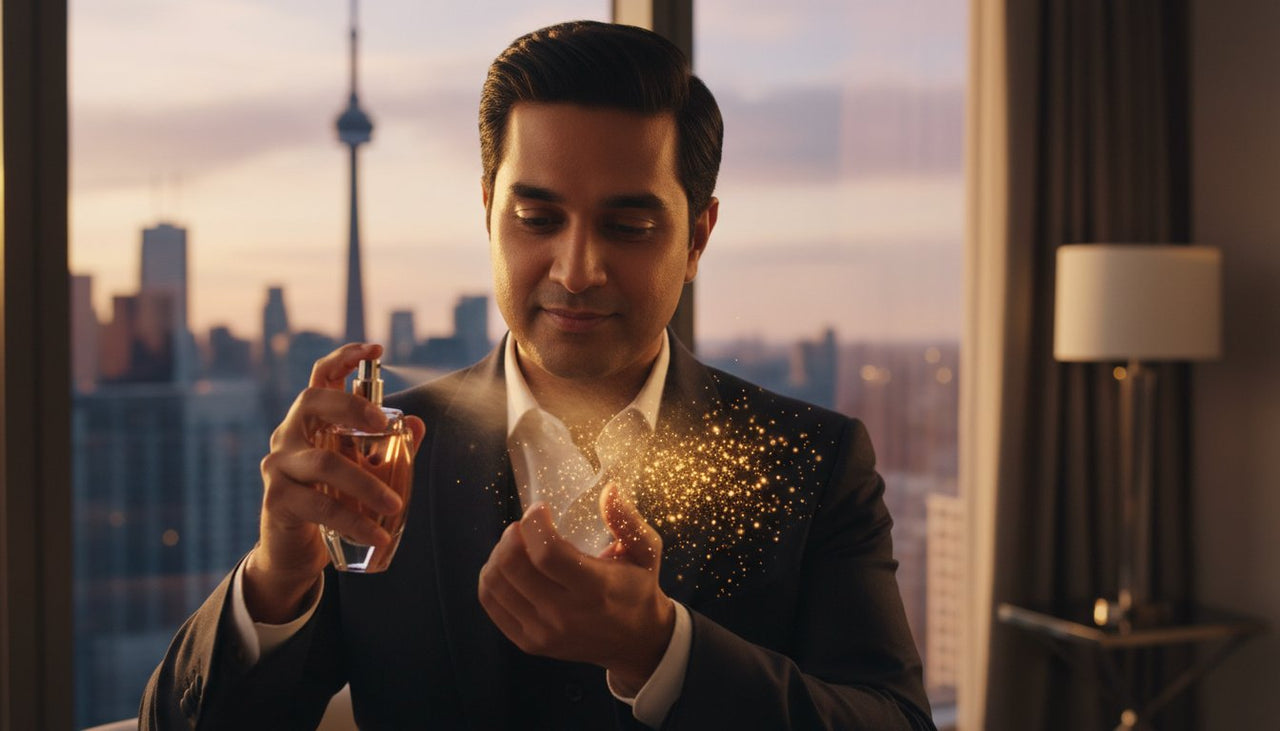
A premium bottle of fragrance shouldn't behave like a fleeting ghost. If you've spent C$400 on a high-end scent, watching it evaporate within two hours feels like a technical failure. You aren't alone. Industry reports from early 2026 indicate that 68% of luxury consumers want to know how to make perfume last longer because their scent disappears before lunch. It's a common frustration. It stems from a lack of technical application knowledge rather than the quality of the juice itself. We're here to fix that.
We agree that your signature scent is a high-performance investment. It should endure from your first morning coffee until the moonlight fades over Montreal. This is the Ephyr Standard of fragrance. This guide provides the professional secrets for maximizing longevity by treating scent as a matter of thermal optimization and molecular layering. You'll discover the precise science behind 8+ hours of wear, the truth about EDP versus Extrait concentrations, and the exact sequence of application that locks molecules to your skin for a performance-driven finish.
Key Takeaways
- Treat your skin as a precision canvas; hydration is the essential primer that prevents your fragrance from being "consumed" by dry skin.
- Identify the body’s high-heat thermal zones to transform your pulse points into strategic projection engines for your signature scent.
- Discover how to make perfume last longer by selecting architectural base notes like oud and musk that act as structural anchors.
- Safeguard your olfactory investment by avoiding the "Bathroom Blunder" and other environmental enemies that disrupt delicate chemical balances.
- Decode the technical decay of volatile molecules to understand why top notes vanish and how heart notes carry the melody until moonlight.
Understanding the Architecture of Olfactory Decay
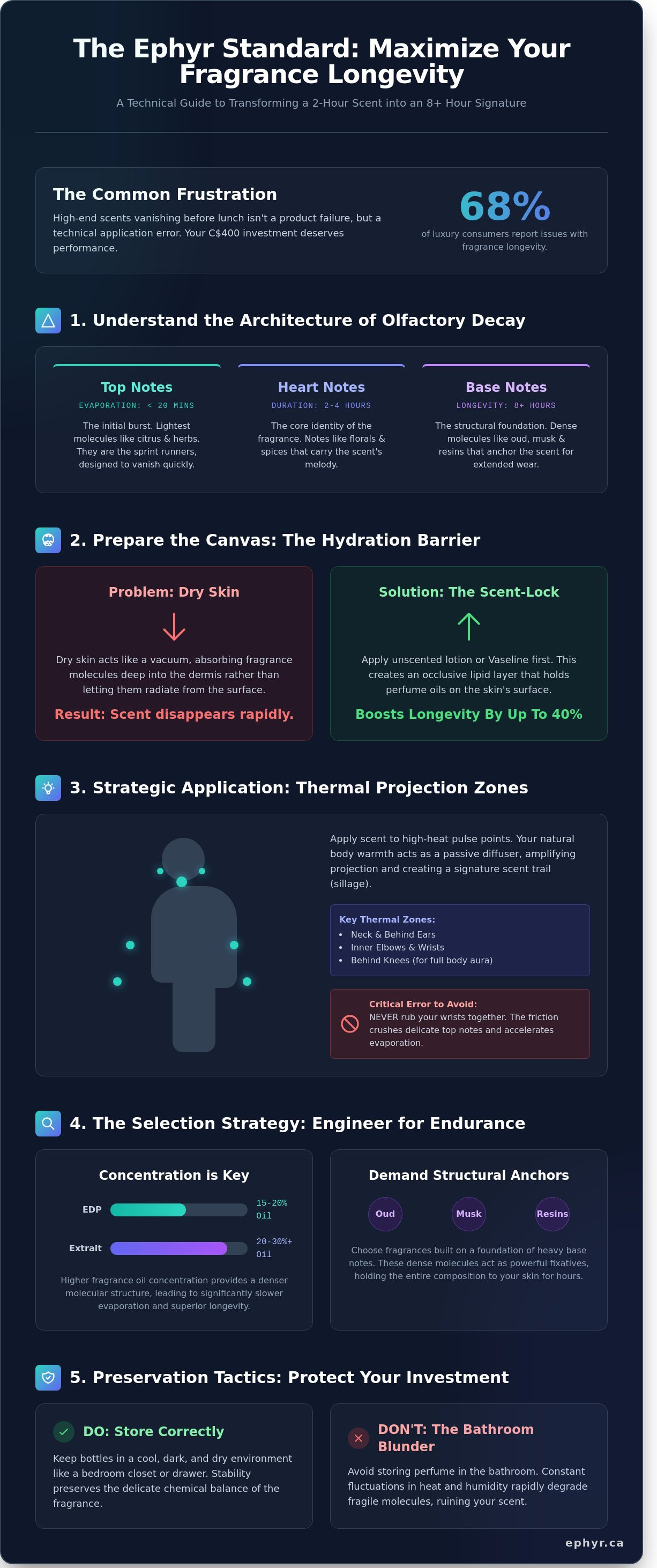
A fine fragrance is a living symphony of volatile molecules designed to evaporate over time. It isn't a static coating. Think of it as a timed release of chemical energy. Understanding how to make perfume last longer begins with the architecture of the scent pyramid. You've likely heard of top, heart, and base notes. This isn't just marketing jargon; it's a map of molecular weight. Top notes are the sprint runners. They provide that initial blast of citrus or herb but vanish as soon as they hit the air. The heart notes form the core identity for several hours. Finally, the base notes provide the structural foundation that lingers long after the sun sets.
Volatility is the metric that dictates this lifespan. Volatility describes the speed at which a molecule transitions from liquid to gas; light citrus oils like bergamot evaporate in under 20 minutes, while dense resins like labdanum can persist on skin for 24 hours. If your scent seems to disappear, it might not be the liquid's fault. Your Olfactory Bulb, the brain's scent processing center, often triggers nose blindness. This is a survival mechanism. Your brain filters out constant stimuli to stay alert for new smells. You haven't lost your scent; your brain has simply archived it.
The Science of Evaporation
Heat and airflow act as the primary engines of scent dispersal. In a climate like Montreal, where indoor heating can strip moisture from the skin, evaporation accelerates. Alcohol-based carriers act as both the hero and the villain here. Ethanol is the perfect delivery system because it flash-evaporates, lifting the scent molecules into the air so others can smell them. This same process eventually depletes the reservoir on your skin. Synthetic fixatives are often engineered to slow this down, acting as chemical anchors for more delicate natural oils that would otherwise vanish in minutes.
Why Niche Scents Behave Differently
Mass-market fragrances often prioritize the "top note sell" to grab attention in a busy mall. Niche houses like Xerjoff or Amouage build for the long game. These brands utilize higher fragrance concentrations, often reaching 20% to 30% oil volume. This density is a core component of the Amouage Perfume pillar, where raw materials like silver frankincense provide an unseen quality that resists breakdown. When you invest in high-performance artistry, you're paying for molecules that have been calibrated for endurance. Learning how to make perfume last longer is often a matter of choosing a build that's engineered for the task from the first spray.
Preparing the Canvas: Skin Hydration and Chemistry
Think of your skin as a parched landscape. Dry skin is a vacuum; it drinks the fragrance molecules, pulling them into the dermis rather than allowing them to radiate from the surface. This rapid absorption is the primary reason why high-end scents often vanish by noon. To understand how to make perfume last longer, you must first master the science of the skin barrier. A well-hydrated surface acts as a primer, ensuring the volatile oils remain suspended and active for 8 to 12 hours.
The legendary Vaseline hack is a staple for a reason. Applying a thin layer of petroleum jelly to pulse points creates an occlusive seal that traps scent. However, a high-quality fragrance-free body lotion is often more effective for full-body performance. These emulsions provide a lipid-rich foundation that mimics the natural oils found in resilient skin types. Your personal pH levels and diet also dictate the narrative. High acidity or a diet rich in spices can shift the scent profile, sometimes accelerating the evaporation of delicate top notes. Understanding these scientific factors of perfume longevity is the first step toward olfactory precision.
The Hydration Barrier
Oil-rich skin retains scent molecules significantly longer than dry skin. It's a matter of molecular adhesion. When you apply a scent to a dry surface, the alcohol carrier evaporates and takes the fragrance with it. By using a "scent-lock" layer of fragrance-free cream, you provide a fatty base for the perfume oils to cling to. This technique can extend the life of a fragrance by up to 40 percent. In the Canadian climate, where winter air strips moisture, this step is non-negotiable. Before investing in a full bottle, using luxury fragrance samples Canada is the most reliable way to test how your specific skin chemistry reacts to different concentrations.
The optimal window for application is the "post-shower golden hour." Apply your scent within 5 minutes of drying off. Your pores are open, your skin is warm, and the moisture levels are peaked. This creates a bespoke bond between the liquid and the skin, ensuring the structural integrity of the fragrance remains intact throughout the day. For those seeking peak performance, this routine is the Ephyr standard for personal grooming.
The No-Rub Rule
Rubbing your wrists together is a cardinal sin in the world of high-end perfumery. It's a mechanical error that compromises the scent's architecture. Friction generates heat. This heat "bruises" the delicate top notes, like citrus or light florals, causing them to evaporate prematurely. You're effectively skipping the first chapter of the fragrance's story.
- Dab, don't rub: Gently press your wrists together to transfer the liquid.
- Mist and walk: For a lighter, uniform distribution, spray into the air and move through the cloud.
- Target pulse points: Focus on the neck, inner elbows, and behind the knees where blood flow is closest to the skin.
Proper application preserves the intended progression from top to base notes. When you treat the application with the same precision as a master craftsman, you discover how to make perfume last longer without over-spraying. It's about efficiency, not volume. This disciplined approach ensures your presence is felt long after you've left the room.
Strategic Application: Pulse Points and Beyond
Application isn't just a final step; it's a technical maneuver. To master how to make perfume last longer, you must target the body's natural heat exchangers. Precision is the hallmark of the master craftsman. Applying fragrance follows the same logic as thermal management in a high-end workstation. You want maximum efficiency with zero waste.
The Power of Pulse Points
Blood vessels sit closest to the skin at the wrists, neck, and behind the ears. These areas maintain a consistent 37 degrees Celsius, acting as miniature diffusers that push the scent outward throughout the day. Don't ignore the lower pulse points. Spraying the back of the knees allows the scent to rise naturally as you move. This creates a vertical scent column that stays with you. For those selecting a professional cologne for men, this strategic placement ensures a sillage that commands respect without overwhelming a boardroom. It's about precision, not volume. Targeted application ensures the fragrance works for you, not against you.
Scenting the Unconventional
The "Cloud Method" is a relic of marketing, not science. Walking through a mist wastes up to 45% of your fragrance on the floor. Direct application to the skin is the only way to ensure the oil bonds with your lipids. For an extended duration, utilize hair and clothing as reservoirs. Standard perfumes often contain 70% to 90% alcohol, which can dehydrate hair fibers over time. Use a bespoke hair mist instead. These formulas offer a lower alcohol concentration to provide a 12-hour slow-release effect without the risk of damage. It's a calculated addition to your grooming routine.
When spraying clothing, prioritize natural fibers like cotton or wool. They hold molecules significantly longer than skin. Be cautious with silk or white linens, as certain heavy oils can leave a permanent mark. Focusing on the nape of the neck is a professional secret. It creates a lingering scent trail that follows you through a space. You can find additional expert tips for long-lasting fragrance that emphasize these tactile techniques. Layering a dedicated hair mist with a traditional Eau de Parfum provides a 360-degree aura. This technical approach is exactly how to make perfume last longer throughout a demanding 14-hour day. Your scent should be as reliable as your hardware.
Preservation Tactics: Protecting Your Olfactory Investment
Perfume is a delicate chemical architecture. It’s an intricate balance of volatile molecules that environmental factors can easily disrupt. Think of your bottle as a precision instrument. If you treat it like a commodity, the scent will degrade before the liquid even reaches the halfway point. Most enthusiasts commit the "Bathroom Blunder." They store their collection in a room where humidity levels spike by 40% and temperatures fluctuate every time someone showers. This cycle of thermal expansion and contraction is the fastest way to ruin a composition. It breaks the chemical bonds that hold the top and heart notes together.
UV rays are equally destructive. Direct sunlight acts as a catalyst for chemical reactions that turn a vibrant juice into a flat, vinegar-like disappointment. This is why the "Dark Room" rule is non-negotiable for anyone learning how to make perfume last longer. Oxidation is the final enemy. Once you depress the atomizer for the first time, oxygen enters the bottle. This process is inevitable; it explains why your last spray will never smell identical to your first. Air slowly alters the molecular structure, eventually turning the liquid cloudy or sour.
The Ideal Storage Environment
Precision is the Ephyr standard. You should aim for a consistent environment between 15°C and 20°C. Fluctuations are more damaging than a slightly higher, but stable, temperature. The "Fridge Debate" continues to divide the community. Chilling your fragrances can extend the life of volatile citrus notes, but it’s rarely necessary for heavier ouds or ambers. If you use a fridge, ensure it’s a dedicated unit. Food odors can permeate seals. Keeping your perfumes in their original boxes remains the ultimate craftsman’s secret. It provides a dual layer of protection against light and minor temperature shifts.
Travel and Decanting
Decanting is a risky necessity for the modern traveler. Every time you transfer liquid, you expose it to air. This acceleration of aging can dull the brilliance of a bespoke scent. Use high-quality glass atomizers with tight seals to minimize this impact. Cheap plastic alternatives often react with the oils. For those in Montreal or Toronto looking to explore without the risk, discover perfume samples Canada. These professional vials are sealed under controlled conditions. They offer a travel-friendly way to maintain your scent profile without compromising the master bottle. Understanding these variables is key to knowing how to make perfume last longer throughout the Canadian seasons.
The Selection Strategy: Concentrations and Base Notes
Performance isn't accidental. It's architectural. If you want to master how to make perfume last longer, you must understand the blueprint of the scent before you ever press the atomizer. Longevity begins at the point of purchase. It's a calculation of molecular weight and oil density. At Ephyr, we view fragrance like high-end hardware. The components dictate the output.
EDT vs. EDP vs. Extrait
The label on your bottle is a technical spec sheet. Eau de Toilette (EDT) typically contains 5 to 15 percent fragrance oil. It's designed for a quick impact, perfect for a short event but rarely surviving a full Canadian workday. Eau de Parfum (EDP) steps up to 15 to 20 percent. This is the industry standard for reliable performance. For those seeking uncompromising endurance, Extrait de Parfum offers 20 to 40 percent concentration.
A higher concentration doesn't necessarily mean the scent will be louder or fill a room more aggressively. In many cases, it means the fragrance stays closer to the skin for a significantly longer duration. It's the difference between a sudden burst of energy and a sustained, high-performance thermal load. Xerjoff Perfumes represents the pinnacle of this high-concentration mastery. Their builds utilize premium oils that ensure the scent profile remains intact from the morning commute until the late-night gallery opening.
Hunting for Heavy Hitters
Not all molecules are created equal. Citrus and "fresh" notes like bergamot or lemon are small and volatile. They evaporate rapidly by design. You cannot force a summer cologne to behave like a winter powerhouse. To truly understand how to make perfume last longer, you have to look at the base notes. These are the anchors of your olfactory investment.
- Oud and Leather: Dense, resinous, and nearly impossible to shake.
- Amber and Vanilla: Sweet but heavy, providing a warm foundation that clings to fibers.
- Musk and Sandalwood: Creamy fixatives that slow down the evaporation of lighter notes.
Read the note pyramid before you buy. If the base is thin, the performance will be too. We recommend the four hour skin test. Spray the scent at a boutique and leave. Don't judge the craftsmanship by the first ten minutes. The top notes are the marketing pitch; the dry down is the reality. If the scent hasn't maintained its integrity after four hours on your skin, it doesn't meet the Ephyr standard for long-term reliability. High-end fragrance is a functional art. Choose the materials that are built to endure.
Mastering the Scent: Your 2026 Olfactory Blueprint
Fragrance is more than a simple scent; it's an invisible architecture. You've learned that mastering how to make perfume last longer requires a technical approach to skin hydration and strategic pulse point application. By treating your skin as a meticulously prepared canvas and protecting your collection from thermal decay, you ensure peak performance from every spray. High-concentration base notes aren't just a choice; they're the foundation of a 12-hour scent trail. This is the Ephyr standard of excellence.
We treat high-end perfumery with the same precision as a handcrafted instrument. As an official retailer for world-class houses like Amouage and Xerjoff, we bridge the gap between raw ingredients and refined luxury. Our experts provide tailored fragrance consultations to align your profile with your unique chemistry. With fast shipping across Canada, your next olfactory investment arrives with speed and care. It's time to elevate your presence with a scent that refuses to fade.
Discover our curated collection of high-performance niche fragrances
Step into the world of elite perfumery and let your signature linger long after you've left the room.
Frequently Asked Questions
Is it true that putting Vaseline on pulse points makes perfume last longer?
Yes, applying a thin layer of petroleum jelly to pulse points creates a moisture-locking base that anchors scent molecules. Fragrance evaporates 30% faster on dry skin compared to hydrated surfaces. By providing a tacky, occlusive foundation, the oils have a surface to cling to rather than being absorbed into the dermis. It’s a simple mechanical solution for anyone wondering how to make perfume last longer throughout a 12 hour Canadian workday.
Does perfume expire, and does old perfume lose its strength?
Perfume typically maintains its peak structural integrity for 36 to 60 months. After this window, oxidation triggers a chemical breakdown of the top notes, often resulting in a vinegary or metallic scent profile. While a 2021 study on aromatic stability suggests some resins last longer, the delicate citrus molecules are the first to fail. If your bottle has darkened or smells off, the volatile compounds have likely reached their thermal limit.
Why can’t I smell my own perfume after a few hours?
Your brain intentionally ignores the scent through a process called olfactory fatigue to prevent sensory overload. This neural filtering happens within 15 to 20 minutes of exposure. While your peers still detect the sillage, your receptors have effectively muted the signal to remain alert for new environmental smells. It’s a biological efficiency mechanism. You haven't lost the scent; your hardware has just optimized its processing power for other inputs.
Can I spray perfume on my hair to make it stay longer?
Spraying fragrance on your hair is an effective diffusion method because hair fibers are more porous than skin. These strands act as a natural diffuser, releasing scent with every movement. However, most formulations contain 80% alcohol, which can strip moisture from the cuticle over time. For a safer application, mist your brush first. This technique offers a controlled distribution that avoids the direct chemical stress of a concentrated blast.
What is the longest-lasting type of perfume concentration?
Extrait de Parfum stands as the pinnacle of longevity, boasting a concentration of 20% to 40% aromatic compounds. In contrast, an Eau de Toilette contains only 5% to 15% oil, leading to much faster dissipation. This high oil to alcohol ratio ensures the scent remains detectable for 10 hours or more. Investing in higher concentrations is a strategic choice for those seeking a persistent, professional presence that survives the entire day without fading.
How many sprays of perfume are too many?
Exceeding 4 sprays often transitions a fragrance from a personal aura to an environmental irritant. For most professional settings in Toronto or Montreal, 2 to 3 targeted sprays provide sufficient projection without overwhelming the room. Each 50ml bottle contains roughly 500 to 700 sprays, so a disciplined application also extends the life of your investment. Balance is the ultimate hallmark of a refined presence; don't let the scent precede you into a room.
Does the weather affect how long my fragrance lasts?
High temperatures accelerate the evaporation of volatile oils, causing scents to peak and fade rapidly. In 30°C heat, a fragrance might vanish in half its usual time. Conversely, cold Canadian winters can suppress a scent’s projection, making it feel muted. Adjusting your application based on the barometer is a key secret in learning how to make perfume last longer. Heavier woods and resins perform best when the mercury drops below freezing.
Should I store my perfume in the fridge?
Storing fragrance in a dedicated cosmetic fridge at a consistent 12°C prevents the thermal degradation caused by bathroom humidity. Fluctuating temperatures and UV light are the primary enemies of aromatic compounds. By maintaining a stable, cool environment, you protect the delicate chemical balance of the juice. It’s a precision storage tactic that ensures your collection remains as potent as the day it was handcrafted, preventing the early onset of oxidation.


