
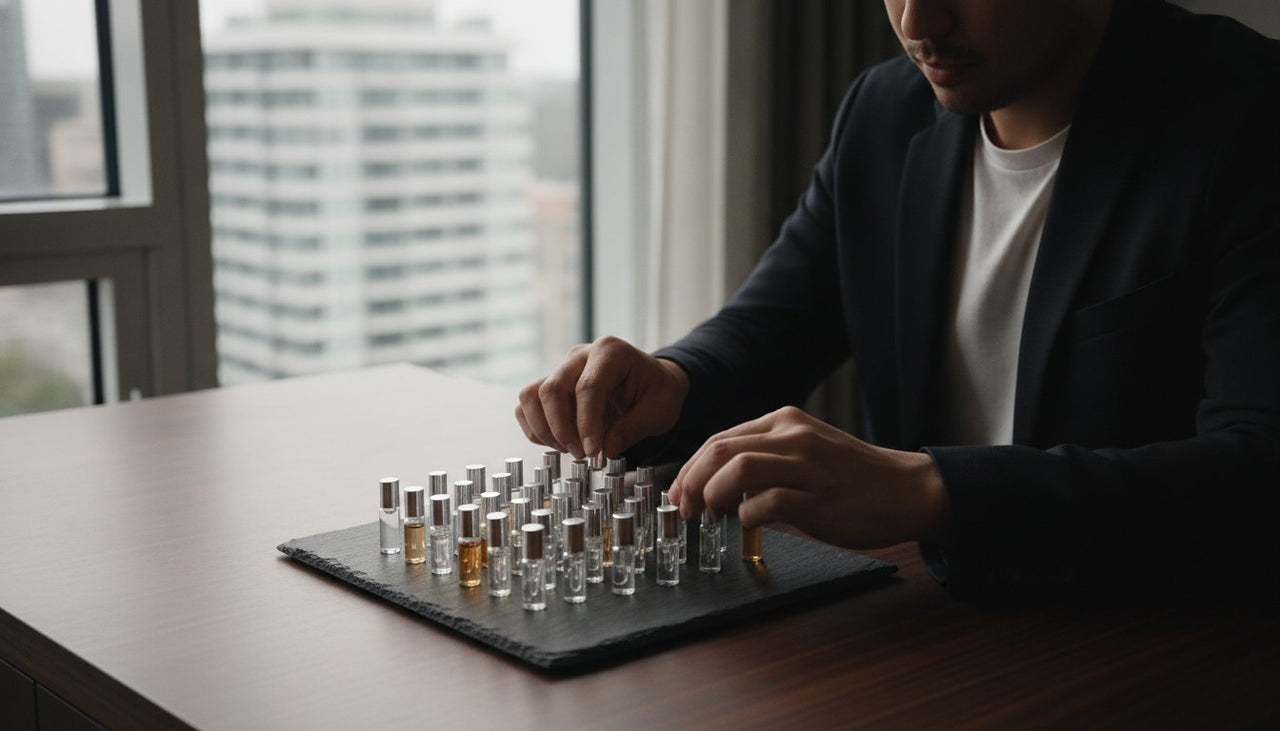
In the U.S. alone, 33% of adults are expected to buy a fragrance in 2026 without ever smelling it first. It's a high-stakes gamble that often leads to a shelf full of expensive, unwearable glass. You've likely felt that sting of disappointment when a scent praised by every online reviewer turns into a metallic mess on your skin. These common perfume blind buy mistakes aren't just bad luck. They're the result of ignoring the technical logic of scent performance and the complex engineering of skin chemistry.
We know the frustration of wasted investments and conflicting notes. This guide will transform your approach to fragrance acquisition from a game of chance into a disciplined craft. You'll learn to master the architectural nuances of niche houses like Xerjoff and Amouage while developing a high-performance framework for discovery. We're moving beyond surface-level hype to explore the internal configuration of a perfect collection, ensuring every bottle you own is an intentional, long-term asset rather than a disposable commodity.
Key Takeaways
- Decode the technical friction between a fragrance’s note pyramid and your skin’s unique lipid profile to predict how a scent truly evolves.
- Audit common perfume blind buy mistakes, specifically the viral hype trap that masks a fragrance's actual suitability for your personal chemistry.
- Implement a master craftsman’s precision blueprint for discovery, graduating from simple blotter tests to rigorous 12-hour skin evaluations.
- Shift your strategy from high-risk bottle purchases to a low-friction sampling methodology using 1ml vials and discovery sets.
- Learn to navigate the sophisticated engineering of niche houses like Amouage by treating each discovery as a technical investment in your olfactory wardrobe.
The Allure and the Abyss: Why We Make Perfume Blind Buy Mistakes
The thrill of the blind buy is rarely about the liquid itself. It is about the dopamine of the unknown. Your brain treats the wait for a mystery bottle like a high-stakes engineering project, building a perfect olfactory model before the package even arrives. By the time you break the seal, your expectations have often outpaced reality. This psychological loop is the primary driver of most perfume blind buy mistakes. You aren't just buying a scent; you're buying the anticipation of a masterpiece.
This cycle creates what we call the "Fragrance Graveyard." It’s a shelf of beautiful glass bottles that you simply never wear. Every unused 100ml bottle represents a significant misallocation of capital. When you calculate the true price of these errors, the cost of "saving time" by skipping the sample phase becomes incredibly high. Even a thousand positive reviews can't save a purchase if the composition doesn't align with your specific biological hardware. Social proof is a data point, but it isn't your data point. In the world of niche perfumery, consensus is often a distraction from personal compatibility.
The Psychology of Scent Anticipation
Our minds are creative liars. When we read a description of a rare Omani frankincense or a sun-drenched Italian citrus, our brains fill the gaps with our "ideal" versions of those smells. We ignore the technical variables. Aesthetic bottle design further clouds our judgment. A heavy, gold-plated cap or a hand-polished flacon suggests a level of internal configuration that the juice might not actually possess. This visual bias, combined with the "fear of missing out" on limited niche releases from houses like Amouage or Xerjoff, pushes us to click "buy" before we've verified the performance metrics on our own skin.
Note Pyramids vs. Olfactory Reality
The "olfactory pyramid" is a marketing abstraction designed to communicate a mood rather than a precise technical formula. It is the architectural sketch, not the finished building. To truly understand the complexity of these compositions, one must look at The history and science of perfume and how volatile compounds interact. For example, a "Bergamot" note in a mass-market scent might smell like industrial floor cleaner, while in a high-performance niche bottle, it smells like a fresh-cut fruit in Calabria. The difference lies in the quality of raw materials versus synthetic accords. Without a physical test, you are guessing at the caliber of the engineering involved.
The Olfactory Trap: Technical Reasons Your Blind Buy Failed
The transition of a fragrance is a deliberate piece of engineering. A scent moves from volatile top notes to heavy base notes over an eight hour cycle. In the dry, biting cold of a Canadian winter in Calgary, sillage is often suppressed. In the heavy humidity of a Toronto summer, that same scent might become overbearing. You cannot predict these environmental shifts from a screen. You need to observe the hardware in action.
The Science of Skin Interaction
Base notes like musk or ambergris react differently to individual skin oils. They are designed to bond with the wearer. This biological link is why a scent can feel like a signature on one person and a costume on another. Our attraction to these notes often stems from the psychology of scent and memory, where our brains seek out familiar comfort. However, memory doesn't account for pH. Skin lipids can "eat" certain molecules, causing a fragrance to vanish in two hours on one person while lasting twelve on another.
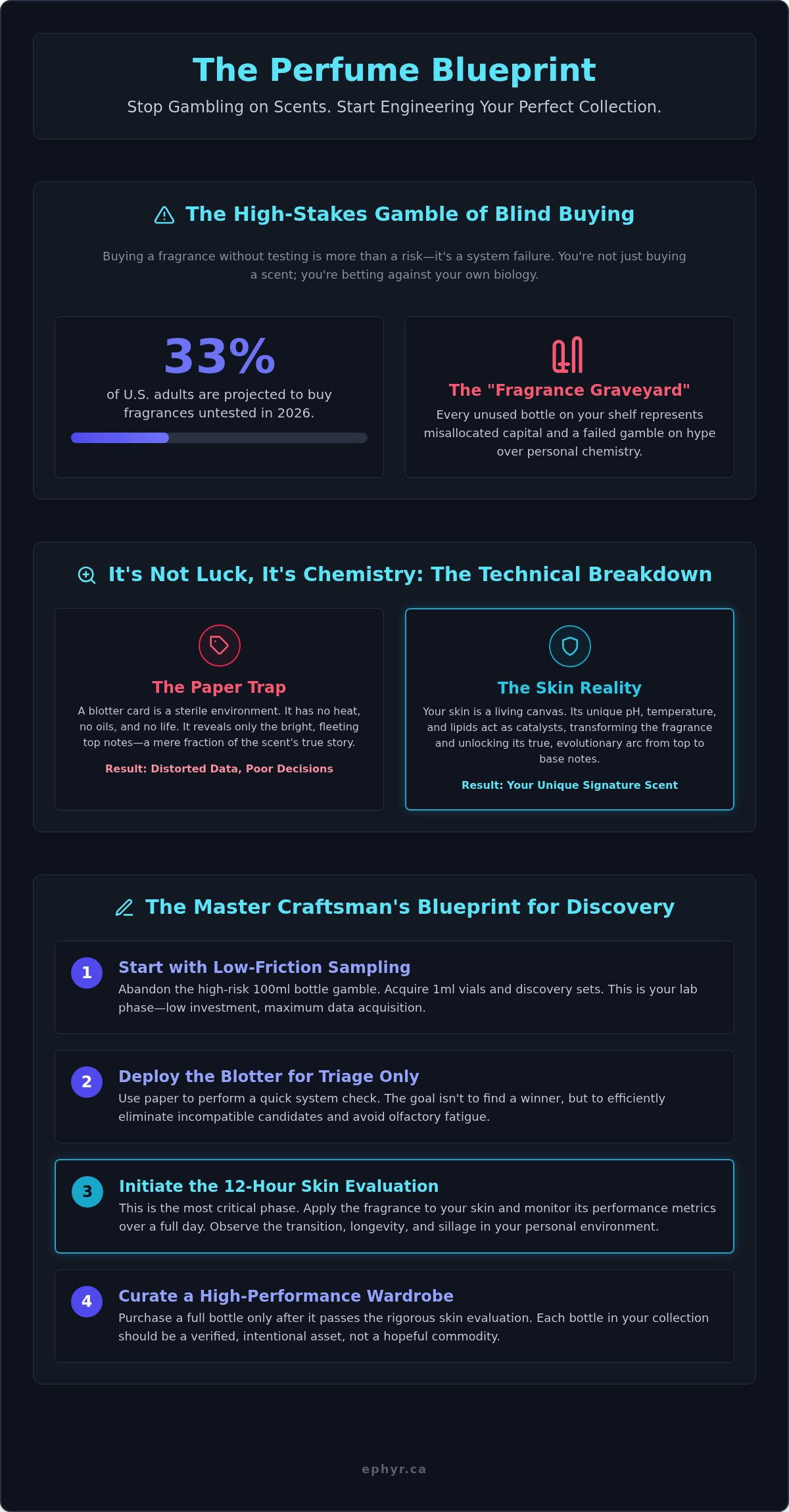
The "Paper Trap" is a common tactical error. A blotter card is neutral. It has no heat. It has no oils. Judging a niche masterpiece by its first 30 seconds on paper is like judging an engine while it's idling in a cold garage. You only see the bright top notes. You miss the entire evolutionary arc. Scent fatigue also plays a role. After three or four different smells, your olfactory receptors "flatline," leading to poor buying decisions based on distorted data.
Performance Metrics: Longevity and Sillage
We define sillage as the architectural footprint of a fragrance. It is the trail you leave behind. Projection is the immediate radius of the scent. Longevity is the total endurance of the composition. High-performance houses like Amouage require a different testing timeline. Their complex concentrations often don't reach their true dry down until four or five hours in. To understand the projection, you must monitor how the scent occupies space over time. To avoid another failed investment, consider testing these metrics with specialized 1ml samples before committing to a full bottle.
Trends vs. Timelessness: Avoiding the Viral Scent Mistake
Digital algorithms have fundamentally altered how we perceive scent. A 15-second TikTok clip can make a fragrance like Bianco Latte feel like a universal necessity. This is the "TikTok Effect." It creates a digital mirage of universal appeal that ignores the technical reality of your own chemistry. You see thousands of likes and assume the scent is a safe bet. In reality, this is one of the most common perfume blind buy mistakes in the modern market. You aren't buying a fragrance; you're buying into a viral moment.
The "Signature Scent" fallacy further complicates the process. We are told that one masterpiece should define us. This leads to high-pressure purchases of expensive bottles based on someone else’s "Top 10" list. But a scent that is a masterpiece on a stranger can be a synthetic headache on you. Niche houses like Xerjoff don't build for mass-market "likability." They prioritize complexity and artistic engineering. These compositions are individually tuned instruments, not mass-produced crowd-pleasers. They require a more disciplined approach to discovery.
Deconstructing the Viral Scent
Viral scents often lean on simple, high-impact gourmand or "clean" profiles. They are designed for immediate digital recognition. However, simplicity often lacks the structural depth required for long-term wearability. A scent that smells "amazing" in a 15-second video might become cloying or linear after two hours on your skin. Developing olfactory maturity means looking past the initial hype. It involves recognizing that a fragrance's performance is an internal configuration, not a social media metric. True quality doesn't need to shout to be effective.
The Value of Artistic Intent
To avoid the trap of viral noise, you must study the perfumer’s portfolio. Look at the "DNA" of the house. For instance, the works of Nishane or Casamorati have distinct technical signatures. They use specific raw materials and blending methodologies that define their performance. Identifying these patterns is more valuable than reading a single review. Complex niche scents are rarely understood on the first spray. They often require three to five full wearings before their architectural logic becomes clear. This is why we treat sampling as a blueprint for a successful collection. It's a low-risk way to audit the artistic intent before you invest in the full flacon.
The Precision Blueprint: How to Sample Like a Master Perfumer
To stop making perfume blind buy mistakes, you must treat scent acquisition as a technical audit. A Master Craftsman doesn't guess. They measure. They test. They verify. This process moves you away from the emotional impulse of a checkout button and toward a disciplined methodology. By following a structured blueprint, you ensure that every bottle in your collection performs to your exact specifications.
- Step 1: The Paper Introduction. Use a blotter card as your initial filter. This is a low-resolution preview. It allows you to eliminate scents that clash with your basic preferences without wasting valuable skin real estate.
- Step 2: The Skin Test. Once a scent passes the paper filter, apply it to clean skin. You are looking for the full 12-hour dry down. Monitor how the internal configuration of the fragrance interacts with your biology.
- Step 3: The Environment Test. Performance varies by context. Wear the sample to your office, during an evening out, and in the open air. A scent that excels in a climate-controlled room might fail in the sharp Canadian winter.
- Step 4: The Discovery Set Advantage. Use a house-specific set to understand the brand's DNA. This reveals the range and consistency of the perfumer's work before you commit to a single masterpiece.
- Step 5: The Final Verdict. Only move to a full bottle acquisition if the scent maintains its integrity through all previous steps. This is the ultimate gatekeeper for your collection.
The Power of the Discovery Set
In the world of high-end perfumery, discovery sets are the most cost-effective tool in your arsenal. They act as a blueprint for a successful collection. The mathematics are simple. Spending $50 on a curated set of samples is a minor investment compared to the $400 loss of a failed blind buy. Sets from houses like Amouage or Xerjoff allow you to audit five or ten different compositions, identifying which technical signatures resonate with your chemistry. It is the difference between a gamble and a calculated acquisition.
Technical Testing Protocols
Precision matters. Apply your 1ml samples to pulse points like the wrists or the neck for the most accurate projection. Avoid rubbing the skin; this creates friction heat that can "bruise" the molecules and distort the top notes. We recommend the "24-Hour Rule." Never buy a bottle on the same day you first smell it. You need to see the final remnants of the base notes the next morning to judge the true longevity. Maintaining a scent journal can help you track how these notes perform across different Canadian seasons, providing a data-driven record of your olfactory journey. To begin your technical audit, explore our curated discovery sets today.
Beyond the Gamble: Curating a High-Performance Fragrance Wardrobe
Maison Ephyr acts as your technical consultant in this process. We specialize in bridging the gap between curiosity and ownership. Our curated selection of niche houses, including Amouage and Nishane, ensures that every bottle we offer meets a specific benchmark of quality. We treat fragrance as functional art. Our goal is to provide the blueprints you need to build something lasting. Every 1ml vial we provide is a step toward a flawless collection, free from the clutter of unused "scrubbers."
The Boutique Experience from Anywhere
You don't need to live in a major fashion capital to access world-class artistry. By utilizing perfume samples in Canada, you can audit the most complex compositions from your own home. This professional guidance replaces the gamble of the blind buy with a systematic testing protocol. Authenticity is our signature. When you explore brands like Xerjoff or Casamorati through our specialized 1ml program, you're receiving the exact internal configuration intended by the master perfumer. There are no shortcuts to excellence. You deserve the certainty that comes with official retail standards.
Final Steps to a Flawless Collection
A disciplined collector always maintains a discovery budget. This ensures you're constantly testing new hardware without the pressure of a full bottle commitment. It keeps your palate sharp and your collection evolving. Don't forget that your olfactory environment extends beyond your skin. Incorporating high-end home fragrances, such as scented candles, allows you to round out your sensory space with the same technical precision you apply to your personal scent. It's about creating a cohesive atmosphere of quality.
The era of the "Fragrance Graveyard" is over. You now have the framework to identify perfume blind buy mistakes before they happen. You understand the science of skin, the trap of viral hype, and the power of a structured blueprint. Start your next discovery journey with the poise of a master craftsman. Precision is the ultimate luxury. Build your collection with intent.
Master Your Olfactory Future
The transition from a cluttered shelf to a curated wardrobe begins with a single technical shift. You've learned that scent is a biological reaction, not a static image. By prioritizing 12-hour skin tests and ignoring the transient noise of viral trends, you've gained the tools to eliminate perfume blind buy mistakes for good. This disciplined approach ensures that every acquisition is a calculated investment in your personal brand rather than a disposable gamble. Your collection should be a testament to precision, not a graveyard of impulse.
As an official Canadian retailer for high-performance houses like Amouage, Xerjoff, and Nishane, Maison Ephyr provides the precision instruments needed for this journey. Our expert-led curation and specialized sample program bridge the gap between curiosity and ownership. We offer fast, nationwide shipping across Canada to ensure your discovery process remains efficient and uncluttered. Excellence is a deliberate choice. Your collection should reflect that commitment to quality and internal engineering.
Explore our curated Discovery Sets and find your next masterpiece risk-free.
Your next signature scent is waiting to be discovered. Approach it with the poise of a master craftsman and let the liquid speak for itself. Happy hunting.
Frequently Asked Questions
What is the most common mistake when blind buying perfume?
The most frequent error is judging a fragrance by its volatile top notes rather than its full 8-hour evolution. Many perfume blind buy mistakes occur because collectors ignore the technical transition from opening accords to the deep dry down. You aren't just buying the first 30 seconds of a scent. You're investing in a complex chemical reaction that requires hours to reveal its true architectural footprint on your skin.
Can I trust "scent notes" listed on a website when buying blind?
Scent notes are marketing abstractions designed to communicate a mood rather than precise technical formulas. A "sandalwood" note in a niche bottle from a house like Amouage is vastly different from a synthetic accord found in mass-market products. These lists describe an intended aesthetic. They don't account for the quality of raw materials or the internal configuration of the blend, which can only be verified through physical testing.
How many times should I wear a sample before buying a full bottle?
We recommend three to five full wearings before you commit to a full bottle acquisition. Your olfactory receptors need time to decode the complexity of high-performance niche scents like those from Xerjoff. Wear the sample in different environments, such as a climate-controlled office and the open air. This provides a comprehensive data set on how the fragrance performs across various technical and environmental variables.
Does skin type really change how a perfume smells?
Skin chemistry is a critical catalyst that fundamentally alters scent performance and is a leading cause of perfume blind buy mistakes. Your pH levels, lipid content, and skin temperature interact with the fragrance's volatile compounds. For instance, dry skin often "eats" lighter citrus molecules, while oily skin can amplify heavy base notes like musk. This biological interaction is why personal testing remains the ultimate benchmark for quality.
Are niche perfumes riskier to blind buy than designer fragrances?
Niche fragrances carry a higher risk profile because they prioritize artistic complexity over mass-market likability. Brands like Nishane use higher concentrations of natural materials that are more reactive to individual skin chemistry. Designer scents are often engineered for universal appeal and stability. Niche masterpieces are individually tuned instruments that require a specific wearer and environment to reach their peak performance levels.
What should I do if I hate a perfume I bought blind?
Don't immediately discard a failed purchase. Try layering the scent with a simpler "clean" fragrance to modify the profile, or set it aside for a different Canadian season. Temperature and humidity shifts can sometimes rescue a fragrance that feels unwearable in the winter. Alternatively, treat the bottle as a learning asset for your olfactory journal or trade it within the enthusiast community to fund your next discovery set.
How do I find my "scent twin" to help with online shopping?
Locate a scent twin by identifying reviewers who share your specific technical preferences across multiple fragrance databases. Look for individuals whose skin reacts similarly to challenging base notes like oud or vetiver. This alignment provides a more reliable blueprint for your own acquisitions. Remember that even a twin's approval is just a high-probability data point. It doesn't replace the need for a 1ml skin test.
Why do some perfumes smell great on others but terrible on me?
Variations in scent perception are driven by a combination of diet, medication, and your body's unique lipid profile. What smells like a sun-drenched garden on a friend might turn into a sharp, metallic accord on your skin. This is the "paper versus skin" divide in action. Your body's internal chemistry acts as the final stage of the perfume's engineering, determining whether the composition succeeds or fails.
Article by
Dmitrii Savishin
Dmitrii Savishin is the founder of Maison Ephyr and Parfum Exquis, two Canadian destinations dedicated to the world of niche perfumery. With years of experience discovering exceptional fragrance houses from around the globe, Dmitrii shares expert insights on perfume trends, fragrance notes, luxury brands, and the art of choosing the perfect scent. His mission is to make niche perfumery more approachable while helping readers discover fragrances that leave a lasting impression.


