
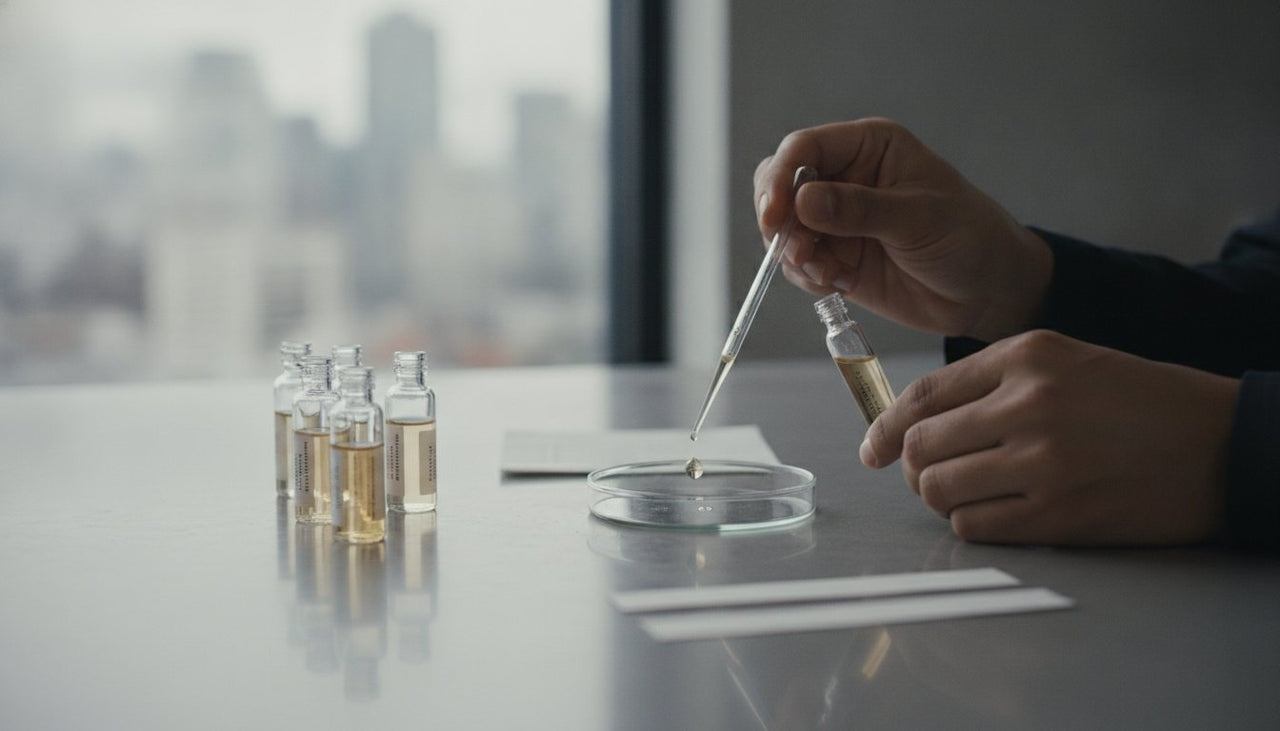
A single spray on a paper strip isn't a test; it's a deception. Most enthusiasts treat fragrance shopping as a sensory whim, only to face buyer's remorse when a niche bottle fails to perform at home. Learning how to test perfumes correctly is the only way to bypass the marketing and see the raw engineering of a scent. You want a fragrance that lasts. However, the air in a boutique is a chaotic soup of competing molecules that clouds your judgment and leads to sensory overload.
We understand the frustration of a scent disappearing before lunch. It's a technical failure that usually stems from rushed evaluation. This article introduces the Master Craftsman’s Protocol, a disciplined 48-hour method designed to reveal a fragrance's true molecular behavior. You will learn to navigate the 2026 IFRA safety updates and understand how the 80 new declarable allergens affect your skin chemistry. We're moving from guesswork to precise selection by using 1ml discovery samples as the professional's primary diagnostic tool for evaluating high-end liquid art.
Key Takeaways
- Stop falling for the "Top Note Trap." Learn why the first 30 seconds of a fragrance are often a marketing illusion designed to hide the scent's true molecular performance.
- Treat your skin as a living laboratory. Understand how your unique pH levels and lipid content act as a biological canvas that alters the diffusion of high-end niche fragrances.
- Deploy the 48-hour protocol to master how to test perfumes correctly. This disciplined approach measures longevity and sillage through distinct phases rather than relying on a single impulsive sniff.
- Eliminate the "blind buy" gamble by utilizing 1ml fragrance samples and curated discovery sets. This professional strategy allows you to validate a brand's house style before committing to a full investment.
- Use paper blotters only as a clinical tool for initial elimination. Reserve your pulse points for the final stage of performance validation where heat-driven diffusion reveals the scent's true character.
The Scent Paradox: Why Most People Test Perfume Incorrectly
Most fragrance enthusiasts fail before they even pick up a bottle. They treat the retail counter like a playground rather than a laboratory. This impulsive behavior leads directly into the "Top Note Trap." It's a psychological bias where the brain prioritizes the immediate burst of citrus or light floral molecules. These top notes are the marketing engine of the fragrance industry. They're specifically engineered to trigger an instant purchase. However, these molecules are highly volatile. They evaporate within minutes, leaving you with a heart and base that might not resemble the opening at all.
Real mastery of how to test perfumes correctly involves viewing the scent as a performance audit. High-end niche fragrances, like those from Amouage or Xerjoff, are complex machines. They possess a dense internal configuration of base notes that don't begin to "rev up" until an hour into the wear. Testing on a paper blotter in a climate-controlled store is like testing a supercar in a parking lot. You never see the true torque. The sterile environment masks the molecular volatility that occurs when the juice hits warm, living skin. Without the heat of your pulse points, the scent remains a flat, two-dimensional sketch of its potential.
The Illusion of the First Impression
When you spray a perfume, the first thing you encounter is the alcohol carrier. This sharp, cooling evaporation can distort your perception of the actual oil concentration. Niche scents often feature much higher oil percentages than mass-market alternatives. This means they require more patience. The heart of the fragrance is buried under these initial layers. If you buy based on the first sixty seconds, you're buying the packaging, not the product. You must wait for the alcohol to dissipate to find the artisanal logic hidden beneath. This is where the true engineering of the scent begins to show its face.
Sensory Overload and Olfactory Fatigue
Your nose is a biological instrument with strict calibration limits. After three distinct scents, your olfactory receptors begin to shut down. This is the "white noise" effect. The air in department stores is already saturated with competing molecules, making it the worst place for a technical evaluation. In 2026, as the luxury fragrance segment accounts for over 65% of the market value, the density of these retail environments has reached a breaking point. Forget the coffee beans. They're a persistent myth that only adds more sensory data for your brain to process. To reset your palate, you need neutral air or the scent of your own clean skin. Professional testing happens in isolation, away from the loud, sensory-heavy clichés of the retail floor.
The Biological Canvas: How Skin Chemistry Dictates the Scent
Your skin is a living laboratory. It is the final, uncredited ingredient in every olfactory composition. While a paper blotter offers a clinical, static view, only the biological canvas of your body can reveal the true performance of a high-end extract. Learning how to test perfumes correctly requires a deep understanding of your own biochemistry. pH levels, lipid content, and even your hydration status act as filters. They can amplify certain molecular groups while muting others.
This interaction creates what professionals call the "Skin Signature." It explains why an Amouage perfume might project a regal, smoky trail on one person while turning sweet and resinous on another. Niche houses use high concentrations of natural raw materials. These materials are chemically restless. They look for lipids to bind to and heat to drive their diffusion. If your skin is dehydrated, it will drink the alcohol and oils. This effectively kills the sillage before the heart notes even arrive. Your diet also plays a subtle role. Highly spiced foods or specific medications can alter your skin's baseline scent, slightly shifting the final profile of the fragrance.
The Physics of Pulse Points
Pulse points are your body's natural radiators. These high-heat zones sit where blood vessels are closest to the surface:
- The inner wrists
- The base of the throat
- Behind the earlobes
- The inner elbows
Climate and Environment Factors
Environmental factors are the external variables in your testing protocol. In the Canadian climate, humidity fluctuations are extreme. Winter air is notoriously dry. It strips moisture from your skin and suppresses the scent's reach. Conversely, a humid summer day can turn a subtle fragrance into an overwhelming cloud. Testing for both indoor and outdoor performance is a technical necessity. To truly master how to test perfumes correctly, you must also observe how the scent interacts with clothing fibers. Natural wools and cottons hold molecules differently than synthetic blends. For a more controlled evaluation, starting with authentic 1ml samples allows you to monitor these shifts across different days and weather patterns before committing to a full bottle.
Blotters vs. Skin: A Technical Comparison for Discovery
Choosing a fragrance is a two-stage filter process. Most amateurs treat the paper blotter as the final verdict. This is a technical error. The blotter is a clinical tool for initial elimination. It allows you to scan the high-level architecture of twenty scents without committing your pulse points to a potential disaster. However, paper is a dead medium. It lacks the thermal energy required to drive the heavier, more complex base notes found in niche perfumery. Learning how to test perfumes correctly starts with assigning each medium its proper role in your evaluation.
Paper strips are made of cellulose. They are designed to hold liquid, not to project it. Because there is no heat, the top notes linger unnaturally long. This creates a distorted timeline. You might love a scent on paper because the bright bergamot opening refuses to leave. On skin, that same bergamot might vanish in ten minutes, revealing a heart of leather or oud that you find repulsive. To bridge this gap, professionals use luxury fragrance samples Canada. These 1ml vials allow you to move the laboratory from the boutique to your home environment, where you can observe the molecular performance in real-world conditions.
The Blotter Audit
The blotter is your first line of defense. When you find a scent that passes the initial sniff, label the strip immediately with the brand and fragrance name. Never throw them loosely into your bag. This leads to cross-contamination, creating a chaotic olfactory blur. Store each strip in a separate envelope or a clean notebook. Review them again after 24 hours. A well-engineered scent will still be legible on paper the next day. This audit helps you identify "linear" fragrances, which stay the same from start to finish, versus "evolving" compositions that change their character over time. If a scent fails the 24-hour blotter test, it doesn't deserve a spot on your skin.
The Skin Validation
Once a fragrance passes the blotter audit, it graduates to the skin validation phase. Follow the "One Scent per Wrist" rule. Testing more than two scents on your body at once is a recipe for sensory confusion. You need a clean, un-scented canvas. Apply the fragrance and monitor the "Dry Down." This is the critical transition from the heart notes to the base. Document your response at specific intervals: the immediate opening, the two-hour mark, and the six-hour mark. Does the sillage remain consistent? Does the scent profile turn sour or metallic? This technical documentation ensures that how to test perfumes correctly becomes a repeatable protocol rather than an impulsive gamble.
The 48-Hour Protocol: A Disciplined Approach to Scent
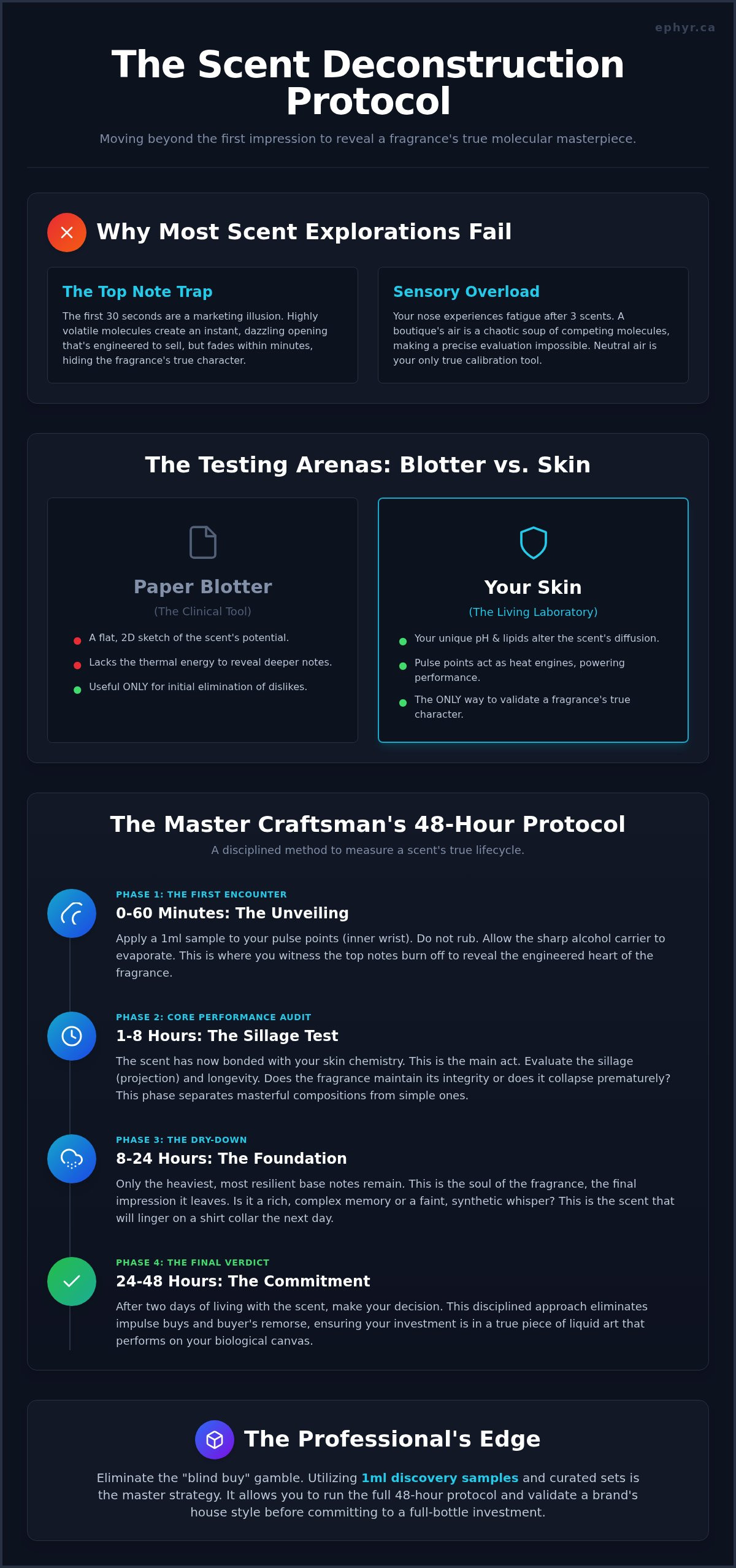
The 48-hour protocol is the gold standard for any serious collector. It's a disciplined audit of liquid engineering. Most retail guides suggest a thirty-minute wait before making a decision. That's a technical failure. Complex niche fragrances, especially those with high resin or wood content, don't even reach their cruising altitude in thirty minutes. Mastering how to test perfumes correctly means observing the scent through four distinct temporal phases to ensure the molecular performance meets your standards.
Phase 1 covers the first two hours. This is the handoff from the volatile top notes to the heart. It's where the architectural intent of the perfumer becomes clear. Phase 2 spans from hours two to eight. This is the primary performance window. You are measuring the sillage and projection during your actual daily routine, not in a sterile store. By Phase 3, usually twelve to twenty-four hours later, you're evaluating the residue. This "skin scent" reveals the quality of the base materials. Finally, Phase 4 occurs on the second day. You re-apply the fragrance to confirm that your emotional response wasn't a fluke of the weather or your mood. Learning how to test perfumes correctly transforms a blind buy into a calculated investment.
To execute this protocol with precision, you can browse our discovery sets to ensure you have enough volume for a multi-day trial.
Step-by-Step Execution
Conduct your test in a neutral environment. Avoid external pollutants like heavy cooking spices, cleaning chemicals, or tobacco smoke. These will contaminate your olfactory data and lead to a false reading. Apply the scent to clean, unscented skin after a shower. Use a digital log or a simple notebook to record your findings at specific intervals: 15 minutes, 2 hours, and 6 hours. This removes the guesswork from the selection process and provides a clear map of the scent's evolution on your specific skin chemistry.
Measuring Technical Metrics
You are looking for three specific data points to judge a fragrance's engineering:
- Sillage: This is the wake left behind you as you move through a room. It's the scent trail.
- Projection: This is the "scent bubble" that surrounds you while you are stationary. A professional fragrance should project without being intrusive.
- Longevity: The total duration the scent remains legible on the skin. In the Canadian market, a fragrance must be durable enough to survive the dry heat of indoor offices and the biting cold of the outdoors.
The Discovery Advantage: Why Sampling is the Professional Choice
The blind buy is a high-stakes gamble with low odds of success. In the world of high-concentration niche perfumery, an impulsive purchase is often a costly technical error. To master how to test perfumes correctly, you must adopt a sampling-first mindset. This isn't just about saving money. It's about data collection. By utilizing a perfume samples Canada strategy, you gain access to the raw materials of luxury without the commitment. You turn your home into a private laboratory. This controlled environment is where the 48-hour protocol thrives, far away from the chaotic atmosphere of a retail floor.
Discovery sets offer a unique technical advantage. They reveal a brand's house style. For instance, exploring Xerjoff through a curated set allows you to see the recurring engineering themes in their Italian craftsmanship. You begin to recognize the specific citrus quality or the way they handle gourmand notes. This builds your olfactory vocabulary. It helps you construct a seasonal library that performs under pressure. Maison Ephyr’s selection is a curated inventory of these high-performance instruments. Each sample is an opportunity to audit a masterpiece before it becomes a permanent part of your collection.
Curating with Discovery Sets
Brands group scents for a reason. There is an internal logic to every collection. A discovery set acts as a diagnostic tool. It helps you identify which olfactory families resonate with your skin's specific biology. Do you thrive with Woody ambers or Oriental resins? Sampling multiple scents from one house reveals the precision of their blending. It's a cost-efficient way to avoid full-bottle mistakes. You pay for the education, not the regret. This is the ultimate hallmark of a disciplined collector.
Your Next Step in the Olfactory Journey
Selecting your first professional-grade discovery set is a tactical move. Start with a brand that aligns with your current aesthetic goals. Once you've applied the 48-hour protocol to each 1ml vial, the transition to a full bottle becomes a logical conclusion rather than an emotional guess. Here is your final checklist for a successful acquisition:
- Verify the scent survived the full 48-hour protocol.
- Confirm the sillage meets your environmental needs.
- Ensure the base notes harmonize with your skin chemistry.
- Validate the emotional connection during the second application.
Master Your Olfactory Signature
Fragrance is more than a scent; it's a technical performance that plays out on your skin over hours and days. By moving from impulsive retail sniffs to the disciplined 48-hour protocol, you ensure that every investment in your collection is a verified success. You now have the tools to navigate the "Top Note Trap" and understand how your own biology acts as the final, critical ingredient in any composition. Mastering how to test perfumes correctly turns the chaotic world of high-end scents into a precise, manageable art form.
We provide the laboratory for your discovery. As an official retailer for Amouage, Xerjoff, and Nishane, Maison Ephyr offers authentic 1ml niche samples and curated discovery sets. We provide fast shipping across all Canadian provinces to bring the boutique experience directly to your pulse points. It's time to stop guessing and start measuring the molecular performance of your next signature scent.
Begin your disciplined discovery with our curated Niche Discovery Sets. Your journey into the world of artisanal quality starts with a single, calculated spray. We look forward to helping you build a library of scents that truly endure.
Frequently Asked Questions
How many perfumes can I realistically test at once without getting confused?
You should limit your evaluation to a maximum of three scents per session. Your olfactory receptors reach a biological saturation point quickly. Beyond this limit, the brain struggles to distinguish individual molecular structures. If you exceed three, you'll experience a "white noise" effect where every fragrance begins to blend into a flat, indistinguishable blur. Space your tests across different days to maintain technical accuracy.
Is it better to test perfume on paper or on my skin?
Use paper blotters for initial elimination and skin for final performance validation. Paper is a clinical medium that captures the top notes accurately but lacks the thermal energy to drive the base. Skin is a living laboratory where heat-driven diffusion reveals the true artisanal logic. To understand how to test perfumes correctly, you must transition from the static blotter to the dynamic pulse points for a complete audit.
Why does a perfume smell different on me than it does on my friend?
Your unique "Skin Signature" is determined by pH levels, lipid content, and hydration status. These biological factors act as a proprietary filter for the fragrance oils. Higher acidity or oilier skin can amplify specific notes while muting others. Even your diet shifts the baseline. This is why a complex extract can manifest as smoky on one person and resinous on another.
How long should I wait before deciding if I like a fragrance?
You must wait a minimum of eight hours to evaluate the full evolution of a niche fragrance. The dry down is where the most expensive and complex base notes reside. Rushing a decision based on the opening is a common tactical error. For a professional-grade assessment, follow the 48-hour protocol to confirm both the technical performance and your long-term emotional connection to the scent.
Can I test perfumes correctly while wearing scented lotion or deodorant?
Successful testing requires a clean, unscented canvas. Scented lotions and deodorants introduce external variables that contaminate the olfactory data. These products create a chaotic molecular environment that masks the fragrance's true character. If you want to know how to test perfumes correctly, ensure your skin is neutral. This allows the scent's internal engineering to speak for itself without interference from mass-market additives.
What is the best way to clear my nose between testing different scents?
Does the weather in Canada affect how I should test my perfumes?
Canadian climate extremes significantly impact fragrance sillage and longevity. The dry, biting cold of winter strips moisture from your skin, which can cause scents to vanish prematurely. Conversely, humid summers can make heavy fragrances feel overwhelming. Testing in your local environment is essential. It ensures the scent's molecular performance can survive the transition from a climate-controlled office to the Canadian outdoors.
Should I test a fragrance on my clothes as well as my skin?
Test on clothing fibers only after you've validated the scent on your skin. Natural fabrics like wool and cotton hold molecules differently than your biological canvas. While clothes provide a linear performance with extreme longevity, they lack the heat-driven diffusion of pulse points. Use clothing tests to see how the scent lingers on a scarf or jacket, but rely on skin for the final performance audit.
Article by
Dmitrii Savishin
Dmitrii Savishin is the founder of Maison Ephyr and Parfum Exquis, two Canadian destinations dedicated to the world of niche perfumery. With years of experience discovering exceptional fragrance houses from around the globe, Dmitrii shares expert insights on perfume trends, fragrance notes, luxury brands, and the art of choosing the perfect scent. His mission is to make niche perfumery more approachable while helping readers discover fragrances that leave a lasting impression.


