

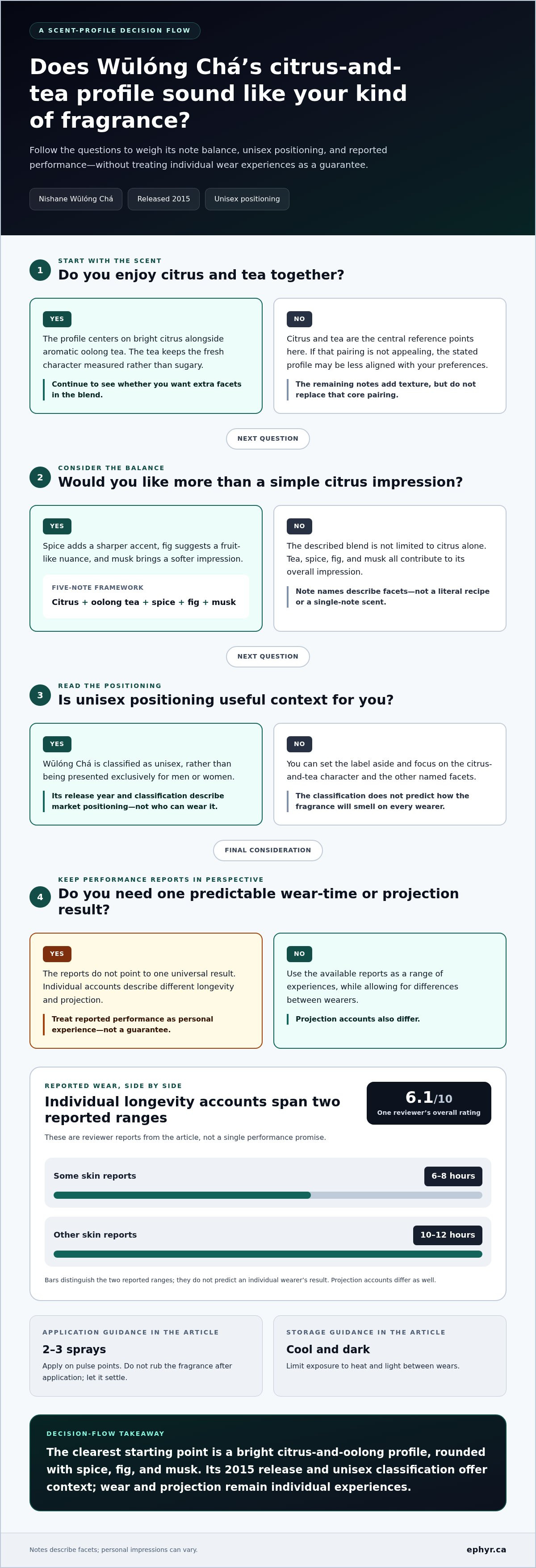
The most revealing part of a Nishane Wulong Cha review may be the gap between its bright tea-and-citrus character and the way different wearers rate its performance. Released in 2015 as a unisex fragrance, Wūlóng Chá is described through citrus, tea, spice, fig, and musk. Individual reports range from 6-8 hours on skin to 10-12 hours, while projection accounts differ. One reviewer rated it 6.1 out of 10 overall.
That variation matters. A fragrance may feel crisp and noticeable to one wearer, then sit close to the skin for another. If you’re weighing its reputation against what you might experience, this review separates the listed notes from personal wear reports instead of treating either as a universal verdict. You’ll get a clearer picture of its accords, positioning, reported wear time and projection, plus the community rating for context. The result is a more grounded sense of what Wūlóng Chá could bring to your fragrance rotation, while recognizing that impressions vary.
Key Takeaways
- Trace how the citrus, tea, spice, fig, and musk notes shape Wūlóng Chá’s overall scent impression.
- Understand its unisex positioning and how the fragrance’s launch year fits its identity.
- Use the accord breakdown to identify whether its balance leans toward the fresh, aromatic profile you enjoy.
- Compare reported wear and projection as individual experiences, not a single performance guarantee.
- Explore 1ml fragrance samples at Maison Ephyr as a practical way to experience niche scents.
Citrus, tea, spice, fig, and musk notes
Citrus is the bright, zesty facet of Wūlóng Chá’s scent profile, while oolong tea gives it its tea-led identity. Spice adds a sharper accent, fig suggests a fruit-like nuance, and musk brings a softer impression. Together, these five note families balance freshness with rounded detail, rather than reducing the scent to a single accord.
Citrus gives the opening a lively edge, while oolong tea keeps the freshness measured rather than sugary. Imagine a clear cup of tea beside sliced citrus: bright, aromatic and composed. Spice adds contrast, so the scent doesn’t come across as a straightforward citrus cologne. Fig brings a softer, fruit-like facet, while musk counterbalances the sharper notes.
Note names describe facets, not a literal recipe. Fig doesn’t mean the fragrance smells exactly like cut fruit, and musk doesn’t automatically make it heavy. The contrast is key: citrus and tea lead, while spice, fig and musk add texture. That balance may appeal if you enjoy fresh scents but want more dimension than a simple lemon-like impression.
How does Nishane Wulong Cha compare with Wulong Cha X? The citrus-and-oolong profile described here belongs to Wūlóng Chá. The name “X” alone doesn’t establish whether the notes are identical or the formula has changed. Treat them as separate scent references unless the listed notes for each version support a direct comparison.
Is Nishane Wulong Cha suitable for hot weather, everyday wear, and the office? Its citrus-and-tea character makes it a plausible choice for warm days and regular wear. In a shared office, apply it lightly to keep the scent more contained. Suitability depends on how noticeable you want your fragrance to be.
The product page recommends applying 2-3 sprays on pulse points and advises against rubbing the fragrance after application. Keep the routine simple: spray, let it settle, then notice how the citrus and tea facets develop on your skin. This gives you a more consistent way to assess the opening and later impression than rubbing the applied fragrance.
Storage is another practical part of caring for a bottle. The product page advises keeping Wūlóng Chá in a cool, dark place, limiting exposure to heat and light between wears. Following the application and storage guidance offers a straightforward routine for experiencing the fragrance while keeping its five-note profile in mind.
Fragrance launch year and gender positioning
A release year is the year a fragrance entered the market. A fragrance’s launch history can provide context, but it does not determine whether it feels modern or traditional today. Its classification is unisex, meaning it isn’t presented exclusively for men or women. Those details describe its market positioning; they don’t dictate who can wear it.
Unisex positioning puts the scent profile, rather than a gender label, at the centre of the choice. For Wūlóng Chá, its citrus-and-tea character is a more useful starting point than its intended audience. Someone who usually chooses crisp citrus scents and someone drawn to aromatic tea notes can both assess the fragrance through familiar preferences, even if they describe it differently.
Classification is a label, not a prediction of how a fragrance will smell on every wearer. Skin, application and personal associations shape perception. One person may notice the bright citrus first, while another focuses on the tea accord. Neither response changes Nishane’s unisex positioning. Fragrance descriptions are best used as a guide to the composition, not a rule about who should wear it.
How does Nishane Wulong Cha compare with other popular tea fragrances? Its stated citrus-and-oolong focus gives you a specific point of comparison: consider how prominent the tea feels beside the citrus, then whether spice, fig and musk add the balance you prefer. Without directly comparable note descriptions, claims that it smells more or less like another tea fragrance wouldn’t be reliable.
The 2015 release date also helps separate launch history from present-day taste. A fragrance can remain in conversation because its profile appeals to current preferences, but its year alone doesn’t prove popularity, performance, or suitability. For a practical comparison, assess the scent structure first, then consider how its unisex label fits your own fragrance wardrobe. A tea-led fragrance can feel relaxed with casual clothing or more polished beside a tailored outfit; the surrounding style changes the impression, not the classification.
Use three questions to assess the positioning: Does the citrus-and-tea profile match the scents you already enjoy? Do you want a fragrance marketed without a gender boundary? Does the blend of tea, spice, fig, and musk sound more appealing than a single-note impression? Those checks turn the release year and unisex label into useful context rather than a verdict. Nishane Wūlóng Chá’s 2015 release and unisex classification identify its place in the fragrance conversation; your preferences decide whether that place feels right for you.
Main fragrance accords
An accord is the combined impression created when fragrance notes are perceived together. In Nishane Wūlóng Chá, citrus, tea, spice, fig and musk form the main note framework. Together, these facets suggest contrast: bright citrus beside aromatic tea, with spice, fig and musk adding texture. An accord isn’t a separate ingredient list; it describes how the named facets work together.
A citrus accord is the fresh, zesty impression associated with citrus notes. In Wūlóng Chá, citrus gives the profile a vivid edge, while tea shifts it away from a simple citrus-only scent. This pairing matters if you like crisp fragrances but want more than a straightforward lemon-like effect. Citrus offers a clear reference point, and the accompanying notes give the overall impression more shape.
A tea accord is the aromatic impression of tea within a fragrance. Here, oolong tea anchors the composition’s tea identity and connects its fresh and softer facets. Rather than seeing the scent as simply bright, picture citrus beside the aroma of brewed tea. That contrast helps explain its central balance. Tea defines the profile; it isn’t merely a decorative note beside the citrus. For those who enjoy bringing that same restorative, aromatic presence into daily wellness rituals, spiritoftheearth.co.uk provides a curated range of wellness teas and mindful living items.
A spice accord is a warm or piquant impression that adds contrast to a fragrance. The listed spice facet gives Wūlóng Chá another dimension beside citrus and oolong tea, without naming a specific spice. Fig is a fruit-like facet that can suggest a softer, rounder impression. Together, spice and fig provide different kinds of contrast: one sharper, the other fruit-toned. Neither has to dominate for the blend to feel layered.
A musk accord is a soft, musky impression that rounds out a fragrance’s overall character. In this note structure, musk sits alongside brighter citrus and aromatic tea, adding a gentler counterpoint. It’s part of the overall impression, not proof that the fragrance is heavy or powdery. The listed notes place musk among five facets, alongside citrus, tea, spice and fig.
To assess the accords, smell the fragrance in stages instead of trying to identify every note at once. First, notice whether citrus or oolong tea makes the clearest impression. Then look for spice as contrast and fig as a fruit-like nuance. Finally, consider whether musk softens the overall scent. This sequence helps distinguish the main facets without specialist vocabulary, and separates a preference for citrus freshness from appreciation of the full tea-led composition.
Reported longevity and projection
Wear reports for Wūlóng Chá vary, so read longevity and projection as separate measures. The figures below capture individual experiences, not one fixed performance profile.
Reported Longevity
Longevity is the time a fragrance remains detectable after application. Reports for Wūlóng Chá range from 6-8 hours on skin to 10-12 hours, while another wearer described about 7-8 hours. One reviewer said the tea impression disappeared at around the one-hour mark. That describes a change in one facet, not necessarily the end of the fragrance.
These reports measure different impressions. A wearer may stop noticing the tea while still detecting other parts of the scent. Someone else may judge longevity by how long the fragrance remains clearly present on skin. For a useful comparison, note both how long the overall scent remains perceptible and when its most recognizable facet becomes less distinct. The reported figures span several hours, rather than indicating one shared result.
Reported Projection
Projection is the distance a fragrance seems to travel from the wearer. One reviewer described initial projection at about 1.5 to 2 feet for the first 30 minutes, followed by about one foot for an additional hour. Another reported projection for 30 minutes on their skin, while a separate report described arm’s-length projection after 8 hours.
Those accounts use different ways to describe presence. A distance estimate records how far the scent seemed to carry; a duration estimate records how long it felt noticeable beyond the wearer. The arm’s-length report at 8 hours also shows that perceived projection can remain relevant after the initial phase. These are individual observations, not a shared measurement taken under identical conditions.
To interpret a wear test, keep the measures distinct. First, record when you can smell Wūlóng Chá on your skin. Then note when someone nearby can detect it without moving closer. Finally, describe whether the tea impression remains or another facet becomes more apparent. This check avoids treating a fading tea note as proof that the entire fragrance has disappeared.
The reported spread, from 6-8 hours to 10-12 hours of longevity, sits alongside projection accounts ranging from 30 minutes to later arm’s-length presence. That contrast is the useful takeaway: lasting on skin and projecting into the surrounding space are not interchangeable. For your own comparison, use the same application area and observation routine each time. Record the moment the scent becomes close to the skin separately from the moment it becomes difficult to detect.
A reviewer also described wearing Wūlóng Chá in Japanese summer temperatures above 33-35C and at 80% humidity, offering another context for interpreting individual wear reports.
Community scent and performance ratings
A community rating is a wearer’s personal score for a fragrance, based on their own impression. One reviewer rated Nishane Wūlóng Chá 6.1 out of 10 overall, a useful snapshot of one response rather than a universal verdict. The number compresses several judgments into one score: the scent itself, its development, and the reviewer’s satisfaction. It doesn’t reveal which facet mattered most without reading the accompanying comments.
A performance rating describes how a wearer evaluates a fragrance’s presence and staying power. Wūlóng Chá feedback includes sharply different impressions: one reviewer said they had to tolerate a bug-spray-like smell for 3 hours before enjoying the dry-down. That comment points to a specific opening-stage objection, not a consensus description of the entire wear. The distinction matters: a reviewer may dislike the first impression yet appreciate what follows.
What are the main complaints or potential drawbacks of Nishane Wulong Cha? One reported drawback is a bug-spray-like impression that one reviewer endured for 3 hours before enjoying the dry-down. The 6.1 out of 10 overall rating also shows that at least one reviewer’s experience was mixed rather than unreservedly positive.
That complaint is practical if you’re sensitive to sharp, medicinal or cleaning-product associations in a fragrance opening. The reviewer’s wording is personal, not a formal note or a reliable prediction of every wearer’s experience. Still, it raises a concrete question: does the opening feel refreshing to you, or bring to mind an unwanted sharpness? Your answer may shape your overall impression more than the later dry-down.
Read the 6.1 score alongside the detailed complaint, not in isolation. A single number can’t explain whether the reviewer objected to the scent profile, the opening, the performance, or the overall value of the experience. The 3-hour wait described in the comment adds context: the reviewer’s eventual appreciation depended on reaching a later stage. That makes the review more informative than its score alone, because it identifies when the impression changed.
For a useful personal evaluation, separate your notes into three parts: the first impression, the transition and the dry-down. Record whether a sharp or bug-spray-like association appears at the opening, then note whether it softens or remains distracting. Finally, judge the later scent on its own. This approach helps distinguish a temporary objection from a lasting mismatch, without treating one reviewer’s response as a rule for everyone.
The clearest takeaway is that Wūlóng Chá has mixed feedback worth reading closely, not just scoring quickly. The 6.1 out of 10 rating signals one reviewer’s measured overall reaction, while the 3-hour complaint pinpoints a possible opening-stage drawback. Together, those details offer a more precise expectation: pay attention to how the first impression develops before deciding whether the complete wear suits your taste.
Maison Ephyr: Xerjoff Fragrances
Maison Ephyr offers Xerjoff and Nishane fragrances for readers exploring niche scent profiles beyond Wūlóng Chá. If you’re comparing styles, Casamorati adds another fragrance house to consider, while 1ml fragrance samples let you experience scents in a smaller format. Try noting each fragrance’s opening, development, and dry-down, then compare those impressions with the tea-and-citrus character discussed above. That simple method can help turn a community review into a more personal reference point. Visit ephyr.ca or contact Maison Ephyr to explore its fragrance selection.
Let your next scent choice begin with curiosity
Use this Nishane Wulong Cha review as a starting point, not a script for what you should enjoy. Your own preferences are the better compass: notice which scent styles appeal to you, then explore neighbouring profiles with a different mood or texture. A small fragrance sample can make that comparison more personal before you settle on a favourite.
Maison Ephyr’s selection includes Xerjoff and Nishane fragrances. Exploring these houses can help you refine your preferences, whether you’re drawn to a familiar tea-led character or ready for a new direction. Follow your curiosity and let your own impressions lead.
Contact Maison Ephyr for fragrance advice and take your next step toward a scent that feels distinctly yours.
Frequently Asked Questions
What does Nishane Wulong Cha smell like, and what are its main notes?
Nishane Wūlóng Chá pairs a bright citrus impression with aromatic oolong tea, supported by spice, fig and musk. The effect is fresh but layered, rather than simply citrusy. If you’re considering a Nishane Wulong Cha review, focus on whether you enjoy tea notes alongside lively citrus. That combination defines the fragrance; the other facets add contrast and softness.
How long does Nishane Wulong Cha last on skin and how strong is its projection?
Wear reports vary: reviewers describe longevity from 6-8 hours to 10-12 hours, with projection reports ranging from 30 minutes to noticeable presence later in wear. These are personal observations, not a single standardized test. For your own assessment, note whether you can still detect the scent on your skin, then separately consider how noticeable it feels to someone nearby. Those are different measures.
What do reviewers and fragrance communities think of Nishane Wulong Cha?
Community reactions are mixed, with some comments focusing on how the opening develops into the dry-down. One reviewer rated the fragrance 6.1 out of 10 overall, while another described an unpleasant bug-spray association before enjoying the later scent. Read detailed comments alongside scores: they can reveal which stage or facet shaped someone’s opinion, giving you more context than a rating alone.
Is Nishane Wulong Cha worth its price, and should you sample it before buying?
Whether it feels worth buying depends on how well its tea-and-citrus profile matches your taste and expectations for wear. Sampling first is a sensible way to experience the opening and later development on your own skin before choosing a full bottle. Maison Ephyr offers 1ml fragrance samples as well as Nishane fragrances, giving fragrance shoppers a smaller-format way to explore niche scents.
How does Nishane Wulong Cha compare with other popular tea fragrances?
Its citrus-and-oolong focus offers a clear point of comparison: consider how prominent the tea feels beside the citrus, and whether spice, fig and musk create a balance you enjoy. Without comparable note descriptions, a direct claim that it smells more or less like another tea fragrance wouldn’t be reliable.

Article by
Dmitrii Savishin
Dmitrii Savishin is the founder of Maison Ephyr and Parfum Exquis, two Canadian destinations dedicated to the world of niche perfumery. With years of experience discovering exceptional fragrance houses from around the globe, Dmitrii shares expert insights on perfume trends, fragrance notes, luxury brands, and the art of choosing the perfect scent. His mission is to make niche perfumery more approachable while helping readers discover fragrances that leave a lasting impression.


