
Your fragrance shouldn't vanish the moment you step outside into a Canadian January. Yet that's exactly what happens to most scents when temperatures plunge below -20°C: the top notes evaporate before you've even locked your door, the heart collapses in dry indoor heat, and what's left smells thin, metallic, and frankly forgettable. If you've been searching for the best fragrances for Canadian winter and keep hitting dead ends, you already know this frustration intimately.
Here's the truth most fragrance guides won't tell you: winter in Canada isn't just a season, it's a performance test. The brutal cold compresses scent molecules, slows diffusion, and strips away anything that isn't built to last. Mass-market formulas simply weren't engineered for this climate. High-concentration niche perfumery was.
This guide cuts through the noise. You'll learn exactly which molecular structures and note families survive the freeze-to-furnace cycle of a Canadian winter, which elite niche houses are consistently delivering powerhouse cold-weather performance, and how to discover your signature winter scent without committing to a full bottle blind. Consider this your technical blueprint for smelling exceptional, from November through March.
Key Takeaways
- Cold Canadian air physically compresses scent molecules, which is why finding the best fragrances for Canadian winter requires understanding the science behind molecular diffusion — not just following generic "winter scent" lists.
- Resinous, oud-forward, and spiced gourmand compositions are built with the molecular density needed to survive the brutal freeze-to-furnace cycle of a Canadian winter day.
- Elite niche houses like Amouage and Xerjoff engineer for longevity and sillage at a level mass-market formulas simply cannot match — and this guide breaks down exactly why that matters when it's -20°C outside.
- How and where you apply your fragrance under winter layers is just as critical as what you're wearing — strategic placement can dramatically extend performance throughout the day.
- Maison Ephyr's sample program and discovery sets let you pressure-test high-concentration niche fragrances in real Canadian winter conditions before committing to a full bottle.
The Molecular Challenge: Why Most Scents Fail a Canadian Winter
Picture this: you've just applied a fragrance you love, stepped outside into a Toronto January, and by the time you've reached the end of your driveway, it's gone. Not faded. Gone. That's not bad luck. That's chemistry working against you, and understanding exactly why it happens is the first step toward finding the best fragrances for Canadian winter that actually hold their ground.
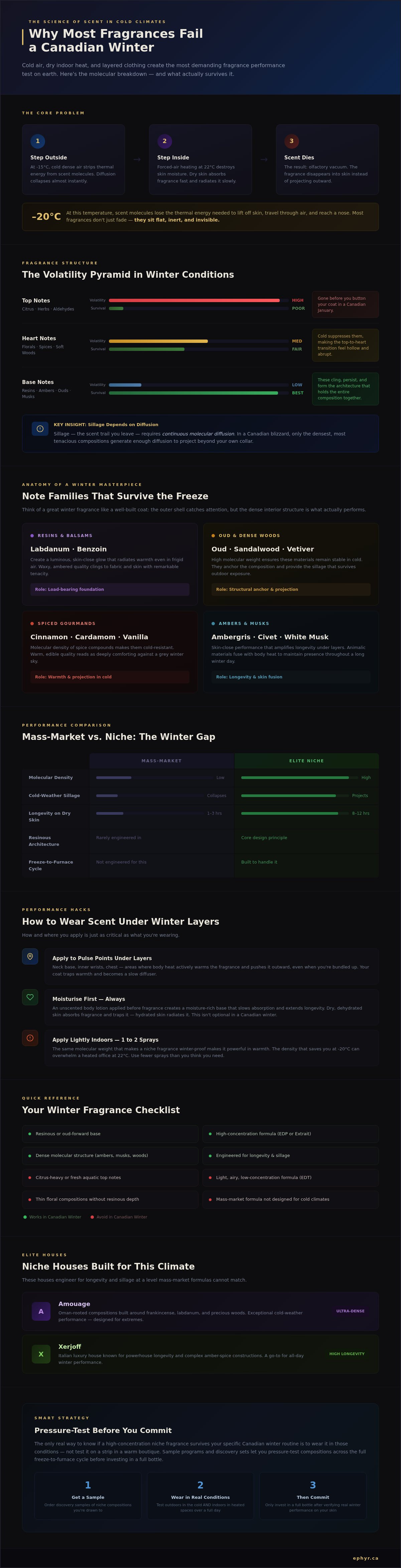
Cold air is dense air. When temperatures drop below -15°C, the molecular activity near your skin slows dramatically. Scent molecules need thermal energy to lift off the skin, travel through the air, and reach someone's nose. In sub-zero conditions, that energy is stripped away almost instantly. The result? Your fragrance sits flat, inert, and invisible.
Temperature vs. Volatility: The Science of Scent
Volatility is simply how readily a molecule evaporates. Fragrance is built in layers, and each layer has a different volatility profile:
- Top notes (citrus, light herbs, aldehydes) are highly volatile. They're designed to evaporate fast, even in temperate conditions. In a Canadian winter, they're gone before you've buttoned your coat.
- Heart notes (florals, spices, soft woods) have medium volatility. Cold air suppresses them, making the transition from top to heart feel abrupt and hollow.
- Base notes (resins, ambers, ouds, musks, dense woods) are low-volatility molecules. They cling. They persist. In the cold, they become the architecture that holds a fragrance together when everything else collapses.
This is why heavy molecular structures aren't just a stylistic choice for winter; they're a functional requirement. Sillage, the trail a fragrance leaves in its wake, depends entirely on continuous molecular diffusion. In a Canadian blizzard, only the densest, most tenacious compositions generate enough diffusion to project beyond your own collar.
The Impact of Dry Indoor Environments
The cold is only half the problem. Step inside any Canadian building in February and you're walking into forced-air heating running at full capacity. That system is pulling moisture out of the air aggressively, and your skin is the first casualty. Dry, dehydrated skin has a compromised lipid barrier, which means it absorbs fragrance faster and releases it slower, creating what perfumers sometimes call an olfactory vacuum: the scent disappears into the skin rather than radiating from it.
Hydrated skin is genuinely better at holding and projecting fragrance. An unscented body lotion applied before your fragrance creates a moisture-rich base that slows absorption and extends longevity. This isn't optional in a Canadian winter. It's maintenance.
There's also the calibration issue. Fragrances engineered for maximum cold-weather projection, the kind of dense, resinous compositions built to survive -20°C, can feel overwhelming in a heated office at 22°C. The best fragrances for Canadian winter require a lighter application hand indoors. One or two targeted sprays, not four. The molecular weight that makes them winter-proof is the same quality that makes them powerful in warmth.
Anatomy of a Winter Masterpiece: Essential Notes and Accords
Not all fragrance ingredients are created equal. Some are architectural. Some are decorative. In a Canadian winter, you need the former, and knowing the difference is what separates a scent that survives until midnight from one that surrenders at the front door.
Think of a great winter fragrance the way you'd think of a well-built coat. The outer shell catches attention. But it's the insulation, the dense, heavy interior structure, that actually keeps you warm. In perfumery, that insulation is built from resins, balsams, woods, and animalic materials. These are the load-bearing walls of any composition worth wearing between November and March.
The Power of Resins and Balsams
Labdanum and benzoin don't just add warmth to a fragrance. They create something more specific: a luminous, skin-close glow that seems to radiate heat even when the air around you doesn't. Labdanum in particular has a waxy, ambered quality that clings to fabric and skin with remarkable tenacity, making it one of the most reliable cold-weather anchors in high-performance perfumery.
Omani frankincense occupies a different register entirely. Sourced from the Boswellia sacra trees of the Arabian Peninsula, it carries a dry, crystalline smokiness that behaves unusually well in cold air. Where lighter materials collapse under the weight of a Canadian freeze, frankincense resin molecules are dense enough to keep diffusing, projecting a quiet but persistent trail even through wool scarves and down parkas. It's no coincidence that houses like Amouage, rooted in Omani heritage, have built some of the most cold-weather-capable compositions in modern niche perfumery. The raw material is practically engineered for endurance.
Resinous scents also feel subjectively "thicker" in cold air, and there's a functional reason for that. Lower temperatures slow the diffusion rate of all molecules, but heavy resinous compounds lose proportionally less of their projection than lighter ones. The result is a composition that feels richer, denser, and more enveloping precisely when the temperature drops.
Spices and Gourmands: The Olfactory Hearth
Spice is where a lot of winter fragrance advice goes wrong. The category gets flattened into a single recommendation, usually cinnamon or vanilla, without any acknowledgment that different spices behave very differently in cold conditions.
- Cold spices like cardamom and pink pepper have a sharp, almost mentholated quality. They add clarity and lift, but they're volatile enough to fade quickly outdoors.
- Warm spices like cinnamon, clove, and nutmeg are denser and more tenacious. They anchor a composition rather than opening it, making them genuinely useful for the best fragrances for Canadian winter.
The gourmand category has evolved significantly beyond simple sweetness. Bianco Latte is a strong example of this evolution: a composition that reads as creamy and warm without collapsing into dessert-counter territory. The key is contrast. When sweetness is balanced against smoke, dry wood, or animalic depth, it gains complexity and staying power. Sweetness alone reads as thin. Sweetness against shadow reads as sophisticated.
Woody notes, particularly sandalwood and cedar, function as the structural skeleton beneath all of this. Sandalwood adds a soft, almost skin-like warmth that blends seamlessly with resins and spices. Cedar provides the dry, slightly austere texture that keeps rich compositions from feeling heavy or suffocating in heated indoor environments.
And then there are leather and animalic accords. These are the notes that generate what perfumers sometimes call "body heat," a quality that makes a fragrance feel inhabited rather than applied. In extreme cold, that distinction matters more than people expect. A fragrance with genuine animalic depth doesn't just smell good; it smells alive.
If you want to test how these structural notes actually perform on your skin before committing to a full bottle, Maison Ephyr's 1ml sample program is the most practical way to pressure-test a composition in real Canadian conditions.
Top Niche Fragrances for the 2026 Canadian Winter
Knowing the science is one thing. Knowing which houses have actually solved the problem is another. The best fragrances for Canadian winter don't come from brands guessing at cold-weather performance. They come from perfumers who've engineered longevity into the molecular architecture itself, from the inside out. Three houses stand above the rest in this regard, and each brings a fundamentally different approach to surviving a Canadian freeze.
The Gift of Kings: Amouage in the Cold
Amouage doesn't just make fragrances. It engineers them. The Muscat-based house has spent decades building compositions around the same Omani frankincense and raw resins discussed earlier in this guide, but the genius is in how those materials are layered. There's a structural logic to Amouage's dense accords that becomes immediately apparent in cold conditions: each layer is designed to activate as the previous one fades, creating a slow, deliberate evolution that can last an entire Canadian winter day without reapplication.
Interlude Man is the clearest example of this philosophy in action. It opens with an almost jarring smoke-and-oregano combination that resolves, over hours, into a deep resinous amber of extraordinary persistence. In sub-zero temperatures, that evolution slows further, stretching the dry-down into something genuinely meditative. Guidance, a more recent release, takes a slightly different angle: incense-forward and austere, with a crystalline quality that projects cleanly even through the dampened diffusion of a January morning. Both compositions reflect what Amouage calls its Master Craftsman approach, the idea that a fragrance should reward patience and reveal itself gradually rather than announce everything at once.
Italian Excellence: Xerjoff and Casamorati
Xerjoff approaches winter performance from a different aesthetic entirely. Where Amouage leans into sacred, ancient materials, Xerjoff brings Italian opulence: rich tobacco, warm honey, aged woods, and a sillage that fills a room without ever feeling aggressive.
Naxos is the house's most celebrated cold-weather performer. Tobacco and jasmine over a base of tonka and honey create a composition that feels almost edible in the best possible sense, warming from the inside out. Alexandria II operates at a different register: a sweeping oriental built on oud, rose, and vanilla that projects with the kind of effortless authority you want when stepping from a heated lobby into a -18°C parking lot.
The Casamorati collection, Xerjoff's heritage sub-line, deserves its own mention. These are quieter compositions, built on vintage Italian perfumery traditions, with a comforting, almost domestic warmth that makes them ideal for layering under heavy coats. They don't compete with the cold. They simply ignore it.
Nishane: Extrait Concentration as Winter Armor
Nishane's defining advantage is concentration. The Istanbul-based house works almost exclusively in extrait de parfum territory, meaning the raw material load in each bottle is significantly higher than in standard eau de parfum formulas. In practical terms, that translates to a fragrance that doesn't need warmth to diffuse. It projects on its own terms, regardless of what the thermometer says.
That's not a minor distinction in Canadian conditions. It's the difference between a scent that performs and one that disappears.
Why Sampling Is the Only Rational Strategy
Here's the honest reality: no amount of reading prepares you for how a fragrance performs on your specific skin chemistry, in your specific climate, under your specific layers. A composition that reads as a winter masterpiece in a review might feel suffocating in your office or thin against the wind on a Winnipeg street.
Maison Ephyr's 1ml sample program and curated discovery sets exist precisely for this reason. You pressure-test before you commit. You wear Interlude Man through a full Tuesday, from the morning commute to the evening meeting, before deciding whether it's your signature. That's not caution. That's intelligence applied to a meaningful purchase.
- Sample first: 1ml is enough for two to three full applications, giving you real-world data across different temperatures and environments.
- Test indoors and out: A fragrance that performs beautifully in cold air may need a lighter application hand in heated spaces.
- Give it a full day: Dense niche compositions evolve over eight to ten hours. The dry-down is often where the real character lives.
Maison Ephyr ships nationally across Canada, which means access to these houses isn't limited to Toronto or Vancouver. Whether you're in Calgary or Halifax, the sample program puts legitimate niche winter performance within reach before you've spent a dollar on a full bottle.
Performance Hacks: How to Wear Scent Under Winter Layers
You've chosen the right fragrance. Dense molecular structure, resinous base, extrait concentration. On paper, it should survive a Canadian January without breaking a sweat. But there's one variable most guides completely ignore: you're wearing four layers of clothing, a wool scarf wrapped to your chin, and a parka that swallows everything from the shoulders up. The best fragrances for Canadian winter can still underperform if you're applying them the same way you would in August.
Application strategy matters. Enormously. Here's how to engineer it correctly.
Scent and Fabric: A Tactical Approach
Fabric is a fragrance storage system. Different materials hold scent with dramatically different efficiency. Wool is the standout performer: its porous, textured fibers trap scent molecules and release them slowly throughout the day, functioning almost like a passive diffuser against your neck. Silk holds scent beautifully but releases it faster. Synthetic fabrics like polyester tend to hold the heavier base notes while shedding lighter molecules quickly, which can skew a composition's balance.
One practical note: never spray directly onto luxury garments. High-concentration extraits can stain delicate fabrics permanently, and the oils in niche formulas are potent enough to leave residue on cashmere or fine wool. Instead, spray onto skin beneath your layers and let the fabric capture the diffusion naturally. Your winter coat, worn daily, will develop a scent memory over the season, a subtle, ambient warmth that becomes part of the garment itself.
The scarf strategy is worth its own attention. Rather than spraying your neck directly (which gets buried under layers anyway), apply one light spray to the interior of your scarf before wrapping it. The fabric warms against your skin, gently releasing scent throughout the day in a slow, controlled diffusion that no pulse point can replicate in cold conditions.
Pulse Point Optimization Under Layers
With your neck covered, rethink your target zones entirely. The inner wrists remain accessible and warm. The inner elbow crease is underused and excellent. The chest, just below the collarbone, projects upward into the scarf and collar zone where your breath and body heat create a microclimate that amplifies diffusion. Hair is the secret weapon: a light mist applied to the ends or crown creates a sillage trail that moves with you through cold air long after skin-applied fragrance has quieted down. Maison Ephyr's hair mists are formulated specifically for this purpose, a lighter concentration that won't overwhelm but will absolutely be noticed.
The Art of Layering
Winter skin is a performance liability. Forced-air heat strips moisture aggressively, and dry skin absorbs fragrance rather than projecting it. Applying an unscented body cream or one of Maison Ephyr's matching body creams before your fragrance creates a lipid-rich base that slows absorption and extends longevity measurably. Think of it as priming a surface before painting: the result holds longer and reads truer.
For those who want to build genuine complexity, layering a dense oud-forward base with a lighter heart note applied separately can create a composition that evolves differently on your skin than either element alone. This isn't guesswork. The Master Craftsman's Guide to Cologne for Men covers layering technique in precise detail, and it's worth reading before you experiment.
Ready to pressure-test these strategies with the right materials? Explore Maison Ephyr's discovery sets and hair mists to build your complete winter application system before committing to a single approach.
Discovering Your Winter Signature with Maison Ephyr
Finding the best fragrances for Canadian winter isn't a single decision. It's a process. And the difference between a process that costs you hundreds of dollars in regrettable full bottles versus one that delivers a genuine signature scent comes down to one thing: how intelligently you sample before you commit.
Maison Ephyr exists precisely to make that process smarter. As an official retailer for Amouage, Xerjoff, Nishane, Casamorati, and other elite niche houses, the curation here isn't accidental. Every house on the roster was selected with Canadian conditions in mind, which means dense molecular architecture, high concentration, and the kind of longevity that doesn't negotiate with a February morning.
The Power of the Discovery Set
A luxury fragrance sample isn't a compromise. It's a calibration tool. Each 1ml sample from Maison Ephyr delivers two to three full applications, which is enough to wear a composition through a complete Canadian winter day: the frozen morning commute, the overheated boardroom, the late-evening walk back to the car. That full arc is exactly what you need to evaluate a fragrance honestly.
Here's a practical testing protocol worth following:
- Test outdoors first. Apply and step outside within ten minutes. Note what survives the cold and what collapses immediately.
- Evaluate the indoor shift. Does the composition feel overwhelming in heated air, or does it recalibrate gracefully? Dense winter fragrances should do the latter.
- Check the eight-hour mark. The dry-down is where character lives. If you still want to smell your wrist at the end of the day, you've found a winter-proof composition.
Discovery sets take this further by letting you test multiple houses side by side, building a real vocabulary for what your skin chemistry does with resinous bases, spiced hearts, and oud-forward structures.
The Maison Ephyr Commitment
National shipping across Canada means this level of access isn't reserved for Toronto or Vancouver. Whether you're navigating a Winnipeg deep freeze or a Halifax nor'easter, Maison Ephyr's curated roster arrives at your door, ready to be pressure-tested in your actual climate.
The boutique approach here matters. This isn't a warehouse algorithm surfacing whatever sells fastest. It's expert curation built around a specific philosophy: that the right fragrance is one engineered to perform, not just one that smells appealing in a controlled environment. That distinction is everything when it's -20°C outside and your coat is the only thing between you and the wind.
Your winter signature is out there. Explore Maison Ephyr's curated winter collection and start with a sample before you commit to a bottle. That's not caution. That's the Master Craftsman approach applied to your own wardrobe.
Your Winter Signature Starts Here
Canadian winters don't forgive weak choices. That's the throughline of everything covered in this guide. The best fragrances for Canadian winter are built from dense molecular architecture, resinous and spiced base structures, and high-concentration formulas engineered to outlast the freeze-to-furnace cycle that defeats everything else. Application strategy matters just as much as the scent itself.
The smartest move you can make right now? Sample before you commit. One real Tuesday in January tells you more than any review ever could. Maison Ephyr is Canada's official retailer for Amouage, Xerjoff, and Nishane, with fast national shipping to every province and a curated sample program starting at 1ml. That's legitimate access to the highest-performing winter compositions in niche perfumery, delivered to your door, ready to be pressure-tested in your actual climate.
Your winter signature is a decision, not a discovery made by accident. Explore Maison Ephyr's curated winter collection and let the cold tell you what actually works. You'll know by the end of the day.
Frequently Asked Questions
Why does my perfume smell different in the winter than in the summer?
Temperature directly controls how quickly scent molecules evaporate from your skin. In summer heat, that evaporation is fast and generous, projecting top and heart notes boldly. In cold air, the process slows dramatically, suppressing lighter molecules almost entirely while leaving heavier base notes to carry the composition. The result is a fragrance that smells denser, quieter, and more skin-close in winter than the same bottle worn in July.
Dry indoor heating compounds this further. Forced-air systems strip moisture from your skin, which affects how your skin holds and radiates fragrance. The same scent can smell thin and absorbed indoors while performing beautifully in cold outdoor air. This is why testing a fragrance across both environments matters before committing to a full bottle.
What are the longest-lasting fragrance notes for cold weather?
Resins, ambers, ouds, dense musks, and balsamic materials consistently outperform everything else in cold conditions. These low-volatility molecules don't rely heavily on thermal energy to diffuse, which means they keep projecting even when the air around you is pulling warmth away. Labdanum, benzoin, Omani frankincense, and sandalwood are the structural anchors you want at the base of any fragrance you're trusting to last a full Canadian winter day.
Warm spices like cinnamon, clove, and nutmeg also hold well in cold air, adding tenacity to a composition rather than just opening it. Contrast that with citrus, light herbs, and aldehydes, which are highly volatile and functionally useless outdoors in sub-zero temperatures. If longevity in the best fragrances for Canadian winter is your priority, look for compositions where resins and woods dominate the base rather than serving as a thin finish.
How many sprays of a niche winter fragrance should I use for the office?
One to two targeted sprays is the right ceiling for dense niche compositions in a heated office environment. The same molecular weight that makes a resinous extrait survive a January commute becomes genuinely overwhelming at 22°C in a closed meeting room. A single spray to the inner wrist or chest is often sufficient for a high-concentration formula from houses like Amouage or Nishane, whose raw material loads are significantly higher than standard eau de parfum formulas.
The practical test is simple: apply one spray, wait fifteen minutes in a warm indoor space, and evaluate the projection radius. If it reaches beyond arm's length comfortably, you don't need more. Niche perfumery rewards restraint indoors. The goal is presence, not announcement.
Does cold weather damage perfume bottles if they are delivered in the mail?
Extreme cold can temporarily affect a fragrance's clarity and scent profile, but this is almost always reversible. Alcohol-based perfumes don't freeze at typical Canadian winter temperatures, though prolonged exposure below -20°C can cause some ingredients to separate or appear cloudy. Once the bottle warms to room temperature gradually, most compositions return to normal without any lasting damage.
The bigger risk is rapid temperature change rather than cold itself. Bringing a frozen package directly into a very warm room and opening it immediately is harder on the formula than the cold transit alone. Let delivered bottles acclimatize at room temperature for an hour before opening. Maison Ephyr ships nationally across Canada, so this is worth keeping in mind when scheduling deliveries during deep freeze periods.
Is Extrait de Parfum better than Eau de Parfum for Canadian winters?
For cold-weather performance, yes, extrait concentration is a genuine functional advantage, not just a prestige marker. Extrait de parfum formulas carry a higher concentration of raw aromatic materials, which means the fragrance projects on its own terms rather than depending on skin warmth to diffuse. In sub-zero conditions where that warmth is being actively stripped away, that self-sufficiency matters enormously. Nishane, for instance, works almost exclusively in extrait territory, and the cold-weather performance difference is immediately apparent.
That said, extrait concentration also means you need a lighter application hand, especially indoors. The best fragrances for Canadian winter in extrait form will project further and last longer than their eau de parfum counterparts, but they require more deliberate calibration. One spray of an extrait often delivers what two or three sprays of an EDP would, so adjust accordingly rather than applying your usual amount.
Can I wear 'summer' scents in the winter by layering them?
You can, but the results are unpredictable and the effort rarely justifies the outcome. Light citrus or aquatic compositions are built on high-volatility molecules that simply don't have the molecular density to survive cold air, regardless of what you layer beneath them. Adding a resinous base underneath a summer scent can extend it slightly, but you're essentially fighting the composition's fundamental architecture rather than working with it.
A more effective approach is choosing a winter-appropriate fragrance that carries some of the brightness you enjoy in summer scents. Certain niche compositions from Xerjoff and Casamorati balance warm, dense bases with cleaner, more luminous heart notes, giving you complexity without sacrificing cold-weather performance. That's a better engineering solution than forcing a summer formula into a season it wasn't built for.
What is the best pulse point to use when wearing a heavy winter scarf?
The interior of the scarf itself is the most effective application point when your neck is fully covered. A single light spray on the inner fabric, before wrapping, lets the material warm against your skin and release fragrance gradually throughout the day in a slow, controlled diffusion. It functions like a passive diffuser, and the results consistently outperform a direct neck application that gets buried under layers anyway.
If you prefer skin application, the inner elbow crease and chest just below the collarbone are the most practical alternatives in winter. Both stay warm under layers and project upward into the collar zone where your breath creates a natural microclimate. The inner wrist remains accessible for easy reapplication if needed mid-day.
How do I make my fragrance last all day in dry indoor heating?
The single most effective step is applying an unscented body cream or lotion before your fragrance. Dry, dehydrated skin absorbs fragrance rather than projecting it, and forced-air heating accelerates that dehydration aggressively. A moisturized skin surface slows absorption and creates a lipid-rich base that holds fragrance molecules closer to the surface longer. Maison Ephyr's body creams are formulated to work as a layering base for this exact purpose.
Beyond skin prep, strategic reapplication matters more than a heavy initial application. One additional spray to the inner wrist at midday will extend performance more efficiently than doubling your morning application, which risks overwhelming heated indoor spaces. For maximum all-day longevity, combining a moisturizing base layer with a high-concentration extrait formula and a single midday refresh is the most reliable system in dry Canadian winter conditions.

Article by
Dmitrii Savishin
Dmitrii Savishin is the founder of Maison Ephyr and Parfum Exquis, two Canadian destinations dedicated to the world of niche perfumery. With years of experience discovering exceptional fragrance houses from around the globe, Dmitrii shares expert insights on perfume trends, fragrance notes, luxury brands, and the art of choosing the perfect scent. His mission is to make niche perfumery more approachable while helping readers discover fragrances that leave a lasting impression.


