
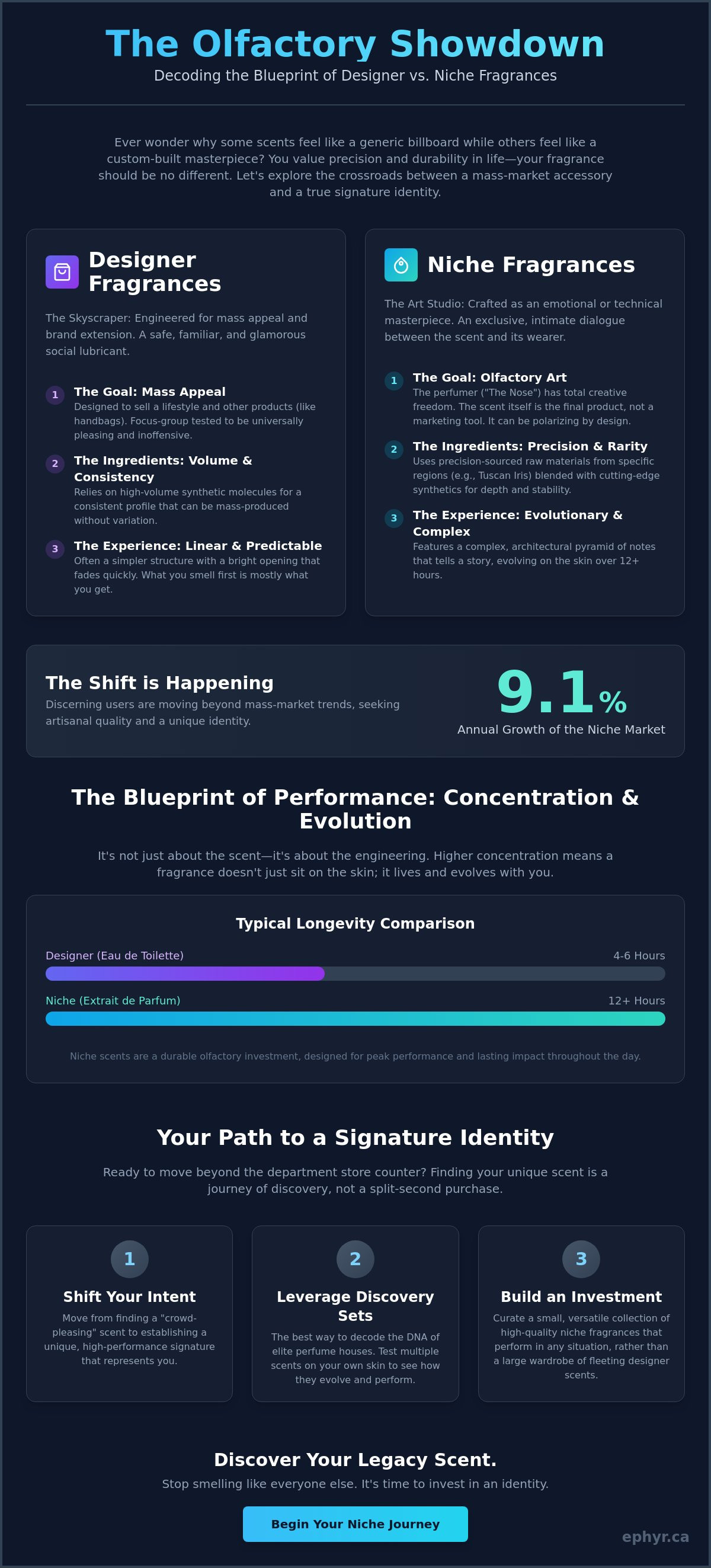
Why spend a premium on a bottle only to smell like every other person in the room? It's a common frustration. Most mass-market scents rely on high-volume synthetic notes that fade long before the day ends. The choice of designer vs niche fragrance represents a crossroads between corporate marketing and genuine olfactory engineering. While designer brands often sell a generic lifestyle image, niche houses focus on the internal configuration of the scent itself. With the niche market growing at 9.1% annually, it's clear that discerning users are shifting toward artisanal quality.
You likely value precision and durability in every other aspect of your life. Your fragrance shouldn't be any different. We'll help you bridge the gap between raw ingredients and refined luxury. This guide explores the technical boundaries that separate mass-market perfumes from the masterpieces found in a boutique studio. You'll learn to identify high-grade ingredients and understand the value proposition of houses like Amouage or Xerjoff. Prepare to discover a unique signature identity that offers peak performance and lasting impact.
Key Takeaways
- Understand the core technical divide in the designer vs niche fragrance debate to prioritize artistic integrity over mass-market trends.
- Identify the difference between mass-produced synthetic fillers and the precision-sourced raw materials that define a master craftsman’s blueprint.
- Shift your intent from wearing a crowd-pleasing social lubricant to establishing a unique, high-performance signature identity.
- Simplify the discovery process by leveraging discovery sets to decode the complex DNA of elite perfume houses.
- Learn how to build a durable olfactory investment with curated selections from global leaders like Nishane and Casamorati.
The Olfactory Crossroads: Defining Designer and Niche Fragrances
The distinction starts in the boardroom. A designer brief usually asks: "How do we sell more handbags?" The scent is a secondary accessory. A Niche perfume house operates with a different logic. Their brief is an emotional or technical challenge. They might aim to capture the exact scent of a rainstorm in the Omani desert or the metallic chill of a modern art gallery. They prioritize the internal engineering of the juice over the marketing campaign. They don't answer to shareholders; they answer to the art.
By 2026, these lines have blurred significantly. Major designers now offer "private collections" or "exclusive lines" to reclaim the prestige lost to artisanal houses. It's a high-stakes game of olfactory chicken. These conglomerates want the niche aura without sacrificing their global supply chain. They use higher-quality materials and more daring compositions, yet the underlying motivation remains market dominance. True niche houses remain the outliers. They are the master craftsmen who refuse to dilute their vision for the sake of a department store shelf.
The Designer Archetype: Familiarity and Glamour
Designer scents are engineered for the "safe" buy. Walk into any department store; the floor is dominated by familiar profiles. These are the social lubricants of the fragrance world. They rely on heavy marketing and celebrity faces to create a sense of immediate glamour. The trade-off for this universal appeal is consistency. You know exactly what you're getting. However, innovation often takes a backseat to market safety. They use focus-group-approved molecules to ensure no one is offended. It's high-quality manufacturing, but it lacks the soul of a singular vision.
The Niche Archetype: Exclusivity and Identity
Niche houses focus on exclusivity and identity. Distribution is intentionally limited. You won't find these at the local mall. Houses like Amouage represent the pinnacle of this "art-first" philosophy. They don't mind being polarizing. A niche scent might be too smoky for some or too animalic for others. That's the point. It's an intimate dialogue between the wearer and the scent. It's not about being liked by everyone; it's about being understood by the right person. These are individually tuned instruments for the olfactory enthusiast.
The Master Craftsman’s Blueprint: Ingredients and Composition
Think of the designer vs niche fragrance debate as a comparison between a generic structural steel and a hand-forged alloy. One is functional and mass-produced; the other is a singular work of engineering. Niche houses prioritize geographic precision when sourcing raw materials. They don't just look for "jasmine." They seek out specific harvests from Grasse or Iris from Tuscany. This isn't just marketing fluff. It's about chemical purity and the complexity of the molecular profile. When you source from a specific origin, you gain a depth of scent that mass-market brands can't replicate at scale.
There's a common myth that niche means "all-natural." In reality, high-end synthetic molecules are the backbone of modern olfactory art. They provide stability and unique textures that nature can't produce on its own. While FDA regulations on fragrance ensure safety and transparency, niche perfumers use these guidelines as a framework for innovation. They combine rare naturals with cutting-edge lab-created molecules to build a more durable structure. It's a sophisticated blend of nature's raw power and human engineering.
Look at the concentration levels. A designer Eau de Toilette is built for a quick blast of freshness. An Extrait de Parfum from a niche house is a different beast. It's a dense, high-concentration formula. It doesn't just sit on the skin; it evolves. The olfactory pyramid in niche scents is often more architectural. The top notes don't just vanish. They transition into heart and base notes that tell a story over twelve hours. This evolution is the hallmark of a master craftsman’s blueprint.
The Freedom of the Nose
Niche perfumers don't answer to focus groups. They have total creative autonomy. This freedom allows them to use incredibly expensive materials like real Oud or rare Iris without worrying about a retail price ceiling. The result is a scent that feels alive. It isn't a static product but a moving narrative. For those ready to explore these complex narratives, starting with discovery sets is the most logical step to find a true match.
Performance Engineering: Sillage and Longevity
Why do niche scents outlast their designer counterparts? It's the internal engineering. Sillage is the architectural trail a scent leaves behind in the air as you move. It isn't just about volume; it's about projection and persistence. Even the hardware matters. A professional-grade atomizer on a niche bottle ensures a fine, even mist. This optimizes the surface area for the skin to absorb the oils, maximizing the longevity of the composition without overwhelming the senses.
Audience and Intent: Who Are You Wearing the Scent For?
Who is the end-user of your olfactory profile? It's a question of technical intent and social strategy. In the designer vs niche fragrance hierarchy, the designer scent functions as a social lubricant. It's engineered to be universally pleasant. It's the safe choice for a crowded elevator or a first date. Niche fragrances, however, serve as an intimate dialogue between the wearer and the scent. They don't seek permission to be liked. They seek to be remembered. Your decision in the designer vs niche fragrance debate should reflect your personal legacy.
The science of scent and memory explains why certain notes trigger deep emotional anchors. When you wear a mass-market scent, you trigger a generic emotional response. You blend into the collective background. When you wear a niche masterpiece, you anchor a specific, unique memory in the minds of those around you. This is the Signature Factor. It's the difference between being a face in the crowd and a presence that lingers after you've left the room.
Some argue that niche scents lack "wearability." This is a misunderstanding of engineering. High-quality ingredients don't have to be loud. They just have to be precise. A scent like Bois Imperial is perfectly wearable for daily use but remains miles away from the department store average. It's about finding a balance between artistic expression and functional performance. Don't look at the bottle price. Look at the price-per-wear. A high-concentration Extrait de Parfum requires fewer sprays to achieve superior results. It's an efficiency benchmark that mass-market brands rarely meet.
The Compliment Factor vs. The Signature Factor
Designer scents are engineered for immediate feedback. They use familiar profiles to elicit a "you smell good" response. Niche scents prioritize identity. They are tools for self-expression. There's a profound psychological impact in being the only person in the room wearing a specific Casamorati or Xerjoff creation. It projects quiet confidence and a refusal to settle for the status quo. It's a signature of excellence.
The Occasion Framework: When to Go Niche
Build a balanced wardrobe. Use designer scents as functional tools for the office or casual gym sessions. Deploy niche powerhouses for milestones, evening events, or moments of personal reflection. This layered approach ensures you have the right instrument for every scenario. It treats fragrance not as a consumable, but as a long-term investment in your personal brand.
The Path to Discovery: Navigating the Niche World
The transition in the designer vs niche fragrance landscape requires a shift in methodology. It's a move from passive consumption to active calibration. This isn't just about choosing a scent. It's about engineering a personal legacy. You don't just buy a bottle; you acquire an instrument. The process must be disciplined and data-driven.
Start by identifying your preferred fragrance families. Woody notes offer architectural strength. Florals provide organic nuance. Amber notes deliver resinous depth. Once you've mapped your preferences, move to Step 2. Use discovery sets to understand a house's specific DNA. This provides a high-level overview of their technical logic and ingredient quality. It's the most efficient way to scan for potential matches without the clutter of mass-market noise.
Never judge a scent on a paper strip. Paper is a static medium. Your skin is a dynamic heat source. Testing on skin is the only way to observe the chemical interaction with your body heat. This is where the internal configuration of the scent truly reveals itself. Live with the fragrance for at least eight hours. You need to evaluate the dry down and the long-term durability metrics. A scent that opens with brilliance but collapses after two hours is a failure of engineering.
Only transition to a full bottle once the emotional connection is confirmed by the technical data. This ensures your investment is sound. A signature scent should be a long-term asset, not a temporary distraction. By following this framework, you avoid the fatigue of generic profiles and find a composition that resonates with your unique identity.
The Power of the Sample
Precision testing requires the right instruments. Accessing luxury fragrance samples canada represents the smartest entry point into the niche world. A 1ml sample allows for multiple full-day tests. It's enough volume to observe the scent in different environments, from the office to an evening event. Store your samples in a cool, dark space to prevent molecular degradation. Avoid the "blind buy" trap at all costs. It's an expensive mistake that ignores the technical nuances of how a scent reacts to your specific skin chemistry. Technical research should always precede the final purchase.
Curation over Consumption
Reject the mass-market "more is better" philosophy. Niche artistry favors curation. A small, highly-curated collection of elite instruments is the goal. Each bottle should serve a specific purpose in your wardrobe. Learn to read a scent like a piece of functional art. Every note is an intentional choice by the master craftsman. By focusing on quality over volume, you build a collection that reflects a mature aesthetic and a commitment to excellence. Your fragrance wardrobe shouldn't be a storage unit; it should be a gallery.
Start your curation process today. Browse our Discovery Sets to find your next masterpiece.
Curating Your Legacy with Maison Ephyr
Maison Ephyr acts as a bridge. We connect global olfactory engineering with the Canadian enthusiast who values precision. In the ongoing debate of designer vs niche fragrance, we don't just participate; we set the benchmark for quality. We treat high-end engineering as functional art. Our studio avoids the loud clichés of mass-market retail. Instead, we offer a refined atmosphere of quiet confidence. Every product is allowed to speak for itself through sleek presentation and precise language.
Our commitment to authenticity is the foundation of our work. We're official retailers for legends like Amouage and Xerjoff. This isn't just a title. It's a guarantee of internal configuration and molecular purity. We provide individually tuned instruments for your collection. Our boutique approach prioritizes depth of service over breadth of volume. We offer expert guidance tailored to your unique performance needs. From the initial search to the final dry down, we ensure your olfactory investment is sound and durable.
Iconic Houses to Explore
The technical opulence of Amouage perfumes represents the pinnacle of regional heritage and artisanal credibility. These aren't mass-produced items. They are complex narratives built with rare materials and Omani craftsmanship. For those who value Italian heritage, the artistic flair of Xerjoff offers a masterclass in aesthetic value and internal hardware optimization. We also curate modern disruptors. The viral impact of Bianco Latte and the architectural strength of Nishane show how niche houses continue to outpace the designer market. These brands don't follow trends. They engineer them.
Your Invitation to the Niche World
Discovery shouldn't be a gamble. Our perfume samples canada service removes the risk of the unknown. We provide 1ml samples to allow for rigorous skin testing and long-term durability metrics. It's a proprietary Maison Ephyr benchmark for quality. We believe every word in your olfactory story should serve a purpose. Our promise is simple: quality, performance, and meticulous attention to detail. Don't settle for the generic. Explore our full collection today and begin curating your legacy.
Engineer Your Olfactory Legacy
Maison Ephyr provides the necessary bridge to this world of refined engineering. As an official retailer for legends like Amouage, Xerjoff, and Nishane, we offer specialized expertise in luxury scent curation. We ensure your instruments are authentic and delivered with speed through our fast nationwide shipping across Canada. Don't settle for a generic profile when you can wear a masterpiece. Begin your journey into olfactory art at Maison Ephyr. Your signature identity is waiting to be engineered. Step into the studio and find the composition that resonates with your unique vision.
Frequently Asked Questions
Is niche perfume always better than designer fragrance?
"Better" is a metric of technical intent and execution. Niche perfumes prioritize artistic integrity and rare ingredient sourcing over the mass-market appeal typical of designer brands. While designer scents function as reliable social lubricants, niche offerings provide a more complex, individually tuned experience. The choice depends on whether you value universal familiarity or a unique, high-performance signature that sets you apart from the crowd.
Why are niche perfumes usually more expensive?
The cost reflects the internal configuration and raw material quality. Niche houses invest in rare naturals and cutting-edge synthetic molecules rather than global celebrity marketing campaigns. They also produce in smaller batches, which increases the cost of manual labor and precision engineering. You're paying for the liquid's complexity and the master craftsman's methodology, not a fashion house's logo or a massive advertising budget.
Does niche perfume last longer on the skin?
Generally, yes, due to higher oil concentrations and superior ingredient stability. Many niche houses focus on Extrait de Parfum concentrations, which provide better longevity and a more architectural dry down. In the designer vs niche fragrance comparison, niche scents often feature base notes designed for twelve or more hours of performance. This durability is a hallmark of professional-grade olfactory engineering and meticulous formulation.
What is a "signature scent" and how do I find one?
A signature scent is an olfactory anchor that uniquely identifies your presence in any room. You find one by testing diverse fragrance families on your skin to observe the chemical interaction with your body heat. Start with discovery sets from houses like Amouage or Nishane. Live with a scent for a full day to ensure the emotional connection matches the technical performance of the dry down.
Can I wear niche fragrances to the office?
Yes, provided you select compositions with controlled projection. Scents like Bois Imperial offer a sophisticated, professional profile that remains distinct without being overwhelming. The key is understanding sillage, the trail your scent leaves behind. Many niche options provide a "skin scent" experience that is intimate and refined. They're perfect for close-quarter professional environments where you still want to project quiet confidence and personal style.
What is the difference between Eau de Parfum and Extrait de Parfum?
The primary difference is the concentration of aromatic compounds. Eau de Parfum typically contains 15% to 20% oil, while Extrait de Parfum often exceeds 20% to 40%. This higher concentration leads to a denser scent profile and increased longevity. Extraits are the precision instruments of the fragrance world. They offer a slower evolution and a more persistent presence on the skin throughout your entire day.
How should I store my niche perfumes to ensure they last?
Protect your investment by keeping bottles in a cool, dark, and dry environment. Molecular degradation occurs when scents are exposed to direct sunlight, high humidity, or fluctuating temperatures. Avoid the bathroom. A dedicated cabinet or the original box is the best storage solution. Proper maintenance ensures that the internal engineering of your Xerjoff or Casamorati masterpiece remains stable and potent for many years.
Are niche perfumes unisex?
Most niche houses reject traditional gender labels in favor of pure artistic expression. They treat scent as a functional art form that transcends binary marketing. While some compositions may lean floral or woody, the intent is for the wearer to define the identity. In the designer vs niche fragrance landscape, niche brands lead the shift toward gender-neutral options, focusing entirely on how a scent makes you feel.


