
That $500 bottle of Amouage sitting on your vanity isn't a ticking time bomb. It's a piece of liquid engineering. Many collectors eventually ask, does perfume expire, worried that their high-end investments will transform into expensive vinegar. It's an understandable fear. You've spent years curating a collection of artisanal quality. Seeing a liquid darken or a top note shift feels like a loss of performance and a waste of premium materials.
Fine fragrance is built for structural longevity. We're going to strip away the confusion and look at the actual molecular chemistry of scent aging. You'll gain a professional framework to distinguish between a bottle that's truly "turned" and one that has simply reached a mature, vintage profile. We'll outline the exact rituals required to stop oxidation and protect your juice from environmental stress. This is your guide to maintaining a luxury collection that performs for a lifetime. It's time to treat your scents as the high-performance instruments they are. Let's master the art of preservation.
Key Takeaways
- Understand that the question of does perfume expire is a matter of chemical integrity, not just a "best before" date on a box.
- Identify the environmental "Unholy Trinity"—light, heat, and oxygen—that dismantles the delicate molecular architecture of your collection.
- Learn why high-concentration extraits from houses like Amouage and Xerjoff provide a more robust chemical foundation for long-term aging.
- Avoid the "bathroom trap" by implementing a preservation ritual that prioritizes climate consistency over the fluctuating temperatures of a vanity.
- Conduct a scent autopsy to recognize the specific olfactory markers, like a "Maggi" or celery-like aroma, that signal a fragrance has truly reached its end.
The Silent Evolution: Does Perfume Actually Expire?
A bottle of perfume is a sealed ecosystem. Unlike organic food products that rot, fragrance undergoes a slow, chemical evolution. When people ask, does perfume expire, they're usually looking for a binary answer. The reality is more nuanced. Expiration in the fragrance world isn't a "best before" date; it's a shift in chemical integrity. The molecules don't simply vanish. They rearrange.
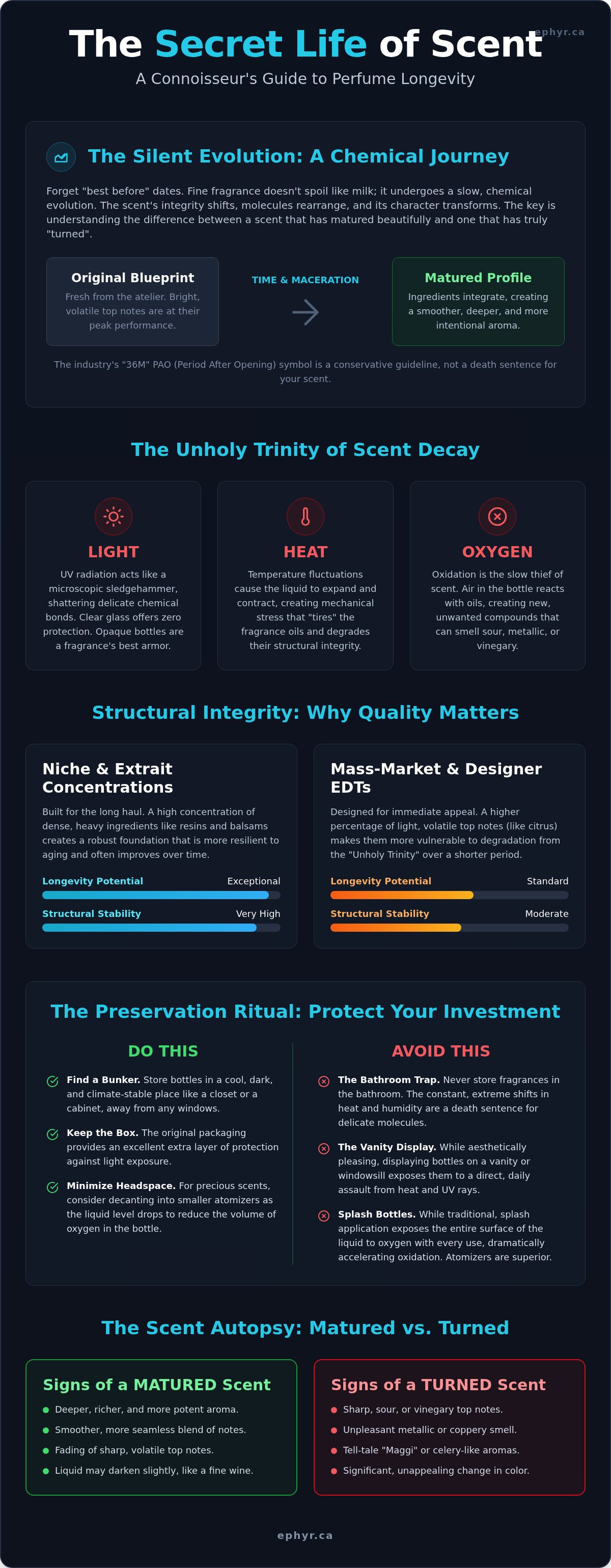
Look at the back of your packaging. You'll likely see a Period After Opening (PAO) symbol. It's a small icon of an open jar with a number like 24M or 36M inside. This is a conservative industry guideline. It represents the manufacturer's guarantee of peak performance. Beyond this window, the scent doesn't necessarily become dangerous. It simply begins to drift from its original blueprint.
The Living Liquid: Why Scent is Not Static
Fragrance is a complex architecture of volatile molecules. Modern perfumery began with the realization that different ingredients evaporate at different speeds. Top notes are the lightest. These citrus and airy florals are the first to fly away or alter their state. They're the frontline of the scent's profile and the most vulnerable to change.
Resins and balsams are the heavy hitters. These dense materials act as anchors. While a bright lemon note might fade after three years, a deep oud or amber often gains gravity. This is why many niche scents actually improve through maceration. It's a process where the ingredients fully integrate over time. A matured scent often feels smoother and more intentional than a fresh batch. Distinguishing between a "turned" bottle and a "matured" one is the mark of a true enthusiast.
The Myth of the Hard Expiration Date
The 36-month shelf life is a safety net. Mass-market brands use this estimate to account for poor storage habits. High-concentration extraits, such as those from Amouage or Xerjoff, are built for a longer timeline. Their internal configuration is dense and resilient. They aren't disposable commodities; they're long-term investments.
The primary enemy of this longevity is oxidization. This is the chemical breakdown that occurs when oxygen enters the bottle and reacts with the liquid. It's a slow-motion collision. Oxygen molecules attack the chemical bonds of the fragrance oils, causing them to break apart and reform into different, often sour-smelling compounds. Understanding this process is the first step in stopping it. So, does perfume expire? Only if you allow the environment to dismantle its engineering.
The Chemistry of Decay: Why Scents Turn Sour
So, does perfume expire? In the lab, we don't look for a calendar date. We look for the Unholy Trinity of degradation: Light, Heat, and Oxygen. These forces work in tandem to dismantle the liquid architecture of your collection. They aren't just environmental factors. They're catalysts for a total molecular restructuring that can turn a masterpiece into a mess.
Heat acts as a source of kinetic chaos. As temperatures rise, the liquid inside your bottle expands. As they drop, it contracts. This constant mechanical stress "tires" the fragrance oils. It's a slow-motion breakdown of the structural integrity that makes a scent sing. Even stable Fragrance ingredients can't survive a cycle of extreme thermal shifts without losing their clarity and precision.
Oxidation: The Slow Thief of Scent
Oxygen is the most persistent threat to your investment. Every time you use your fragrance, a small volume of air enters the bottle to replace the liquid you've sprayed. This "headspace" becomes a chamber for oxidation. At a molecular level, oxygen atoms latch onto the fragrance oils. They strip away electrons and force the creation of new, unwanted compounds. This is why an old bottle might suddenly smell like metallic copper or sharp vinegar. Splash bottles are particularly vulnerable because they expose the entire surface area of the liquid to the atmosphere. Modern atomizers are superior pieces of engineering because they minimize this contact, acting as a one-way valve that keeps the internal environment stable.
The Impact of UV Radiation
UV rays act like a microscopic sledgehammer on chemical bonds. They provide enough energy to shatter the complex chains that hold a scent together. Natural oils are organic and complex, making them the first to fail under high-energy light exposure. Synthetic molecules are often more resilient, but even they succumb to prolonged radiation. Clear glass offers zero protection. It's why darker or opaque bottles are a hallmark of protective engineering. A flacon from Amouage isn't just an aesthetic choice; it's a shielded bunker for the juice inside. If you want to ensure your collection remains pristine, consider trying discovery sets to see how fresh, properly stored niche scents should actually perform. Darker bottles represent a commitment to long-term durability metrics over surface-level shelf appeal.
Niche vs. Designer: Does Quality Impact Shelf Life?
The generic three to five year shelf life often cited by mass-market brands is a simplification. It ignores the reality of high-end olfactory engineering. For those holding a serious collection, the answer to does perfume expire depends heavily on the internal configuration of the juice. Quality isn't just about the initial scent profile. It's about the structural durability of the molecules over time. Niche houses prioritize high-grade raw materials that offer a resilience designer scents often lack.
The Concentration Factor
A Xerjoff fragrance often carries a significantly higher oil concentration than a standard designer Eau de Toilette. This high-concentration extrait format provides a longer runway for the scent's evolution. Base note density is the key metric here. While a designer EDT relies on a high ratio of alcohol and volatile top notes, a niche extrait is anchored by a dense foundation of resins and woods. This density slows the rate at which oxygen can penetrate and dismantle the composition.
Citrus and aquatic notes are inherently fragile. They lack the molecular weight to resist degradation for decades. However, when these notes are built on a platform of high-grade raw materials, they're better shielded. The relationship between base note density and olfactory longevity is linear. The more "weight" at the bottom of the pyramid, the more stable the entire structure becomes against environmental stress.
Ingredient Purity and Stability
The "Amouage standard" represents a benchmark for structural longevity. By utilizing heavy base notes like frankincense, myrrh, and oud, Amouage perfumes create a chemical environment that naturally resists decay. These natural resins act as organic preservatives. They've been used for millennia for their ability to withstand the passage of time without losing their essence. This is why niche scents have such high vintage potential.
Alcohol purity is another invisible hallmark of quality. Premium houses prioritize high-grade, denatured alcohol that ensures a sterile internal environment. This prevents the growth of contaminants that could accelerate the breakdown of the fragrance oils. While fragrances do eventually expire in the technical sense of shifting character, a well-built niche scent often enters a mature phase rather than a ruined one. Compositions heavy in sandalwood, amber, and oud don't just survive; they mature into deeper, more complex versions of themselves. Quality ingredients ensure that the evolution is an improvement, not a failure.
The Preservation Ritual: How to Extend Your Fragrance’s Life
Preservation isn't about freezing time. It's about engineering stability. If you're still asking, does perfume expire, the answer often depends on your storage ritual. The Golden Rule of fragrance maintenance is consistency. Thermal fluctuations are more damaging than a slightly warm room. Your collection needs a static environment to perform at its peak. Moving a bottle between extreme temperatures "tires" the liquid, leading to a faster breakdown of the delicate chemical bonds.
The bathroom is a graveyard for fine scent. Steam and humidity are the ultimate killers. Moisture can infiltrate the seal of even the most high-end atomizers. This triggers hydrolysis, a chemical reaction that breaks down the essential esters in your perfume. Always keep the original box. It acts as a custom-engineered UV shield, protecting the liquid from the microscopic sledgehammer of light. It's a simple step that adds years of performance to your investment.
In Canada, we face a specific seasonal threat: the HVAC system. During the winter, indoor air becomes desert-dry. Heating vents blast focused thermal energy that can cook your fragrance. Placing your Xerjoff or Amouage bottles near a vent or on a sunny windowsill is a recipe for rapid oxidation. Keep your collection on an interior wall, away from windows and heat sources, to maintain its structural integrity.
The Ideal Environment
The "Sweet Spot" for long-term storage is between 12°C and 18°C. While the fragrance fridge is a popular debate, it can be a double-edged sword. Extreme cold can cause certain natural oils to crystallize or separate if the temperature isn't perfectly regulated. A dark, interior closet is the best vault for a Canadian collector. It provides a natural thermal buffer against the harsh exterior climate and keeps the temperature steady year-round without the risk of power-cycle fluctuations.
Rituals for the Serious Collector
Never leave a bottle uncapped. The cap is a functional component that prevents evaporation and limits oxygen exchange. As you deplete a bottle, the headspace, or the air inside, increases. This accelerates the oxidation process because there's more oxygen available to react with the oils. To extend the life of your full-sized investment, many collectors use luxury fragrance samples for daily application. This limits the frequency of air exposure for your primary flacon, ensuring the juice inside remains pristine for decades. Protect your investment by starting with the highest quality juice from Maison Ephyr’s curated niche collection.
The Scent Autopsy: Identifying a Fragrance That Has Truly Turned
Determining if a masterpiece has reached its end of life is a diagnostic process. It's a scent autopsy. When enthusiasts ask, does perfume expire, they're often looking for a visual or olfactory signal that the liquid has failed. A common mistake is dismissing a bottle because the top notes have "bruised." Citrus molecules are fragile. They can turn sharp or disappear while the heart and base of the fragrance remain perfectly intact. True degradation happens deeper in the chemical structure.
If your juice starts smelling like Maggi seasoning, celery, or old pennies, the engineering has failed. These are the markers of advanced oxidation. It's not a subtle evolution; it's a total breakdown. Visual cues are equally telling. While some darkening is normal for scents containing vanilla or jasmine, extreme cloudiness or visible sediment suggests the oils have separated from the alcohol. This is a clear sign of instability. The liquid should remain a clear, cohesive solution regardless of its age.
Safety is paramount. Even if a scent smells acceptable, an expired bottle can cause skin irritation. Oxidation creates new chemical compounds that weren't in the original formula. These can act as allergens. Always perform a patch test on a blotter strip before applying an aged fragrance to your skin. If the liquid feels oily or leaves a residue that wasn't there before, the formula's balance has shifted.
The Three-Point Inspection
Start with a visual check for "floaties." These are particles of degraded material that indicate the formula is no longer a stable solution. Next, perform the vinegar test. Spray the scent on a clean blotter and wait ten minutes. If the dry down is dominated by a sour, acidic aroma, the heart has turned. Finally, monitor performance. If a high-concentration extrait that once lasted ten hours now vanishes in twenty minutes, the fixatives have likely decomposed. This performance drop is a definitive sign of chemical failure.
When to Cherish an Aged Scent
Not every change is a failure. Many collectors seek out bottles that have aged for five years or more. Resins like oud, amber, and sandalwood thicken and gain gravity over time. This creates a profile that is often richer and more "mature" than a fresh batch. The top notes might be quieter, but the soul of the fragrance is often more profound. If the liquid remains clear and the scent brings joy without causing irritation, the art remains valid. So, does perfume expire? Only when it loses its ability to perform safely and beautifully. Until then, it's just maturing.
Securing Your Olfactory Legacy
Your collection is more than a series of scents; it's a long-term investment in liquid engineering. We've seen that the answer to does perfume expire isn't found on a calendar but in the precision of your storage environment. By mastering the preservation ritual and understanding the structural integrity of high-concentration extraits, you move from a casual wearer to a dedicated curator. You now possess the diagnostic tools to identify true molecular failure and the methodology to prevent it before it starts.
Quality begins with proper handling. At Maison Ephyr, we treat every flacon as a precision instrument. As an authorized retailer for Amouage and Xerjoff, we maintain every bottle in temperature-controlled storage to guarantee peak performance upon arrival. Our expert scent consultations help Canadian collectors navigate the nuances of aging and structural durability. Explore the freshly curated niche collection at Maison Ephyr to find your next enduring masterpiece. Your collection is a legacy. Protect its integrity with the care it deserves.
Frequently Asked Questions
How long does an unopened bottle of perfume last?
An unopened bottle can remain stable for 10 to 15 years, or even longer if stored in a climate-controlled environment. The factory seal prevents oxygen from entering, which halts the oxidation process. The question of does perfume expire usually applies to bottles already in use. However, the quality of ingredients matters. High-concentration extraits possess a denser molecular structure that resists degradation better than mass-market fragrances.
Does perfume expire if it’s never been sprayed?
While a fragrance doesn't technically expire the moment it's manufactured, it undergoes slow chemical evolution even without being sprayed. The lack of oxygen exposure in an unsprayed bottle significantly extends its lifespan. However, heat and light can still penetrate the glass and agitate the volatile molecules. To ensure your luxury investment performs as intended, keep unsprayed bottles in their original boxes within a dark, interior Canadian closet.
Can I still wear perfume that has changed colour?
Yes, you can often wear a fragrance that has darkened, provided the scent profile remains intact. Darkening is a natural result of ingredients like vanilla, jasmine, or resins maturing over time. It doesn't always indicate that the juice is ruined. You should only be concerned if the liquid becomes cloudy or develops visible sediment. Perform a patch test on a blotter to confirm the heart notes still sing before applying it to your skin.
What happens if I use expired perfume on my skin?
Using a fragrance that has truly turned can lead to contact dermatitis or allergic reactions. As the chemical bonds break down through oxidation, new compounds form that may act as skin irritants. Even if you don't see a rash, the scent performance will be compromised, often resulting in a sharp, metallic, or sour aroma. If you suspect your perfume has expired, avoid direct skin contact and use it on clothing instead.
Why does my perfume smell like alcohol or vinegar?
A sharp alcohol or vinegar smell is a definitive sign of advanced oxidation. When oxygen reacts with the fragrance oils, it dismantles the esters and creates acidic byproducts. This usually happens to the top notes first. In some cases, the vinegar scent might dissipate after a few minutes, revealing a still-functional heart and base. However, if the sourness persists, the structural integrity of the liquid has likely suffered a total failure.
Do certain scent families expire faster than others?
Citrus and aquatic families are the most vulnerable to the question of does perfume expire. These light, volatile molecules have a shorter runway before they begin to drift or disappear. Conversely, oriental and woody families anchored by resins, oud, and amber are built for the ages. Their dense molecular weight acts as a natural preservative. This is why a heavy Amouage extrait often outlasts a fresh designer cologne by several years.
Should I keep my perfume in the refrigerator to stop it from expiring?
A dedicated fragrance fridge can help, but a standard kitchen refrigerator is often too cold and humid. Extreme cold can cause certain natural oils to crystallize, which permanently alters the scent profile. The goal is thermal stability, not refrigeration. A cool, dark drawer on an interior wall is usually superior for the Canadian climate. It provides a consistent buffer against the dry heat of indoor winter environments without the risk of over-chilling.
Is a 10-year-old bottle of niche perfume still safe to buy?
It is safe and often highly desirable if the bottle was stored correctly. Niche fragrances from houses like Xerjoff are engineered with premium raw materials that mature beautifully. Many collectors seek out these aged batches for their deeper, more resonant base notes. Before purchasing, check for liquid clarity and ask about the storage history. A well-maintained 10-year-old niche bottle is an artisanal instrument that has simply reached its peak maturity.
Article by
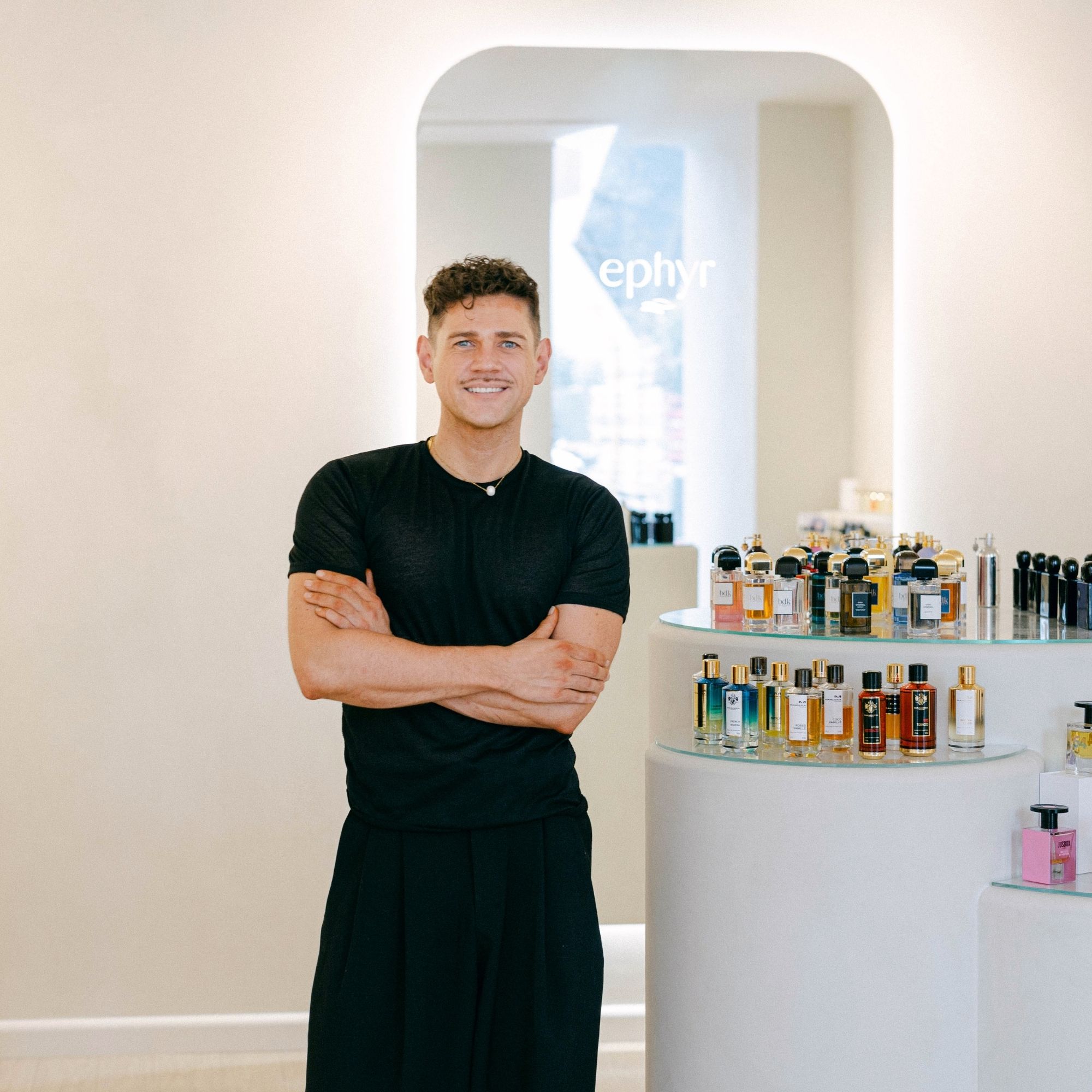
Dmitrii Savishin
Dmitrii Savishin is the founder of Maison Ephyr and Parfum Exquis, two Canadian destinations dedicated to the world of niche perfumery. With years of experience discovering exceptional fragrance houses from around the globe, Dmitrii shares expert insights on perfume trends, fragrance notes, luxury brands, and the art of choosing the perfect scent. His mission is to make niche perfumery more approachable while helping readers discover fragrances that leave a lasting impression.


