
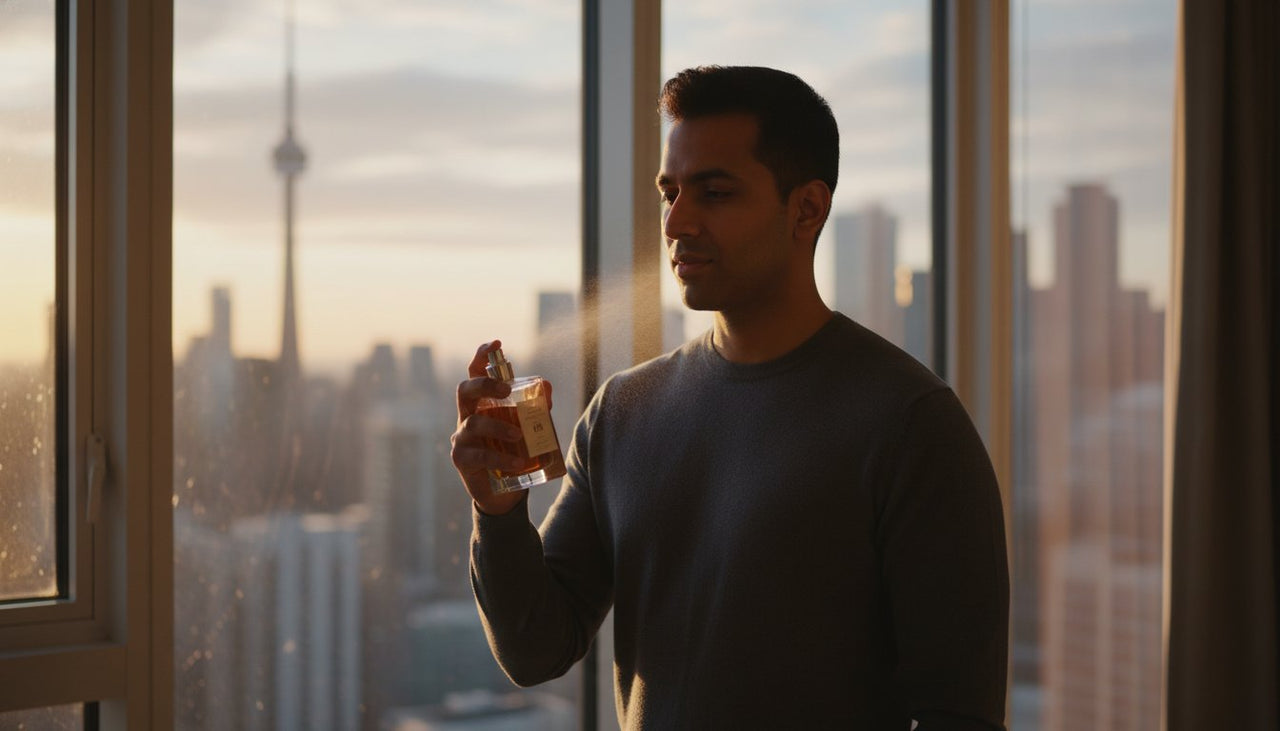
Your niche fragrance is a high-performance instrument. Yet, you are likely operating it at ten percent capacity. It is a common frustration. You invest in a masterpiece from Nishane or Casamorati, only to have the profile flatten within the hour. Or worse, you inadvertently overwhelm the office. Mastering how to properly apply cologne is not about vanity. It is about technical precision.
We understand that your scent is a silent handshake. You want it to project confidence and last from your morning ritual until the evening wind-down. This guide provides the blueprint to transform a simple spray into a disciplined scent ritual. You will learn to synchronize your skin chemistry with luxury extracts to ensure maximum longevity and a perfect scent bubble. We will break down the mechanics of pulse points, the importance of hydration, and the specific application zones that turn a fleeting aroma into a lasting signature.
Key Takeaways
- Treat your skin as a functional canvas by applying fragrance immediately after a shower to lock in scent through open pores.
- Master the architecture of your body's heat map to understand how to properly apply cologne on strategic pulse points for a controlled projection.
- Eliminate technical errors like the friction fallacy to prevent crushing delicate top notes and accelerating premature evaporation.
- Calibrate your spray count based on oil concentration to ensure high-density niche extracts perform with precision rather than overwhelming your space.
- Shift from wasteful application methods to targeted delivery that maximizes the longevity and financial value of every luxury bottle.
The Science of Scent: Why Proper Application is a Technical Necessity
Fragrance is not a static accessory. It is a volatile chemical composition designed to evolve over time. When you spray a luxury extract, you are initiating a sequence of molecular evaporation. Each ingredient has a specific weight. Citrus notes are light and fast. Ouds and resins are heavy and slow. Understanding how to properly apply cologne allows you to control this rate of decay. You aren't just wearing a scent. You're managing a biological reaction. The objective is to transform the liquid into a living atmosphere that performs with intent.
The master craftsman aims for a "scent bubble" rather than a "scent trail." A scent bubble is a personal atmosphere that extends roughly an arm's length. It creates an intimate experience for those you choose to let in. Achieving this requires an understanding of how to properly apply cologne to optimize the hardware of your own body. If the application is too concentrated, the evaporation is chaotic. If it is too dispersed, the performance is weak. Precision is the difference between a functional art piece and a wasted investment.
Defining Sillage and Projection
Sillage is the olfactory trail left behind as you move through a room. It is the wake of your presence. Projection refers to the distance the scent travels from your body, while longevity is how long the molecules remain detectable. Niche fragrances from houses like Amouage or Xerjoff often feature high oil concentrations. These require extreme precision. A single extra spray can shift your presence from a sophisticated bubble to an aggressive trail that dominates the space. You must calibrate your application to the specific density of the liquid.
The Role of Skin Chemistry
Your skin is the final ingredient. It is a living canvas. Factors like pH levels, diet, and surface temperature dictate the "dry down" phase. This is why a scent smells different on you than it does on a friend. To understand the history and science of perfume, one must respect the transition from paper strip to pulse point. Paper is sterile. Skin is dynamic. The oils in your skin anchor the fragrance, while your body heat acts as a natural diffuser. Testing on skin is the only way to verify how a composition will actually perform in the real world. Without the biological warmth of your body, the scent remains locked and one-dimensional.
- Top Notes: High volatility, 15-30 minutes of life.
- Heart Notes: Medium volatility, 2-4 hours of life.
- Base Notes: Low volatility, 6+ hours of life.
The Master Craftsman’s Protocol: A Step-by-Step Application Guide
Applying a niche fragrance is an engineering task. You don't just spritz and walk away. To understand how to properly apply cologne, you must treat your skin as a prepared surface. Performance starts with a clean, neutral base. Residue from scented soaps or deodorants acts as interference. It distorts the intended chemical profile of your extract. You want the fragrance to speak for itself. This requires a blank canvas.
Timing is your most powerful variable. Apply your scent immediately after a warm shower. The heat opens your pores. This creates a receptive environment where the perfume oils can settle deeply. If you wait until you are fully dressed and cooled down, the fragrance sits on the surface. It evaporates too quickly. Maintaining a distance of 3 to 6 inches between the nozzle and your skin is the standard. This ensures an even distribution of the atomized liquid. Too close, and the scent pools. Too far, and it dissipates before contact.
The Hydration Requirement
Moisture is the ultimate anchor for fragrance. Dry skin is porous in the wrong way; it swallows the perfume oils, leading to a rapid breakdown of the scent profile. This is especially critical during Canadian winters. The harsh, dry air acts as a vacuum for moisture, often killing a fragrance within minutes. Using an unscented lotion or one of our specialized body creams creates a necessary primer. It provides a lipid barrier that holds the scent molecules in place. For those exploring complex profiles, a well-hydrated base is non-negotiable. You can experiment with this by using Discovery Sets to see how different concentrations react to your skin's moisture levels.
The 3-Step Spray Sequence
Execution requires discipline. First, identify your primary target points. These are the high-heat zones that will drive your scent bubble throughout the day. Second, execute clean, decisive sprays. Half-presses lead to dripping and uneven distribution. Third, allow the liquid to air-dry naturally. Friction is the enemy of quality. By avoiding common cologne mistakes like rubbing your skin, you preserve the integrity of the top notes. Let the chemistry work without interference. Start with two sprays. Evaluate the projection after fifteen minutes. It is easier to add than to subtract. A master craftsman values precision over volume.

The Pulse Point Architecture: Mapping Your Body’s Heat Map
Think of your body as a thermal engine. Certain zones run hotter than others. These pulse points are areas where blood vessels sit closest to the skin's surface. They act as natural, low-energy diffusers. Understanding how to properly apply cologne requires a strategic map of these heat zones. Blindly spraying a cloud into the air is a tactical error. It wastes ninety percent of the product. You want the liquid to bond with specific high-heat coordinates to initiate a controlled, rhythmic release of the scent profile.
Strategic placement allows you to calibrate your presence for different social environments. An office setting demands a tight, professional scent bubble. A formal evening or a date requires a more intimate, inviting projection. By choosing your targets with intention, you decide who experiences your fragrance and at what distance. You are not just wearing a scent. You are engineering an atmosphere.
The Primary Targets: Neck and Wrists
The lower jawline and neck are the most active zones for social interaction. Heat from the carotid artery pushes the fragrance outward during greetings or close-range conversations. It is the primary zone for immediate impact. Wrists are effective for expressive individuals. As you move your hands, you create micro-currents of air that carry the scent to those around you. However, the inner elbow is a technical hidden gem. It is a warm, shielded area where the fragrance is protected from the friction of shirt cuffs. It provides a slow, consistent diffusion that often outlasts the application on the wrists.
The Secondary Targets: Chest and Shoulders
Targeting the chest is a move for the wearer. It creates a private scent bubble that rises vertically, allowing you to enjoy the evolution of the fragrance throughout the day. It is a slow-release method that relies on the steady warmth of your core. Behind the ears is a secret weapon for close-encounter social settings. It places the scent exactly where it will be detected during a whisper or a close greeting. For a sophisticated finish, apply to the back of the neck. This area is less exposed to the elements. It serves as the technical engine for sillage, leaving a refined trail behind you as you exit a room. This ensures your presence is felt even after you have moved on.
- Office Protocol: Two sprays to the chest or inner elbows.
- Social Protocol: Three sprays, including the neck and back of the neck.
- Intimate Protocol: Two sprays, focusing on the neck and behind the ears.
The Friction Fallacy: Common Errors to Eliminate
Friction is the enemy of nuance. Most men instinctively rub their wrists together after a spray. This is a technical failure. When you rub your skin, the mechanical energy generates localized heat. This thermal spike forces the volatile top notes to evaporate instantly. You are essentially skipping the opening act of your fragrance. To master how to properly apply cologne, you must allow the liquid to settle undisturbed. Let the molecules find their own rhythm on your skin. Intervening only serves to degrade the composition.
Applying to clothing is another frequent misstep. Niche extracts from houses like Nishane or Amouage contain high oil concentrations. These oils can leave permanent stains on silk, linen, or light-colored cotton. Beyond the physical damage, fabric is a dead surface. It lacks the biological heat and pH levels required to move the scent through its intended dry-down phases. A fragrance on a shirt remains linear and cold. It never achieves the depth that direct skin contact provides. If you have been wasting your high-end scents through poor technique, it is time to browse our collection of niche extracts and start fresh with a superior ritual.
Understanding Olfactory Fatigue
Your brain is a sophisticated filter. After thirty minutes of constant exposure, your olfactory system "mutes" your own scent to remain alert to new environmental changes. This is biological adaptation, not a product failure. The danger here is the "top-up" spray. You assume the scent has vanished and apply more. This is how you become the "cologne guy" who overwhelms a room. To test if your fragrance is still active, sniff a neutral area like your inner elbow or ask a trusted peer. Trust the chemistry even when your nose stops reporting it.
The Fragrance Cloud Myth
The "mist and walk" method is a cinematic trope with zero technical merit. It is an inefficient use of premium liquid. When you spray into the air, ninety percent of the product settles on the floor or dissipates. Niche perfumes are too concentrated for air-misting. They are designed for targeted delivery. Direct skin contact ensures that the heavy base notes anchor properly. This allows the heat of your body to drive the projection. Misting is a decorative gesture; direct application is an engineering requirement for performance.
- No Rubbing: Preserve the delicate top notes.
- No Fabric: Protect your wardrobe and allow for chemical evolution.
- No Misting: Ensure every drop of your investment reaches the target.
Curating Your Presence: Adjusting for Niche Concentrations
A mass-market fragrance is often a light breeze. A niche extract is a tectonic shift. Niche houses like Amouage operate on a different technical frequency, utilizing significantly higher oil percentages than their commercial counterparts. This internal configuration fundamentally changes how to properly apply cologne. You are dealing with higher torque and greater density. If you apply a high-concentration Extrait with the same reckless volume as a drugstore splash, you don't just wear the scent; you weaponize it. Precision is your only safeguard against social overexposure.
The molecular weight of your ingredients dictates your spray count. Heavy, resinous profiles featuring Oud, Amber, or leather possess a low volatility. They cling to the skin and project with immense power. These require a minimalist touch. Conversely, bright citrus or botanical scents are fleeting and light. They allow for a more generous application. Your environment is the final variable in this equation. A climate-controlled office acts as an incubator; it amplifies scent. The open, biting air of a Canadian winter does the opposite. Calibrate your volume to the room you intend to inhabit.
Concentration Guide for the Discerning Wearer
- Eau de Toilette (EDT): Generally containing 5 to 15 percent oil. This is your daily driver. A 3 to 5 spray standard provides a respectable presence without overstaying its welcome.
- Eau de Parfum (EDP): Stepping up to 15 to 20 percent oil. This is the balanced protocol. Stick to 2 or 3 sprays to achieve a sophisticated, long-lasting scent bubble.
- Extrait de Parfum: The pinnacle of potency, often exceeding 20 to 40 percent oil. This is a "one and done" masterpiece. A single, well-placed spray is frequently all that is required for twelve hours of performance.
The Final Touch: Sampling and Discovery
Mastery requires experimentation. Every skin profile is a unique variable that can accelerate or dampen a scent's performance. Utilizing luxury fragrance samples is the most efficient way to stress-test a new extract before committing to a full bottle. It allows you to observe the dry-down in different temperatures and social contexts. As the seasons shift, so should your wardrobe. A dense, warming scent that thrives in January might feel suffocating in July. Building a versatile collection ensures you always have the right instrument for the moment. Explore our curated collection of cologne for men to find your next signature and refine your application ritual.
Master the Architecture of Your Atmosphere
Mastering your fragrance is the final layer of a disciplined aesthetic. It's more than a simple spritz; it's a technical performance. By understanding the thermal architecture of your skin and the molecular density of your extract, you transform a liquid into a living presence. You now possess the blueprint for how to properly apply cologne with the precision of a craftsman. Prioritize skin hydration, target your high-heat zones, and let the chemistry evolve without the interference of friction.
Your niche collection deserves a ritual that matches its engineering. At Maison Ephyr, we serve as the official retailer for industry benchmarks like Amouage, Xerjoff, and Nishane. We provide expert fragrance guidance and fast shipping across Canada to help you curate a world-class scent wardrobe. Your signature is waiting for its first application.
Discover Your Signature Scent at Maison Ephyr
Take command of your presence. The atmosphere you create is your most enduring legacy.
Frequently Asked Questions
How many sprays of cologne is too much?
Generally, two to four sprays is the technical limit for most professional environments. Overdoing it creates an aggressive trail that compromises the scent's sophistication. Start with two sprays and evaluate the projection after fifteen minutes. Precision is the ultimate goal. You want to create an inviting atmosphere, not an overwhelming force that dictates the air quality of the entire room.
Where is the best place to spray cologne for maximum longevity?
The inner elbows and the back of the neck are the high-performance zones for maximum durability. These areas are shielded from the elements and maintain a consistent temperature. They act as slow-release diffusers that preserve the integrity of the base notes for hours. Targeting these points ensures your scent stays active without needing a top-up spray later in the day.
Should I apply cologne to my clothes or my skin?
Always prioritize direct skin contact. Scent is a chemical reaction that requires body heat and pH levels to evolve through its dry-down phases. Applying to fabrics can lead to permanent oil staining and results in a flat, one-dimensional aroma. Your skin is the final ingredient in the composition; without it, the fragrance never reaches its full artistic potential.
Does rubbing my wrists together really ruin the scent?
Rubbing your wrists is a common error that destroys the delicate top notes of a fragrance. The friction generates heat that forces premature evaporation. To master how to properly apply cologne, you must let the liquid air-dry naturally to preserve the intended olfactory sequence. Friction essentially skips the opening act of the composition, leading to a distorted and shortened performance.
How can I make my cologne last all day?
Hydration is the key to maximizing scent longevity. Apply an unscented lotion or a specialized body cream to your pulse points before spraying to create a moisture-rich anchor. This prevents your skin from absorbing the perfume oils too quickly, allowing the fragrance to project steadily throughout the day. A well-hydrated canvas is the secret to a high-performance scent ritual that survives the morning commute.
Is it better to apply cologne before or after putting on clothes?
Apply your fragrance before putting on your clothes. This ensures the liquid reaches the pulse points directly without being intercepted by fabric. It also prevents potential damage to delicate materials like silk or fine wool while allowing the scent to bond with your skin chemistry. This sequence is a fundamental step for anyone learning how to properly apply cologne with technical precision.
Why can't I smell my cologne after a few hours?
You are likely experiencing olfactory fatigue. Your brain is a sophisticated filter that mutes consistent stimuli to remain alert to new changes. While you may not detect the scent after a few hours, those in your immediate scent bubble will still experience the full profile. Trust the engineering of the extract. Avoid the temptation to over-apply, as this leads to an overpowering presence.
Can I apply cologne to my hair?
Avoid applying standard cologne to your hair. The high alcohol content can lead to significant dryness and damage over time. If you desire a lasting hair scent, use a dedicated hair mist. These are formulated with lower alcohol levels and often include nourishing ingredients. This protects your hair's internal structure while adding a subtle layer to your overall fragrance profile.


