
What if adding more perfume is the least useful way to find out whether your scent is still there? The olfactory fatigue perfume wearers worry about is often a temporary shift in perception, not proof that a fragrance has faded. Your nose and brain adapt to a steady scent, so it can slip from conscious awareness even while others may still notice it.
It’s natural to wonder whether your perfume has disappeared or you’ve simply stopped detecting it. Coffee beans are often suggested as a reset, but they haven’t been shown to restore your sense of smell. A pause, followed by a careful re-test, offers a more useful way to assess what’s happening.
Here, you’ll learn why familiar fragrances can seem to vanish, how to try a gentle routine for noticing them more clearly, and why applying more isn’t the first step. You’ll also find out when a persistent change in your sense of smell deserves medical attention. If you’re revisiting a scent, a small sample can help you evaluate it in measured amounts, but it won’t reset olfactory fatigue.
Key Takeaways
- With olfactory fatigue, perfume can seem to fade even when the scent is still present. Distinguish a change in perception from a fragrance that has genuinely weakened.
- Don’t rely on coffee beans or extra sprays for an instant fix. Step away from competing odours, then reassess in a neutral setting.
- Use a measured re-test to evaluate the fragrance, not as a guaranteed way to reset your sense of smell.
- If your ability to smell everyday scents changes suddenly, persists, or concerns you, seek medical guidance.
What Is Olfactory Fatigue, and Why Can Perfume Seem to Disappear?
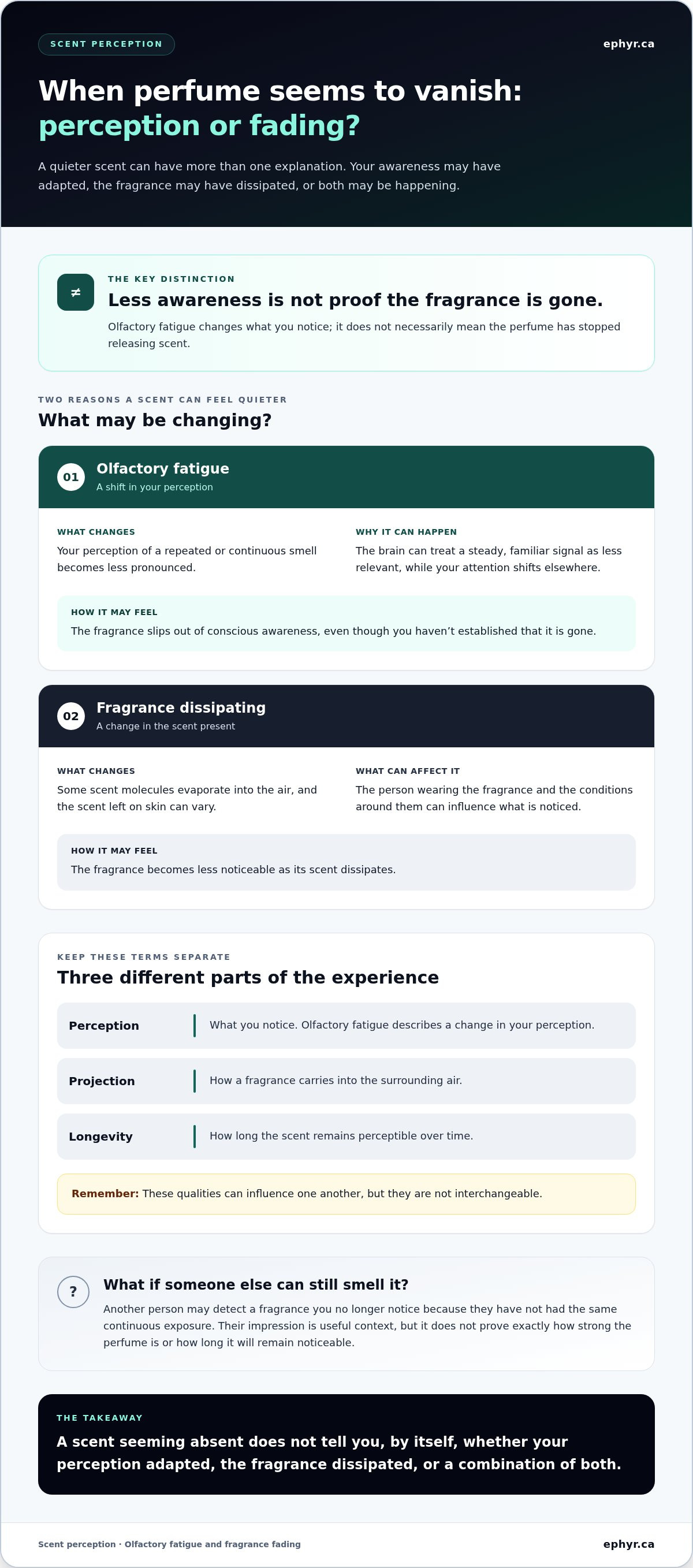
You apply a fragrance and notice it clearly: a bright opening, a soft trail, perhaps a familiar note on your sleeve. As the day goes on, though, it seems to vanish. Olfactory fatigue is a temporary reduction in your perception of a repeated or continuous smell. It changes what you notice, not necessarily how much scent the perfume is releasing. Less awareness doesn’t, by itself, mean the fragrance has stopped emitting scent or that anything is wrong.
Also called sensory adaptation, this ordinary response helps the brain filter steady background signals. Olfactory fatigue, also known as odor fatigue or noseblindness, describes how a smell can become less noticeable with continued exposure. The phrase olfactory fatigue perfume wearers use for that disappearing-scent moment doesn’t measure a perfume’s quality or performance.
How the brain adapts to a familiar perfume
Your nose hasn’t switched off. Odour molecules still reach sensory receptors, but their response can become less pronounced during continuous exposure. Meanwhile, the brain learns to treat a steady, familiar signal as less relevant. Attention shifts elsewhere, and the smell can slip out of conscious awareness.
Think of a room with a ticking clock. At first, each tick is easy to hear. After a while, you may stop noticing it until someone points it out. Perfume can recede in a similar way. A shift in attention can make a scent feel absent, even though you haven’t established that it’s gone.
Olfactory fatigue versus a perfume that has faded
Perception is only part of the picture. Perfume also changes after application: some scent molecules evaporate into the air, and the scent left on skin can vary with the person and the conditions around them. A fragrance may become less noticeable because it has dissipated, because your perception has adapted, or through a combination of both.
That’s why another person might still detect a scent you no longer notice. They haven’t had the same continuous exposure, and they may be standing in a different position relative to the fragrance. Their impression is useful context, but it doesn’t prove exactly how strong the perfume is or how long it will remain noticeable.
It helps to keep three ideas separate. Olfactory fatigue describes a change in your perception. Projection refers to how a fragrance carries into the surrounding air. Longevity describes how long its scent remains perceptible over time. These qualities can influence one another, but they aren’t interchangeable. A perfume that seems quiet to its wearer may still be detectable nearby, while one that has genuinely dissipated may be faint to everyone.
Why Your Nose Stops Noticing a Fragrance: The Sensory Adaptation Behind It
A scent can linger in the background long enough to become easy to overlook. This is sensory adaptation: perception adjusts to a steady, familiar signal, while attention gives more space to changes and new information. It’s a normal response, though its timing and degree vary from person to person. A fragrance that feels quieter to you hasn’t necessarily become undetectable to everyone else.
Perceived intensity can shift as your attention adapts, without proving that the fragrance has vanished. That distinction matters when olfactory fatigue makes a perfume seem to “disappear” and leaves you wondering whether it’s still there.
Continuous exposure, attention, and scent awareness
Imagine walking into a kitchen where something is baking. The smell may be clear at first, then fade into the background as you focus on conversation or other tasks. Step outside for a while and return, and you may notice it again. The aroma didn’t need to switch on a second time; your exposure and attention changed.
Perfume can follow a similar pattern. When it remains around you, your brain may give its familiar signal less conscious attention. After a break, the scent can feel more prominent because it’s no longer part of the uninterrupted background. People don’t all adapt at the same pace, and a pause won’t restore the same impression for every wearer.
Awareness and presence aren’t identical. You may stop consciously noticing a fragrance while someone who hasn’t been around it continuously can still detect it. Their impression offers a second perspective, but it isn’t a precise measure of how strongly the scent carries or how long it will last.
Why perfume can smell different from one day to another
Perception isn’t a fixed instrument. You encounter a fragrance in a particular setting, on a particular person, among other smells. A scented room, laundry products, food, or another perfume may compete for attention. Where you apply fragrance also affects where you encounter it: a scent close to your face may be more present in your awareness than one applied farther away.
Skin is part of the experience, too. Fragrance develops on skin, and what you notice can vary with the wearer and the circumstances. That variation alone doesn’t show that the perfume itself has changed. Nor does one person’s reaction predict another’s: the same scent may seem vivid to one nose and subdued to another.
For a clearer comparison, notice the conditions as well as the perfume. Consider where you applied it, what other scents are nearby, and whether you’ve been around it continuously. If you’re revisiting a fragrance, individual perfume samples offer a measured way to evaluate it on separate occasions, not a reset for your sense of smell.
Coffee Beans, More Sprays, and Other Perfume Reset Myths
There’s no guaranteed instant trick that restores your sense of smell on command. That can be frustrating when a familiar fragrance seems to have disappeared, but a quick fix may change what you notice without resolving why it feels less noticeable. The key point about olfactory fatigue and perfume is simple: a new sensory impression doesn’t prove that your perception has reset.
Do coffee beans reset your sense of smell?
Coffee beans are often suggested as a way to “clear” the nose between fragrances. Their strong, distinct aroma gives you a different smell to notice, but that change in sensory context doesn’t establish that olfactory adaptation has been reversed. Coffee isn’t a necessary step or a proven physiological reset.
The same caution applies to sniffing any other strong scent. It may briefly draw your attention away from the perfume, then leave you noticing the new smell instead. That’s a shift in what’s in the foreground, not evidence that your nose has been cleansed. To reassess a fragrance, step away from competing odours and return to it later. This is a more measured test than adding another scent to the mix.
Fresh air can also offer a change of surroundings, particularly if the room contains several competing smells. Think of it as a chance to take a break, not a guaranteed way to restore perception. A neutral pause is enough; you don’t need coffee beans or a special “palate cleanser” to assess what you can smell.
Why applying more perfume may not help
Another spray adds more fragrance, but it doesn’t reveal whether the original application is still detectable. If your awareness has adapted, the added scent may also become less noticeable to you. It can, however, make the fragrance more prominent to people nearby, especially in enclosed or shared spaces.
Resist the urge to keep layering applications simply because you can’t smell the first one. More perfume can create a stronger presence for others without answering the question you’re trying to resolve. If you’re unsure, pause and reassess later rather than turning uncertainty into extra sprays. That’s more considerate in offices, transit, and other close quarters, where people may have different sensitivities or preferences.
It also helps to avoid testing several strong fragrances back to back. Each new scent adds another impression, making it harder to judge the one you meant to assess. Give your attention a quieter setting instead.
A change of scent or surroundings can alter what you notice; it isn’t a guaranteed reset. Treat coffee beans as an optional smell, not a remedy, and extra perfume as extra application, not a diagnostic test. A pause and careful re-test can tell you more than either quick fix.
How to Reset Your Sense of Smell: A Gentle Perfume Re-Test
Think of this as a way to reassess what you can perceive, not a treatment or guaranteed reset. There’s no universal countdown for olfactory adaptation. Your impressions may change after a break, or they may not. Keep the test simple: fewer scents, less sniffing, and no extra sprays to force a result.
A simple pause-and-retest routine
- Step away. Leave the area where you applied perfume and move away from scented products, food aromas, candles, or other competing odours. Take a break without watching the clock; there’s no fixed interval that works for everyone.
- Choose one fragrance. Return to the scent you want to assess rather than introducing several perfumes at once. If possible, do the re-test in a neutral setting with minimal background fragrance.
- Notice without chasing. Bring the fragrance into your awareness gently. Avoid repeated close sniffing, which can make the test feel intense without providing a reliable measure of how the scent wears.
- Make a brief note. Record what you can perceive, such as whether the scent seems faint, familiar, or different from your first impression. Don’t treat the result as a score or a definitive verdict on the perfume.
- Stop if it feels uncomfortable. If the smell becomes unpleasant or the test causes discomfort, put the blotter or perfume aside. There’s no need to keep testing.
How to evaluate perfume without overwhelming your nose
For a fresh assessment, use a blotter or a modest application on skin. Let the scent develop naturally instead of repeatedly bringing it close to your nose. A blotter offers a simple way to revisit the aroma without applying more perfume; skin lets you experience the fragrance where you usually wear it. Either can help you observe, but neither guarantees that your perception will return to its earlier intensity.
Keep each test distinct. Trying several new scents in one sitting can make their impressions compete, leaving you with less clarity about any one of them. If you want to compare fragrances, give each its own occasion rather than layering them or moving rapidly from one to the next. For a more structured approach to evaluating a scent, follow How to Properly Test Perfume Samples at Home.
Be patient with the result. A break may make a familiar fragrance easier to notice, but the timing and effect vary. A sample can make it easier to revisit a perfume in a measured way, not reset your sense of smell. Explore perfume samples when you’re ready to evaluate a fragrance deliberately.
When Perfume Fatigue May Be More Than a Fragrance Problem
Noticing less of one familiar perfume can fit with ordinary adaptation. A broader change deserves different attention. If several everyday smells seem weaker or different than usual, such as food, soap, or the outdoors after rain, don’t assume perfume is the explanation. The pattern matters more than one fragrance on one day.
Signs the change may not be limited to perfume
Pay attention if the change affects multiple familiar smells, begins suddenly, persists, or concerns you for any reason. You don’t need to identify a cause yourself. A qualified health professional can help assess a change in smell and advise you on what to do next.
This isn’t a reason to panic. It’s a sensible boundary: olfactory fatigue around one repeatedly worn scent is not the same as a wider or lasting change in smell. If your perception doesn’t return to what feels typical, or the change is troubling, pause fragrance testing and seek medical guidance rather than trying to solve it with more perfume or a new sample.
Keep track of what you’ve noticed, including whether it involves one scent or several and whether it’s changing over time. Those observations may help you describe the concern clearly. They aren’t a diagnosis, and you don’t have to wait a particular amount of time before asking for advice if the change feels sudden or concerning.
Explore fragrance at your own pace
Once your sense of smell feels typical again, you can return to fragrance evaluation without turning it into a test of your health. A sample lets you revisit one scent in a measured way, while a discovery set offers an optional route through a curated range. Neither is a treatment for smell changes; they’re simply considered ways to explore perfume when you’re ready.
For a thoughtful approach to niche discovery, Luxury Fragrance Samples Canada: The 2026 Guide to Niche Discovery can help you think about sampling as a way to compare scents at your own pace. Keep each evaluation separate, and let your impressions develop naturally rather than trying to force a particular result.
Fragrance should feel like exploration, not pressure. When you’re ready to browse, explore Maison Ephyr fragrances and discovery options at your own pace.
Make Your Next Fragrance Test More Intentional
Let curiosity set the pace. The next time a perfume seems quieter than expected, give yourself room to notice it without trying to force a result. A thoughtful re-test can be more revealing than another spray, and it keeps fragrance enjoyable rather than turning it into a test you need to pass.
If the change is limited to one familiar scent, return to it another day and compare impressions under calmer conditions. If your sense of smell changes more broadly or the change concerns you, put fragrance experiments aside and seek medical guidance. Olfactory fatigue perfume experiences can prompt questions, but shopping for a new scent isn’t a way to treat a change in smell.
When you’re ready to explore, Maison Ephyr offers individual samples and discovery sets, with expert guidance to help you consider your fragrance choices. Explore Maison Ephyr fragrances and discovery options, and take your time finding a scent that feels right to you.
Frequently Asked Questions
How long does olfactory fatigue from perfume last?
There’s no set duration for olfactory fatigue; the time it takes for a scent to feel noticeable again varies between people and situations. You might notice a difference after moving away from the fragrance, or your impression may remain unchanged until later. Rather than repeatedly checking, leave the scent alone and revisit it in a different setting. A persistent change involving everyday smells is a separate concern to discuss with a health professional.
Can coffee beans reset your sense of smell between perfumes?
No, coffee beans aren’t a proven or reliable way to reset smell perception. Their aroma may give you something different to notice, but that doesn’t show that your response to the previous perfume has been restored. If you’re comparing fragrances, take a break in a less scented setting instead. You can also write down your first impression before moving on, making comparison less dependent on repeatedly sniffing each perfume.
Why can other people smell my perfume when I cannot?
Other people may notice your perfume because they haven’t been exposed to it continuously in the way you have. Their distance from you, the room, and their own sensitivity to scent can shape what they detect. For a practical check, ask someone nearby whether they notice it without prompting them to sniff your skin. Their response is one perspective, not a precise measure of the fragrance’s strength or how long it will last.
Should I apply more perfume when I stop noticing it?
Usually, it’s better to wait than to apply more just because the scent feels faint to you. Another application can increase the fragrance others encounter without clarifying why your impression changed. Consider your setting, especially in shared spaces such as a workplace or public transit, and follow the product’s directions. If you want to assess the perfume, revisit it later on a blotter rather than adding sprays during the same wear.
Can a cold or allergies affect how perfume smells?
Yes, a cold or allergies can affect how clearly you notice smells, especially if your nose feels congested. That may change your experience of perfume as well as familiar odours such as coffee or shampoo. Don’t use a fragrance test to diagnose what’s happening. If the change is sudden, continues after you feel better, affects several everyday smells, or concerns you, seek advice from a qualified health professional.
Is olfactory fatigue the same as losing your sense of smell?
No. Olfactory fatigue usually describes reduced awareness of a scent you’ve encountered repeatedly, while a broader loss or change can affect familiar smells beyond perfume. This distinction can help you decide what to pay attention to, but it can’t identify a medical cause. If you’re having trouble noticing several everyday smells, or the change is sudden, persistent, or worrying, consult a qualified health professional.
Can I test several perfumes in one sitting after a smell break?
You can, but a break doesn’t guarantee that you’ll perceive every fragrance clearly. Testing several scents in quick succession may make it harder to remember what each one smelled like on its own. For a more useful comparison, assess one perfume at a time and note a few impressions before moving on. If the scents start to blur together or feel uncomfortable, stop and continue another day.

Article by
Dmitrii Savishin
Dmitrii Savishin is the founder of Maison Ephyr and Parfum Exquis, two Canadian destinations dedicated to the world of niche perfumery. With years of experience discovering exceptional fragrance houses from around the globe, Dmitrii shares expert insights on perfume trends, fragrance notes, luxury brands, and the art of choosing the perfect scent. His mission is to make niche perfumery more approachable while helping readers discover fragrances that leave a lasting impression.


